


Scientific research has long assumed gray wolves are non-migratory during springtime, staying anchored to tend to litters of nearly helpless pups. For the first weeks of life, after all, pups are blind, deaf and extremely vulnerable.
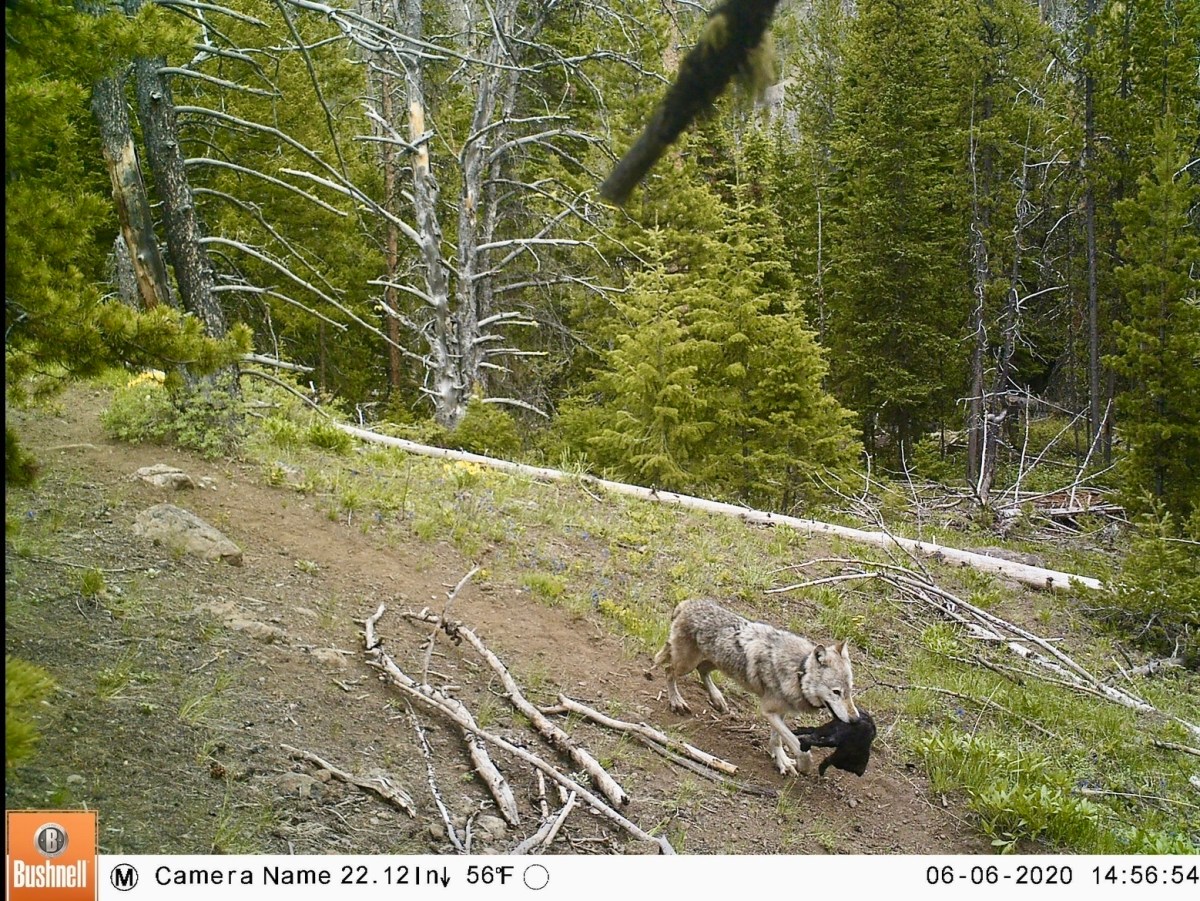
A game camera image captured in the Greater Yellowstone Ecosystem, however, upends that assumption. In the picture, an adult female wolf hauls a squirmy-looking pup by its hindquarters. The collared female, GPS data shows, was transporting the youngster from a den site to a new pack “rendezvous” site — effectively relocating her young family.
The photograph is part of a study, “Wolves use diverse tactics to track partially migratory prey,” that sheds new light on the evolving dynamics between ungulates and the carnivores that prey on them.
The study, published Aug. 1 in the journal Current Biology, finds that canids with very young pups relocate homesites if their source of prey — in this case, elk — migrate.
The research helps illuminate the ways shifting ungulate migrations can impact predator behaviors and ecosystem dynamics, said senior author Arthur Middleton, a University of California, Berkeley, professor who has spent years researching ungulate migration and conservation in Wyoming.
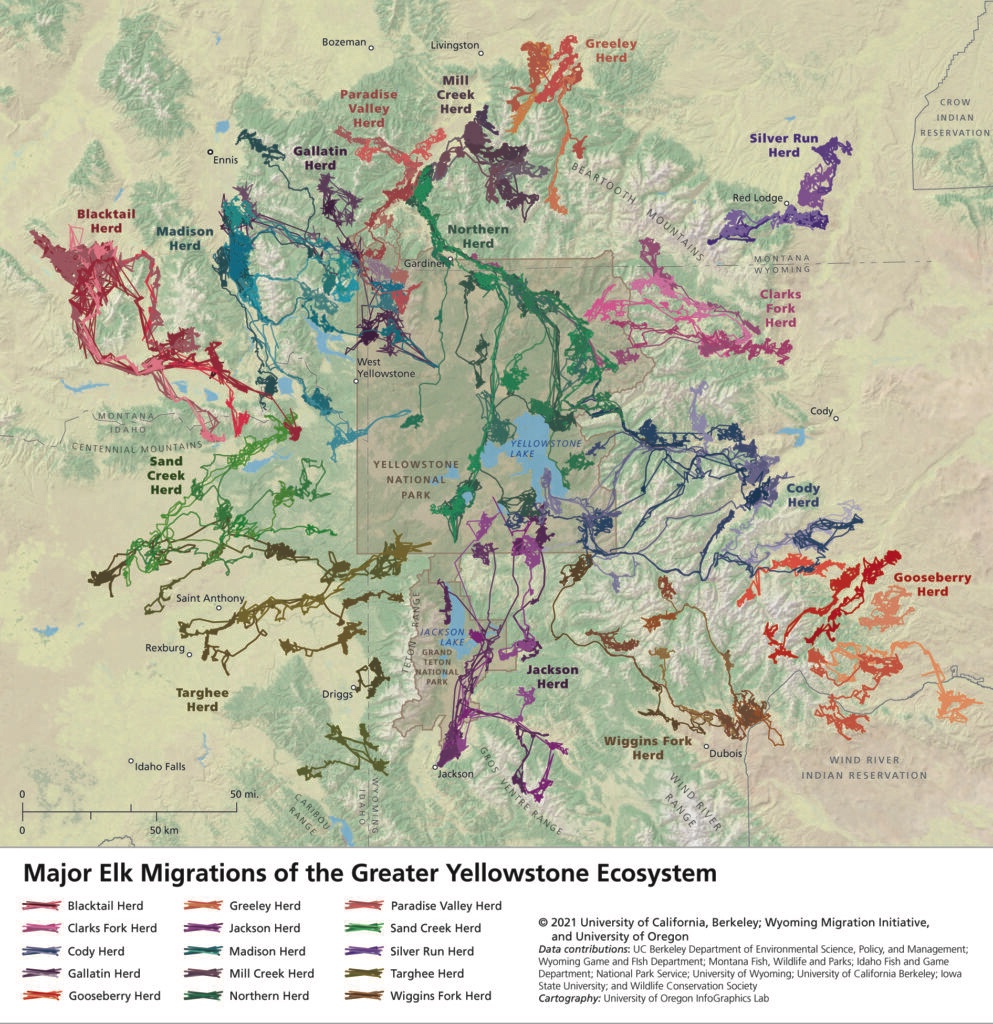
“It’s sort of become pretty obvious to me that [ungulate migrations are] really important to the functioning of the ecosystem,” Middleton said. “But, we’ve had work to do to show how and why, and so I think this helps add another piece of that puzzle.”
This puzzle piece relates to the ways ungulate movements can directly influence the behavior of large carnivores. “That has broader implications, I think, for how we think about the migrations and why we’re trying to conserve them and things like that,” Middleton said.
Tracking movements
The research team set out in 2019 to learn about wolf predation in more granular detail, said co-author Avery Shawler. To do that, researchers partnered with the Wyoming Game and Fish Department to put collars on both prey — nearly 100 members of the large Cody elk herd — as well as their predators — 19 wolves belonging to seven packs.
“So we were investigating wolf kill sites to see what they were killing and eating,” said Shawler, who completed her PhD at UC Berkeley in 2024.
This study area is east of Yellowstone National Park in the Absaroka Mountains, a rugged landscape home to high-alpine meadows, Douglas fir forests, aspen glades and sagebrush steppe.
Over summer and winter seasons through 2021, scientists collected a great deal of data on the movement patterns of the animals, Shawler said.

That allowed researchers “to do movement analyses and compare GPS collar information,” she said. Through that, they realized “that different wolf packs have different strategies for tracking the Cody elk herd, which has individuals that migrate and individuals that don’t migrate.”
Wyoming Game and Fish game camera images helped bolster the collar observations.
Ultimate findings demonstrated that gray wolves use diverse movement tactics to track partially migratory elk. Some Yellowstone Ecosystem elk only migrate short distances in the spring, and the wolf packs that tracked them generally stayed in the territory where they first established their dens. Other elk travel longer springtime distances, and the wolf packs that tracked them went to greater lengths to keep close. That includes packs with pups shifting homesites to follow migratory elk to summer range. Sometimes they carried small pups as far as 20 kilometers from their original dens.
Because the highest source of wolf mortality can be attributed to members of other packs killing puppies, moving them is risky, Shawler said.
The relocation of small pups was not a surprise to Game and Fish biologists and other large carnivore specialists, Shawler and Middleton said. Experts have observed that behavior on the ground for years. The finer-scaled detail provided by GPS collars confirmed their observations.
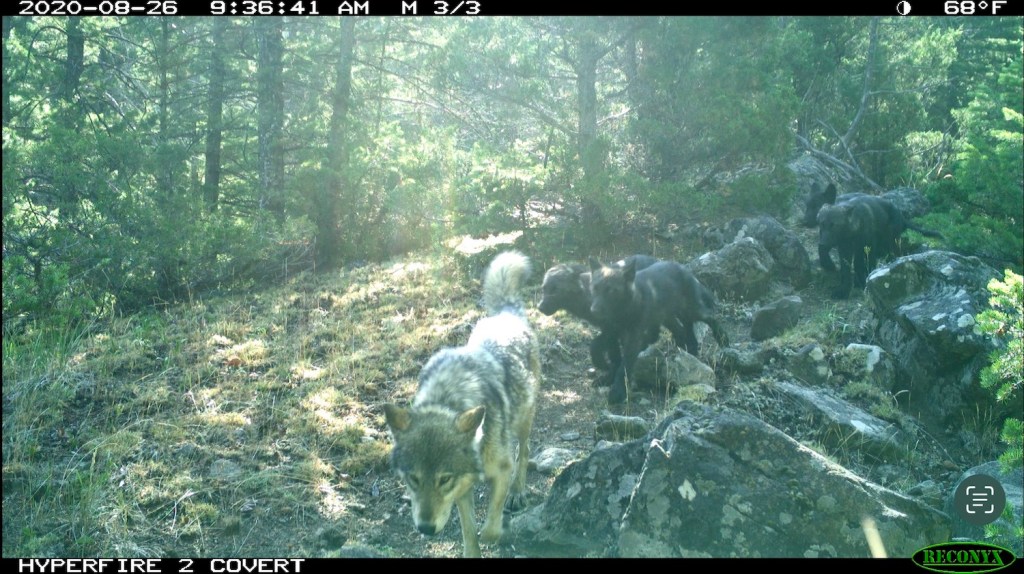
But, Middleton said, these findings counter years of assumptions by the larger body of animal researchers that migratory ungulates can escape predation in spring because wolves are anchored to dens and their largely immobile pups. The study is the first time researchers outside of the Arctic have observed gray wolves shifting their territorial range to be closer to prey during pup-rearing season.
The game camera photo captured it perfectly, Shawler noted. “Once they got that camera trap photo, literally of an adult wolf carrying a pup that was really, really young … It was like, ‘Oh, they actually are moving the pups, and that’s over some really rugged terrain, over a pretty long distance.’”
Implications
Previous work by Middleton illustrated that elk are highly variable and have the means to adapt to changing climate cues.
This study takes that a step further, Shawler said.
“There’s less research on how predators respond to that flexibility, and it would make sense that predators are also able to adapt,” she said. “So it’s just kind of adding to that literature.”
Understanding how wolves adapt to the prey’s behavior can help land managers better conserve both species, Middleton said. The study area, outside of Yellowstone National Park boundaries, encompasses human development like ranches and wilderness. That makes it a candidate for human-wildlife conflict.

Researchers generated a significant body of data, and Shawler is working to publish further work from it.
Additional study co-authors include Kenneth J. Mills and Tony W. Mong of the Wyoming Game and Fish Department; Kristin J. Barker of UC Berkeley and Beyond Yellowstone Living Lab; and Wenjing Xu of the Senckenberg Biodiversity and Climate Research Centre in Germany.
The National Geographic Society, Knobloch Family Foundation, George B. Storer Foundation, Wyoming Game and Fish Department, UC Berkeley and USDA National Institute of Food and Agriculture supported the study, which was conducted from a base at the Buffalo Bill Center of the West in Cody.
Thanks so much for the continued research and protection everyone who works at Yellowstone national Park.. I will never visit I’m too poor to travel. But I teach my son all I know.. he’s autistic an David Attenborough is his fav human.
The wolves are amazing creatures. I always thought no matter what pray animals will follow what they eat even if the mothers with babies have babies. Because they all take care of each other in our pets I imagine they would all work together… Kind of like humans do animals are so much more intelligent than we give them credit… Thank you for finding out what we thought they might do they really do… In following the food.. it’s so cute to see the mom carrying the Pup little bum.. lol! Kids no matter human nor animal… Kids will be kids.. thanks to all researchers an everyone who does this work of conservation..
We have observed wolves in our 1200 sq km project area in Idaho for 18 years. If these wolves are undisturbed, they will remain at their original den site while pups are young. Moving pups is not their first choice. It’s appears more an act of desperation if they feel threatened. We’ve seen Yellowstone wolves move pups fairly frequently over the years because of threats from other wolves or pressure from tourists. There, female wolves have raided the dens of other wolves and stolen pups. This could be linked to the extensive pressure of too many tourists chasing wolves around the park. Nature is very complex, especially in response to human influences, and we still know very little about all the pressures that wolves face.
We have observed wolves in our 1200 sq km project area for 18 years. If these wolves are undisturbed, they will stay at their den site while pups are young. Moving pups is not their first choice. It’s appears more an act of desperation if they feel threatened. We’ve seen Yellowstone wolves move pups fairly frequently over the years because of threats from other wolves. There, female wolves have raided the dens of other wolves and stolen pups. This is very complex and we still know very little about all the pressures that wolves face.
Good article. Good subject matter. Balance in nature must be maintained at all costs. Man must realize that everything can’t be bent to man’s will.
So, great article…. however, the very first comment posted obviously shows it will be used against the wolves. It makes me very sad that some humans can’t appreciate all wildlife and coexist. The last comment “need more tags” shows the widespread mindset of kill kill kill!
Connie, thousands of elk tags that fed thousands of families have vanished over the years since wolves were transplanted into the GYE.
Areas 75-79 used to issue 1500+ tags 20-25 years ago. Now Area 79 has been closed for a decade and area 75 allocated a record low 20 tags total.
This isn’t about “killing wolves”, it’s about keeping a healthy elk population.
I’ll be darned, the old trappers have known this for years , but it took the “ experts “ to make it true,. Need way more tags available!
Good article, we have wolves in Michigan with mixed reviews. One turned up west of Homer and was shot for a big coyote.
.
2 things thqt have contibuted to this disaster is desire for control over people andd money for the “researchers”. They wanted to see what would result, now they want to claim somehow that it is a benefit to have lots of wolves and few elk. Of course those who dislike rancher are happpy with the results. And of couorse the researchers can get big money to study and write about “what could have caused such a loss of elk”.
I enjoyed the article, but as I read I wondered what the perspective of more experienced wolf researchers like Rick Mcintyre and Diane Boyd might have on this research.
Stop feeding the elk, and start selling more wolf tags. Predation and disease will end.
I’ll bet in happy local times, mother wolf stays put. relocation too much energy expended to perform regularly,
Doug is spot on. Montana and Wyoming need to drastically open up the numbers of tags for wolves and begin grizzly hunts in the GYE
Elk calves are not surviving in numbers that healthy elk herds need. Wolves and grizzlies home in on calving grounds.
Elk calf to cow ratios in the entire GYE are at UNHEALTHY levels, and have been for almost 2 decades.
The south Yellowstone herd of thousands that used to migrate from Yellowstone to the elk refuge in Jackson every winter is hard to even locate anymore. 15-20 years ago on the right day in late November, you could witness 2-3000 elk marching south in single file along the flats above the Snake river. The last 5+ years, a ghost town.
8/11
Could this be for other reasons besides Wolf and grizzly? Could illness also be a cause?
Thats a huge decline.
Any other regions of Wyoming with elk populations have ratios of 30-50 calves per 100 cows (healthy), GYE units are less than half that in the mid teens.
Doug Olsen – what is the source(s) of your information that predators are the major factors depressing elk numbers ? I live in Cody . I don’t believe you. Wyo Game & Fish doesn’t either ( read the reports )
Dewey, this very story is a source. Common sense is a source. Calf elk ratios aren’t unsustainably low due to suicide or alien abduction. The wolves are literally moving their young to follow the elk that have also just had their young.
Sunlight/Crandall in your area used to be one of the best elk hunting areas in the country for OTC tags, for nearly 2 decades now it has been Powerball lottery equivalent taking years of points to draw a tag.
Wolves love calf elk so much they will “upend scientific assumptions” to stay close to them in the spring.
If you don’t think wolves and griz are causing unhealthy calf survival, what do you think is?
How about the health of the habitat in that region? Wasnt it a problem when more elk were around with very few wolves causing the habitat degradation?
I believe a study monitoring calf health needs to be done. If nothing is found then this could be the normal cycling of feast and famine. Rational approaches to selling tags needs to be looked at from ALL sides.