

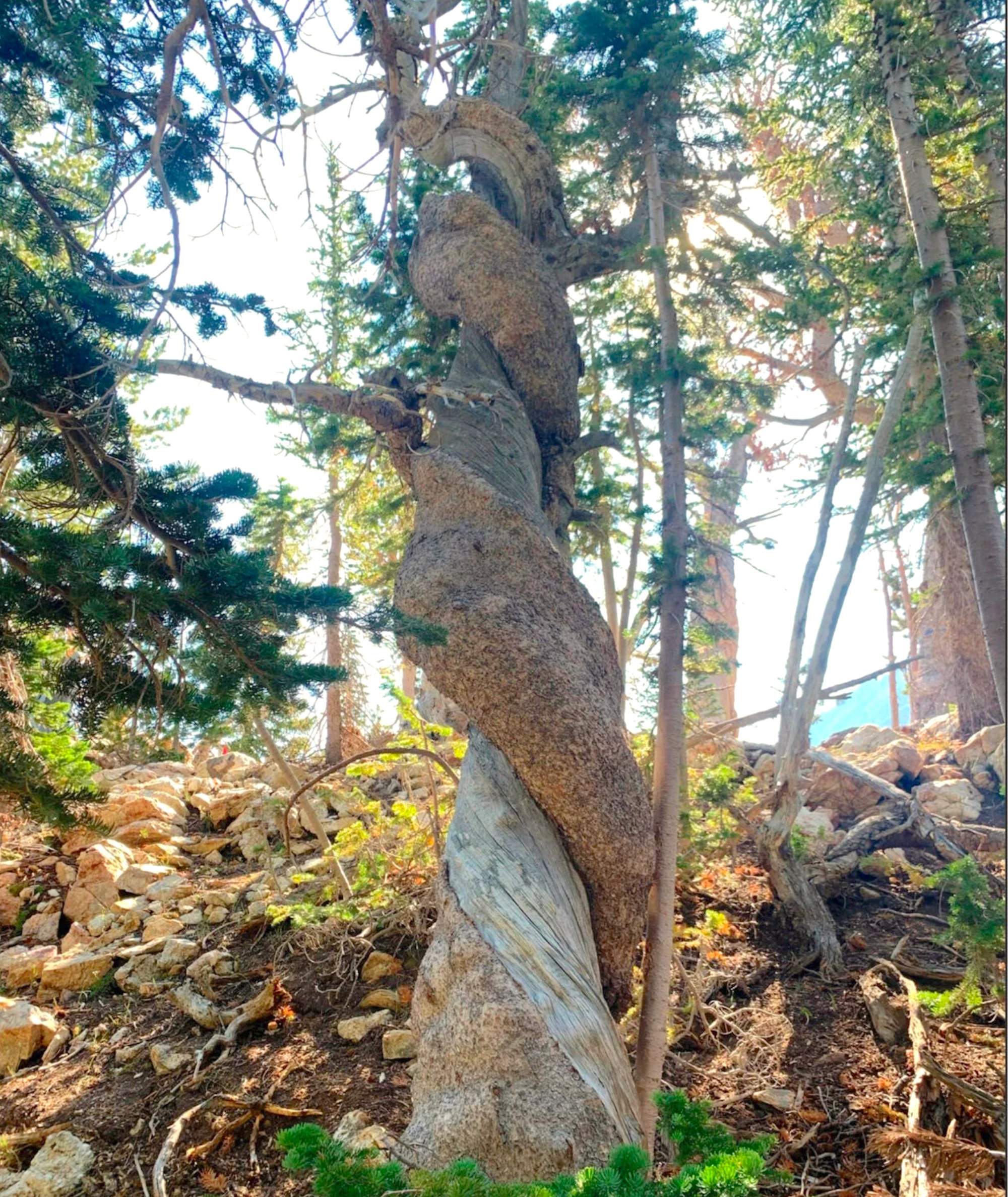
JACKSON—When Jared Friedman took a core sample of an incredibly gnarled, spindly and not-very-tall whitebark pine in Paintbrush Canyon, it did not occur to him that the tree might be ancient. It was less than 30 feet tall.
Friedman, a doctoral student in forest ecology at the University of Wyoming, was in Grand Teton National Park studying what kills whitebark pines. He takes core samples of every dead tree he encounters.
He dated the unsuspecting tree at 1,289 years old, making it the oldest recorded whitebark pine tree on record.
The tree eclipsed the previous record-holding whitebark from Idaho’s Sawtooth Range by 22 years.
“It was a dream-come-true finding for me,” Friedman said.
Whitebark pines are hardy, grizzled trees that eke out a living in mountain environments across an expansive range that stretches from Canada to California. Because they live in places where conditions are harsh, nutrients are limited and soils are poor, they are slow-growing. Some trees are growing by just two cells per year, Friedman said.
Whitebark that get really old are particularly good at playing the long game.
“Life’s not easy, but growing slowly helps,” said Diana Tomback, a biology professor at the University of Colorado Denver.
That makes counting their rings difficult. Friedman used a microscope to date the tree, because its rings were too close together to be seen with the naked eye. He counted 1,275 rings. He used a model that extrapolates how many rings are missing between a core section and the actual center of the tree, which added another 14 years. He dated the tree to have died in 2021, killed by mountain pine beetles, a native insect that is wreaking havoc on whitebark as its population grows and expands due to climate change.
For all their resilience, whitebark pine are facing declines from nonnative blister rust, mountain pine beetles, wildfire and climate change. In 2022, the U.S. Fish and Wildlife Service listed the species as threatened.
Because whitebark grow in the alpine — in the case of Friedman’s tree, at 9,800 feet — they’re beloved by mountain athletes and enthusiasts. That also puts them in the crosshairs of recreation, including development at Jackson Hole Mountain Resort and the proposed expansion of Grand Targhee Resort.
The tree was considerably older than its peers. The average age of whitebarks sampled in the stand was 400 years old, with most between 300 and 500, Friedman said. There were a couple of trees that were 800 years old and a couple that were about 1,000 years old. The next oldest tree was just over 1,000, Friedman said.
There are probably more really old whitebark than we’re aware of, Tomback said. In the course of her research she has encountered very old looking trees in the southern Wind River Range, by Christina Lake in British Columbia and by Yellowstone Lake.
“The problem is finding ages on these trees is not that easy,” Tomback said. “Most people when they encounter these trees don’t happen to have a tree core with them.”
“I would say trees this old are rare,” she added. “They’re just probably not as rare as the record would indicate.”
Post mortem
Sara Germain, a botany professor at the University of Wyoming and Friedman’s advisor, and Tucker Furniss, an ecosystem science and management professor, established a forest monitoring plot in Grand Teton two years ago. The plot is one of 85 sites across 30 countries as part of a forest health monitoring network managed by the Smithsonian Institute. Scientists contributing to the network are studying how forests are changing in response to a warming climate.
The professors and their students monitor trees at the entire elevational gradient in the Tetons, from cottonwoods by the Snake River to whitebark pine in the alpine. They know where every tree is and track competitive relationships, insect spread, disease spread, growth, regeneration and survival. Every year, they figure out what kills trees when they die.
Peak whitebark death occurred in Paintbrush Canyon about a decade ago, Germain said. Most of the trees in the plot were dead. There’s evidence that trees that died there 30 to 40 years ago were also killed by mountain pine beetles, Friedman said. It’s possible the old tree was never hit by beetles before. It could have been growing in a spot with access to water, which made it more resilient to fending them off.
The tree had some stripped bark, meaning that the tree was killing branches and roots while continuing to grow, Germain said. That’s a sign that it had been dying slowly over time, in some portions and not others. It’s common to see in old trees. The strip-barked parts of the tree could have died hundreds of years ago, Friedman said.
Old trees are often battered and gnarled looking.
“It’s just the effect of all these severe climate conditions on them,” Tomback said. “It’s an indicator that the conditions are just not where you want to take a vacation.”
The tree’s age could have contributed to its susceptibility to mountain pine beetles, Tomback said. Because it was strip-barked, that means things might not have been working well for the tree, compared to a younger tree that is growing more vigorously. It could have been more vulnerable if it had fewer roots with which to take in water.
“I don’t think old trees are less susceptible, they’re at least average if not more susceptible,” Tomback said.
Those who live and those who die
Trees that get the oldest are those that are able to put up with different stressors the longest, Germain said. That’s a product of genetics (like resistance to pests), neighbors — including trees and beneficial fungi — and a little bit of chance, such as germinating in a west-facing spot and not getting clawed by a grizzly bear, burning or being struck by lightning.
“Between genetics, friends and the luck of the draw, those things come together to produce our oldest trees,” Germain said.
Whitebark pine, in general, have the potential to get older than other forest trees, because they’re slow-growing and able to tolerate rough conditions, Tomback said. Under the right circumstances, whitebark can reach ages of 400 to 600 years. It takes a protected situation within harsh conditions to become a millennial tree, Tomback said. That typically is found right below treeline.
“They’re growing very slow as a result of these very harsh conditions,” she said. “That enables them to live long.”

How amazing this tree became so ancient and wonderful its story was captured so thoroughly and delightfully.
Amazing article.
That is pretty amazing! Thanks for the story!