

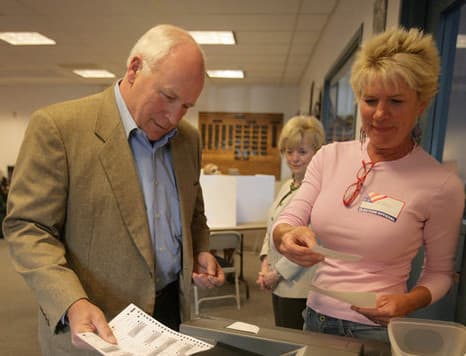
Sen. Cale Case said Tuesday he no longer sees a need for a bill he co-sponsored that would outlaw the photographing of ballots, legislation he proposed following reports of Facebook posts from the polling booth.
Case (R-Lander) made his statement by email in response to an inquiry regarding HB 68. The bill would make “photographing, videotaping or otherwise recording the image of an official ballot while in a polling place or while in possession of an absentee ballot …” a misdemeanor.
The bill, co-sponsored by Case, Sen. Bernadine Craft (D-Rock Springs) and Rep. James Byrd (D-Cheyenne), was introduced Jan. 14 and referred to the Corporations, Elections & Political Subdivisions Committee. In his email, Case said he originally believed the bill would protect against fraud.
“I am no longer convinced that there is a need for the bill,” he said via email. “I originally was told that there was a fraud issue of concern to local county clerks, but I cannot substantiate this to my satisfaction.”
Byrd referred questions to two county clerks he said could provide the reasoning behind the proposed law. Teton County Clerk Sherry Daigle said the posting of photos of ballots on Facebook and possible other social media drove the worries.
“I have issues with the fact that people were taking pictures after (the ballot) had been voted, even though it was their own ballot, and posting it on Facebook,” Daigle said.
Ballots don’t have the voter’s name on them. People in Teton County called Daigle and began questioning whose ballot was photographed, whether it might be theirs, and whether their supposedly confidential vote might also have been photographed.
“I did get some calls from people (saying) ‘how come you’re putting ballots on the internet,’” she said. “It just undermines the confidence the voters have in the secrecy of the ballot.”
Photographs of ballots and the people casting them, of course, are world-famous. From Lyndon B. Johnson putting his envelope in a ballot box to Fidel Castro and Vladimir Putin, images of ballots are a routine picture of the voting process.
Pulitzer-Prize-winning photographer David Hume Kennerly even traveled to Wyoming in 2004 to photograph Vice President Dick Cheney, ballot in hand, voting at the firehouse at Teton Pines. There’s no apparent provision in the bill that would allow such pictures to again be taken in Wyoming.
Daigle isn’t alone in her worries, she said. She got wind of the bill when Byrd circulated it to county clerks for comment.
“I was not the only county that had issues,” Daigle said. “They had real issues on it down in Cheyenne. With social media, everything is so available and accessible it also causes problems for those who don’t use social media.”
Asked whether the fear came from a small fringe group that might be susceptible to conspiracy theories, Daigle said, “to some extent, yes.” Nevertheless, “we’re trying to keep the confidence level as high as we can.”
View the bill here.
Kennerly’s picture of Cheney can be found here.
