

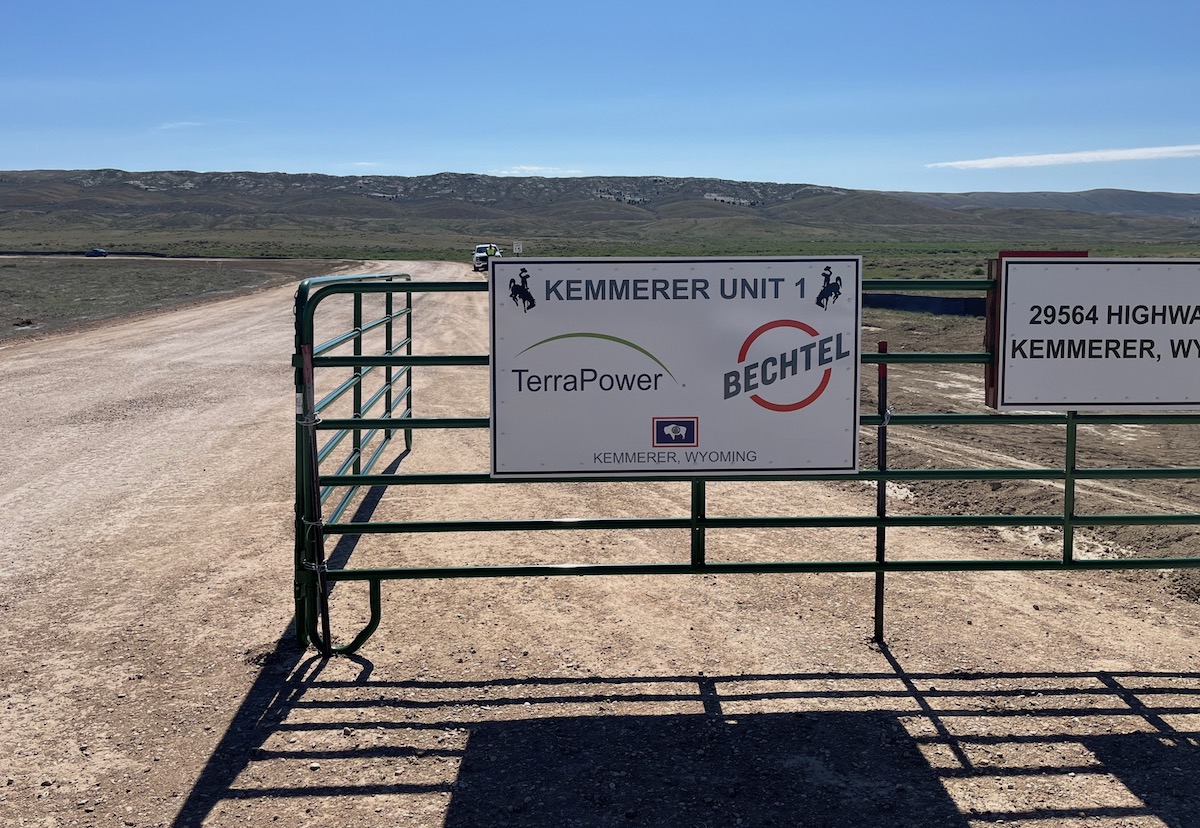
The U.S. Nuclear Regulatory Commission wants to hear from Wyoming residents — and the U.S. public in general — about TerraPower’s Natrium nuclear power project just outside Kemmerer as the agency weighs a construction permit application for the next-generation liquid sodium-cooled reactor.
The federal agency is conducting an environmental review to determine whether to grant the construction permit. In a separate move, TerraPower earlier this month commenced construction on a liquid sodium testing facility, a non-nuclear component that doesn’t fall under the commission’s regulatory authority.
The federal review will consider “the environmental impacts of construction, operation, and decommissioning of the Kemmerer Power Station Unit 1, and reasonable alternatives thereto,” according to the agency’s notice published in the Federal Register. “Possible alternatives to the proposed action include the no-action alternative and alternative sites.”
The Natrium project is under two primary NRC review tracks, each with a safety and environmental component: one to consider the construction permit, and another to consider the operating license. TerraPower plans to submit its operating license application in 2027, which specifically addresses the design and operation of the reactor, and says the project is on track to begin operating in 2030.
The regulatory commission will host a public meeting July 16 in Kemmerer to explain the review process and how to comment. Visit the NRC’s Natrium project website to learn more about the proposal and the agency’s review process.
Public comments regarding the construction permit and environmental review are due Aug. 12. Comments can be submitted via this federal portal.
A first for Wyoming
Though many state and local officials eagerly support the $4 billion Natrium project for jobs and tax revenue, the prospect of Wyoming’s first-ever nuclear reactor has raised many questions for residents as well as the general public.
In November, more than 100 people attended a NRC meeting in Kemmerer and posed questions about whether the agency will evaluate seismic activity in the area, security measures for the potential terrorist target and how radioactive fuel will be transported to the facility and safely stored once spent.
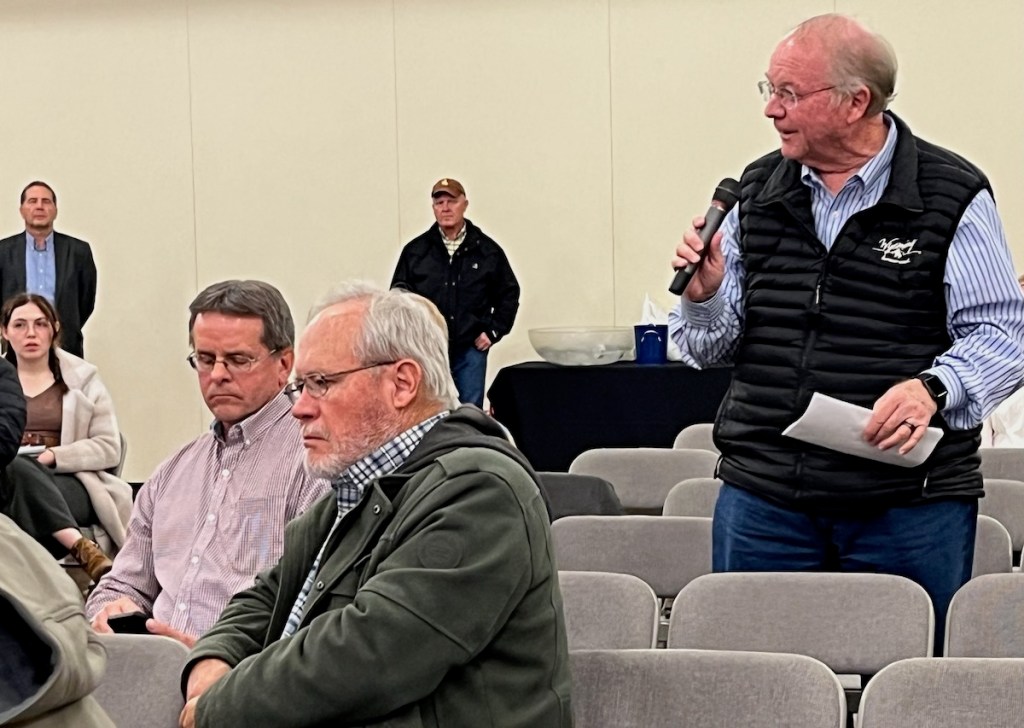
The agency’s review does include analysis for potential seismic activity, NRC staff told residents at the meeting. They assured the commission will maintain partnerships with local emergency managers and statewide authorities, as well as Homeland Security. TerraPower must coordinate with transportation officials and follow federal protocols for moving nuclear fuel to the facility. There is no permanent repository for spent nuclear fuel in the U.S., so the radioactive material will be stored on-site, according to the commission. For how long, nobody knows.
The agency’s multi-pronged review will also evaluate potential impacts to air and water, as well as socioeconomic impacts in the region.
About Natrium
TerraPower claims the Natrium plant will be the first “advanced” nuclear energy facility in the Western Hemisphere. The company touts the design as novel in that it’s much smaller in size compared to the industry standard, generating a consistent 345 megawatts of electricity — enough energy to power about 250,000 homes.

The plant would also be the first commercial-scale nuclear energy facility to use liquid sodium to cool the reactor, which requires less water and acts as an energy storage mechanism to boost generation up to 500 megawatts for short periods.
The nuclear facility will be co-located near the coal-fired Naughton power plant to take advantage of existing infrastructure linking it to the western electricity grid.


“Less water” than what? Power is still generated from a Rankine steam cycle with cooling towers like the coal plant it replaces. They typically evaporate 2/3 gallon per kWh generated at 35%ish efficiency. Rooting about on the web finds claims of 41% net thermal efficiency for this system. So maybe 0.6 gal/kWh instead of 0.66. Still way more than wind and solar which are essentially zero. And instead of a dispatchable firming, it has some modulation but not enough to go to zero for economic backup when wind/solar exceed demand or transmission capacity. Who gets curtailed?
The distinction between starting construction on a sodium testing facility and the actual nuclear power plant is very important. The two concepts are mixed up in this article. If construction starts before the design and EIS are approved, it will mean that the regulators have been bought off and Terra Power is certain the power plant will be approved.
We had our own nuke plant “adventure” in N. Colorado a few years back. Here is the history: https://en.wikipedia.org/wiki/Fort_Saint_Vrain_Nuclear_Power_Plant
Summary: Bad design, bad materials, moisture accumulation, poor maintenance, corrosion. Result: Danger as corrosion affected the plant operation and safety systems. If the safety systems don’t work you get anything from a glowing hole in the ground to a full scale nuke run away explosion and fallout, which can go anywhere the prevailing winds go… (Wyoming, did I hear wind?).
The operator had to keep pouring money in to keep it running. Eventually got too expensive, and they decommissioned the nuke part, and converted the remainder to natural gas.
This one used helium as a coolant. Helium is tricky, but the good news: its non reactive, and not flammable… Liquid sodium, on the other hand reacts with almost anything, its very hot, I immagine, quite corrosive.
Not an easy material to work with, and not what I would want in my neighborhood when mixed with high radioactivity… and with the track record of Bill Gates (the king of buggy software) what could go wrong?
If it was me, I would steer clear.
Its not worth the short term economic benefit of a few short term jobs.
I’ve met Bill Gates and have followed him throughout his career. He’s famous for releasing buggy, insecure products for which users are the “beta testers” and which fail catastrophically. Losing your data is bad, but a nuclear disaster is obviously a lot worse. A sodium leak would cause a fire that is impossible to put out, and the reactor’s location at the western edge of Wyoming would nearly guarantee that the entire state would be blanketed with radioactivity. Gates liely picked Wyoming because he believed we were either desperate or suckers – and because he lives northwest of us. Let’s not fall for this.
There are significant thermodynamic and engineering advantages to using liquid sodium metal as a coolant/heat transfer material for power generation (no high pressures required, and much higher working fluid initial temperature’s are possible).
Given that it being built near a retiring power plant, the potential for reuse of the existing transmission and water sources (yes, it is still going to require significant water for cooling the steam side) is a great economic, and environmental advantage. Instead of hauling hundreds of tons of coal to a generating unit EVERY DAY, only a few tons (+/-) of reactor fuel is hauled every few years.
Is it the “first”?. Not really. See
https://en.wikipedia.org/wiki/Fermi_1
A large risk to be respected is the EXTREME chemical reactivity of pure sodium metal with water. Careful selection of the materials of construction and design of heat transfer fluid systems is absolutely critical, as is the purity of the sodium. I suspect there might be a secondary heat transfer media being used (such as an oil, or other appropriate fluid) to better reduce the possibility of any contact between the liquid sodium, and water used for the steam side.
This plant will still reject about 60% (+/-) of the total heat generated by the reactor to the environment. This cannot be overcome unless the initial sodium coolant temperatures are increased beyond the capability of today’s metallurgy. THAT is not gonna happen in my lifetime.
As far as I understand, it will NOT be used to breed new fuel.
I think it a good opportunity for wyoming, I was born and raised in Wyoming and it’s about time that wyoming move to the 21st century. This state is way far behind on any industries
Nuclear energy needs to be part of the Nation’s energy mix. With coal plants being decommissioned more and more frequently, there must be a replacement. The technology must be proven to be safe first and that is the responsibility of Natrium with review by NRC.
Unproven, and there is more negatives about this. Go build it somewhere else. We shouldn’t be an experiment 😔. It is time to be realistic. The amount of damage to our ecosystem is not even in the plans. I say no!
Amen to that. I trust nothing involving nukes or Gates, and this boondoggle involves both…plus, I have little faith in nukes. Better to get the human monkey population down to carrying capacity of its habitat than to pursue schemes like this.
This experimental nuke plant is being located in Wyoming because there are so few people. Why not in Bill Gates home state? The U.S. Navy turned the technology down. Liquid sodium can eat through stainless steel. Weapons grade plutonium is the fuel. The Yellowstone ecosystem is downwind and the Colorado River system is downstream. Will Wyoming do ANYTHING for a buck? Think thrice!
You’re thinking of molten sodium chloride (a salt) whereas the Natrium reactor will use molten sodium (a metal). The Natrium reactor will use high-assay low-enriched uranium not weapons grade plutonium. Best to keep the facts straight.
Why Wyoming?
I thought we have sufficient power
Using hydro power
A boondoggle that will never fire up.