

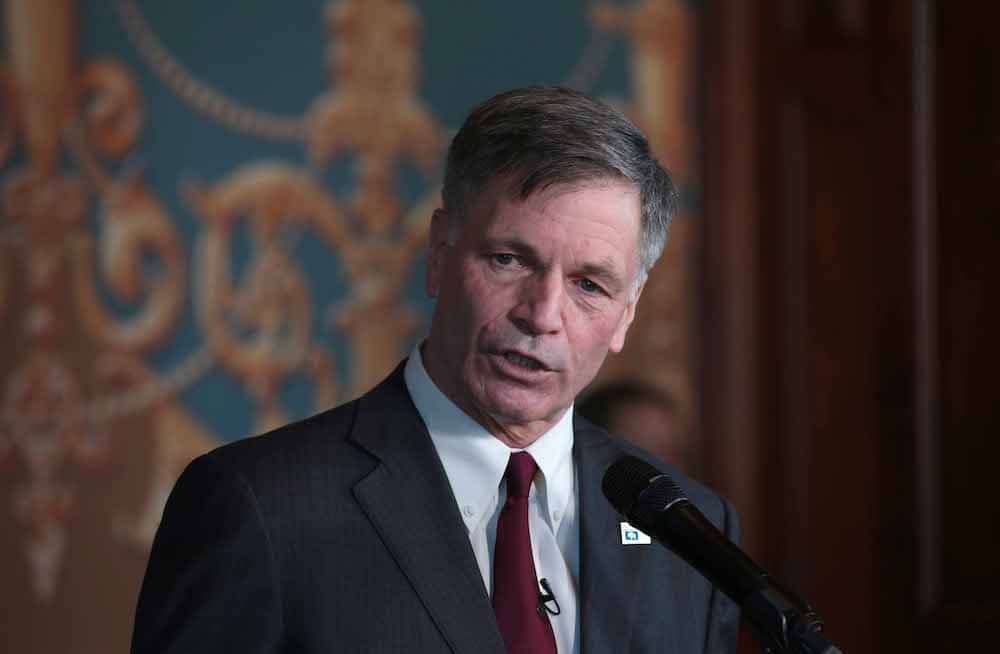
Gov. Mark Gordon is quick to tell the federal government not to interfere with the free market, but he has a hard time taking his own advice.
Opinion
“Our federal government should not be issuing overreaching mandates that manipulate the free market,” Gordon said in a prepared statement last week announcing yet another lawsuit du jour against President Joe Biden’s administration. This time Wyoming has joined a coalition with 25 other states to fight fuel-efficiency standards for gasoline-powered vehicles.
One problem with Gordon’s tough-talking critique of government mandates is it’s totally at odds with his approach to carbon capture.
The governor and state lawmakers have gone to extraordinary lengths to mandate utilities use expensive and unproven carbon capture and sequestration technology to keep the coal industry alive. How is that in line with the state’s supposedly cherished free-market principles?
If Gordon’s strategy is successful, it will keep mineral severance tax revenue flowing into Wyoming’s coffers to pay for government services. The state is banking on carbon capture to extend the coal industry’s lifespan.
But it’s rate payers who will suffer when they have to foot the bill for carbon capture conversion through electric bill hikes. If that’s not government overreach that hurts everyday people and manipulates the free market, what is?
Wyoming’s carbon capture legislation is a Hail Mary pass aimed at keeping the coal industry alive, despite the fact it’s rapidly losing its share of the energy market as the need to stop climate change becomes even more critical and as competition grows from other sources of energy.
Carbon capture and sequestration can also be used for enhanced oil recovery, which is touted as one of the benefits. But EOR is just another mechanism to produce fossil energy, and the produced oil releases carbon dioxide back into the atmosphere upon combustion. That’s the opposite direction the conversion of power plants is supposed to take us.
The cost of carbon capture research is tremendous, with no guarantee a commercially viable power plant will be built in Wyoming or anywhere else. The state has spent hundreds of millions of dollars in this pursuit, largely from federal COVID-19 relief funds and the Infrastructure Investment and Jobs Act.

Unlike the more than $1 billion in federal funds for Medicaid expansion that the Legislature has rejected over the past decade, Wyoming lawmakers always welcome carbon capture money with open arms and implore, “Please send more.”
Let’s compare the financial and environmental impacts of the state’s carbon capture/coal protection laws to Gordon’s rigid opposition to the fuel-efficiency standards announced last month by the National Highway Traffic Safety Administration and the U.S. Department of Transportation.
The Biden administration’s Corporate Average Fuel Economy (CAFE) standards for light trucks — which includes most sport utility vehicles, pickups and minivans — must produce an overall new model fleet average of 50.4 miles per gallon by model year 2031.
Gordon called the new standards “unworkable” in Wyoming.
“Wyoming residents drive thousands of miles each year through remote areas,” the governor noted. “They should be able to decide what vehicle technology is most suitable for their needs, not the Biden administration.”
One of the major reasons for increasing fuel-efficiency standards for gas-powered vehicles is to drive customers’ demands for more affordable and green EVs from manufacturers and dealers. Obviously, this is, as Gordon charges, the federal government trying to manipulate the free market.
But the benefits don’t rely on huge expenditures in unproven technology.
The new fuel standards will save billions of dollars in fuel costs, according to the National Highway Traffic Safety Administration, plus “prevent more than 710 million metric tons of carbon dioxide emissions by 2050, reduce air pollution, and reduce the country’s dependence on oil.”
But the Gordon administration’s unwillingness to accept federal funds to build EV charging infrastructure — even though the feds will pick up 80% of the tab, with the rest from private businesses — makes no sense. His decision has made Wyoming one of the slowest in the nation to roll out more charging stations.
Wyoming’s hands-off approach to accepting federal money for charging stations has led to little statewide demand for EVs. According to S&P Global Mobility, only 87 EVs were sold in Wyoming in the first quarter of 2024. Only about 1,000 EVs are registered, and there are fewer than 100 charging stations.
“Wyoming has no desire to establish infrastructure that will likely fail,” the state said in its plan for how to spend federal EV-charging funds from the 2021 bipartisan infrastructure law, which would have provided Wyoming $26 million over the next five years.
In May, the Biden administration made $1.3 billion available to states to expand the national network. Don’t look for Wyoming to apply for its fair share.
Building a statewide system of EV charging stations will admittedly be a difficult task, even with federal funds, in a state so sparsely populated as Wyoming. I well understand why the state has balked at some of the federal requirements, including that charging stations be placed every 50 miles.
But during a recent trip to Cheyenne, U.S. Transportation Secretary Pete Buttigieg told Wyoming Public Media his agency knows that “a one-size-fits-all approach is not going to work.” He said his department is willing to work with Wyoming officials on a “common sense” solution here.
It would be advantageous for Wyoming to negotiate with the feds on this issue, rather than filing more lawsuits that will only further delay a system the state needs.
Wyoming has a $4.5 billion tourism industry, and even though EVs aren’t yet in much demand here, our economy greatly depends on visits from people in states that have unequivocally embraced electric vehicles. Why would we want them to turn around at our borders and make a beeline to states that provide essential charging services?
Gordon’s “all-of-the-above” approach to energy partnerships, which includes fossil fuels, wind, solar, hydrogen and nuclear power, is missing a key ingredient: more support for battery-powered electric vehicles.
The governor clearly has no appetite for the argument that having more EVs on the road is vital to protect the environment. But he should drop the pretense of fighting EVs because of his supposed faith in free-market principles — which he has violated throughout his carbon capture crusade — and accept the economic benefits they offer with little state investment.

The only truth in this opinion, is that carbon capture is unproven, expensive, and will cost billions. Then it goes down hill rapidly. Stop climate change? That’s funny. What, stop the earth from turning? One cannot stop climate change. The trillions that will be spent trying are simply wasted. There is no empirical evidence that links fossil fuel to climate change, and no empirical evidence that links the rise in CO2 to global warming.