


The whereabouts of the pint-sized pika, a mammalian indicator species that is losing its alpine habitat to climate change, have been mapped for the first time in Wyoming’s reaches of the Rocky Mountains.
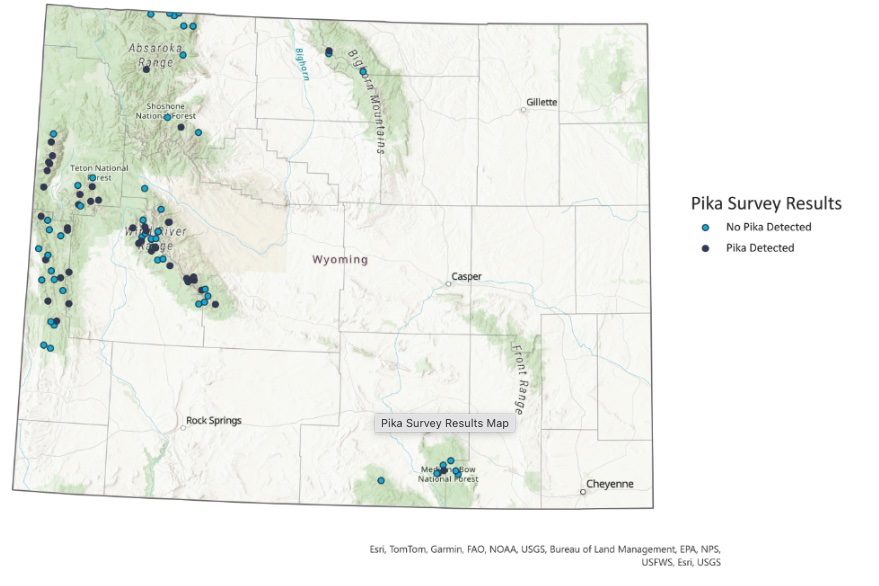
Biologists who keep watch over non-game species for the Wyoming Game and Fish Department surveyed the distribution of the talus-dwelling lagomorphs, finding pikas in nine mountainous areas: the Salt River, Snake River, Wyoming, Wind River, Gros Ventre, Teton, Absaroka, Bighorn and Snowy ranges. The effort was motivated by a desire to better understand how climate change stands to influence the animal’s unique alpine habitat niche in the Equality State.
“They are a habitat specialist that is sensitive to temperature,” Game and Fish Nongame Mammal Biologist Dana Nelson told WyoFile. “Knowing that, and knowing that climate change is a leading threat that we really want to have figured out, that motivated the implementation of those statewide occupancy surveys a few years ago.”
Although the surveys date to 2020 and 2021, the results were more recently published in the state agency’s annual nongame “job completion report.”
The results of 167 surveys completed at 100 unique sites show that the tiny, short-eared cousin of the rabbit occupied 57% of the suitable habitat in the state. As time goes on, and Wyoming’s mountains continue to warm, biologists will then have baseline data to examine, and lots of it. Fortunately, the technicians who shouldered the intensive fieldwork also amassed data on slope angle and direction where pikas dwelled, in addition to inventorying vegetative cover — and logging temperatures above and below ground.
Armed with that data, Nelson, colleagues and generations of Wyoming biologists to come will be able to detect not only if pikas have abandoned certain areas, but also if they are shifting their range uphill or selecting habitat based on another parameter.
Wyoming’s pika research is funding-dependent, and the schedule isn’t cemented, but Nelson’s hoping to pull off a repeat of the 2021 and 2022 surveys every five to six years. The initial effort was funded through a state wildlife grant, she said.
Based on a mountain of existing research, it’s likely that the changes Game and Fish biologists detect won’t be favorable for the American pika, a twice Endangered Species Act-petitioned — but not listed — species.
“Pikas have been lost from 32% to 36% of the [habitat] patches in four different mountain ranges in Idaho and Montana,” said Erik Beever, a research ecologist for the U.S. Geological Survey’s Northern Rocky Mountain Science Center.
Beever, who’s studied pikas for three decades, cited that grim finding from a 2021 study led by his then-graduate student that looked at evidence of where pikas live now — and where they used to — based on their scat and food caches. Vacant habitat suggested that climate change is already making incursions into pika range: The places they used to be are consistently warmer, consistently drier, and consistently hold a lower snowpack, he said.
The environmental changes affecting pikas vary from place to place.
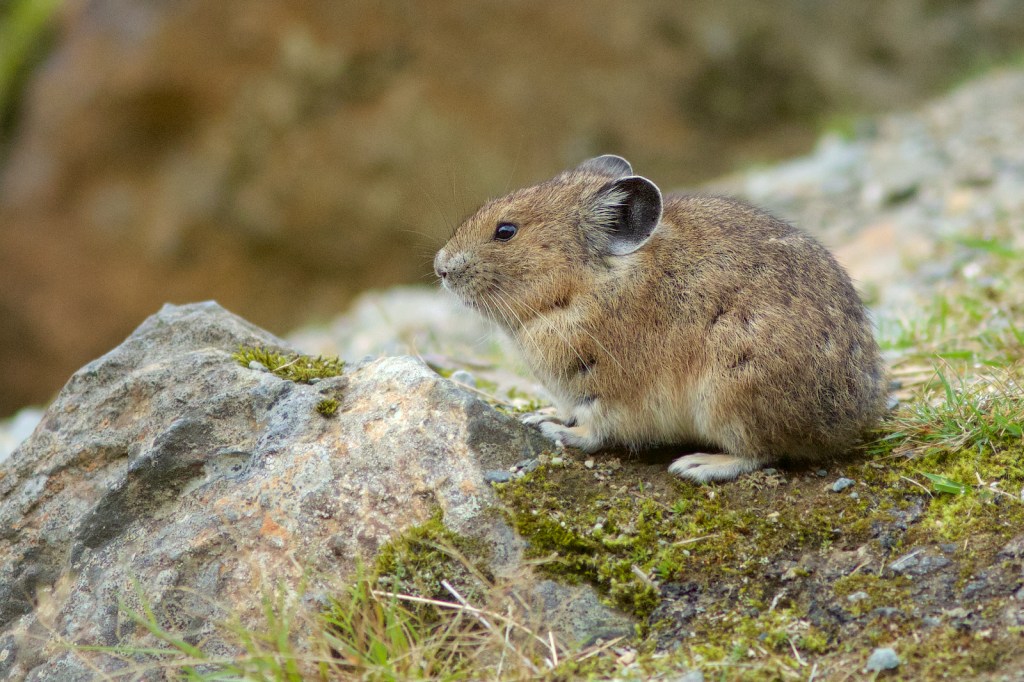
“The nice thing about this species is it really spans about a third of North America,” Beever said. “Magnitudes of change across studies have varied pretty markedly based on where you are in the range.”
With a range extending south to New Mexico and north into Canada, Wyoming’s pikas are located approximately in the middle. Being central bodes well, Beever said, because it lessens the likelihood they’ll experience the starker habitat changes felt on the far reaches of the range.
“At first blush, one might expect the magnitude of influence of contemporary climate variability and change to be less in Wyoming than other places,” Beever said.
A National Park Service-led study also suggests that Wyoming pikas’ alpine abodes might hold up more favorably than other areas of the range. The collaborative research, forebodingly titled Pikas in Peril, examined pika habitat in eight different national parks and monuments.
“They predicted pika occupancy in Grand Teton National Park to remain at 100% throughout the 21st century, whereas it was predicted to decline in every other park — in some of them dramatically,” Beever said. “Working there [in the Tetons], we’re trying to figure out what that ‘secret sauce’ is so that we can help export that for climate adaptation efforts across the rest of the country.”


As they say, “Neep!”
I have a hiking group of 36 people in JH. We hike at least once a week, generally getting 6 to 8 people who can make the hike. In hiking in the Tetons last summer at 8 to 9,000 feet, we commented on not seeing as many pikas as we have during previous summers. We are not scientists, but the populations in the rocks of the Tetons does not seem to be as plentiful as in the past.
Yet they managed to survive the previous warm periods in the Holocene.
My favorite Snowy Range critter. Couple years ago I spent the afternoon observing and photographing them. I could hear them but it took me about an hour to locate them. As long as I was still and quite, they went about their business of harvesting for their winter haystacks. Hope to get up there again next year. Thanks for the article.
Great story, Mike K.
University of Colorado/Boulder funded a study of the Upper Green/Wind Rivers Pika population in the early 70’s.
Dr.Thomas Swain was the lead biologist, camping in the Cora Area.
A delightful summer pursuit!
Embere Hall studied pikas in the Tetons (and other ranges) before the WY G & F did.
One of her findings is that pikas change there activity times to avoid the heat of the day. There are pikas in the Crators of the Moon NM, a very hot place, for example. Embere and her colleagues published their work in various journals etc., and the articles are easy to find. Their change in behavior may be the “secret sauce” Eric Beever wonders about.
I have heard pikas call at night in the Tetons, and one woke me up while I was sleeping at the base of the east ridge of the Grand Teton, calling right next to my head. Very loud!
Thanks to Mike for that reminder about Embere Hall’s work for the Pika Project.
She joined me at an unusual location in the Bridger-Teton Forest where a lone Pika had set up a home in an abandoned Slash/log pile, miles from the nearest Talus slope and at lower elevation. How he got there mystified us both. I haven’t seen him there for a few years, but that kind of “Pika-Creativity” might help them in these changing times!