

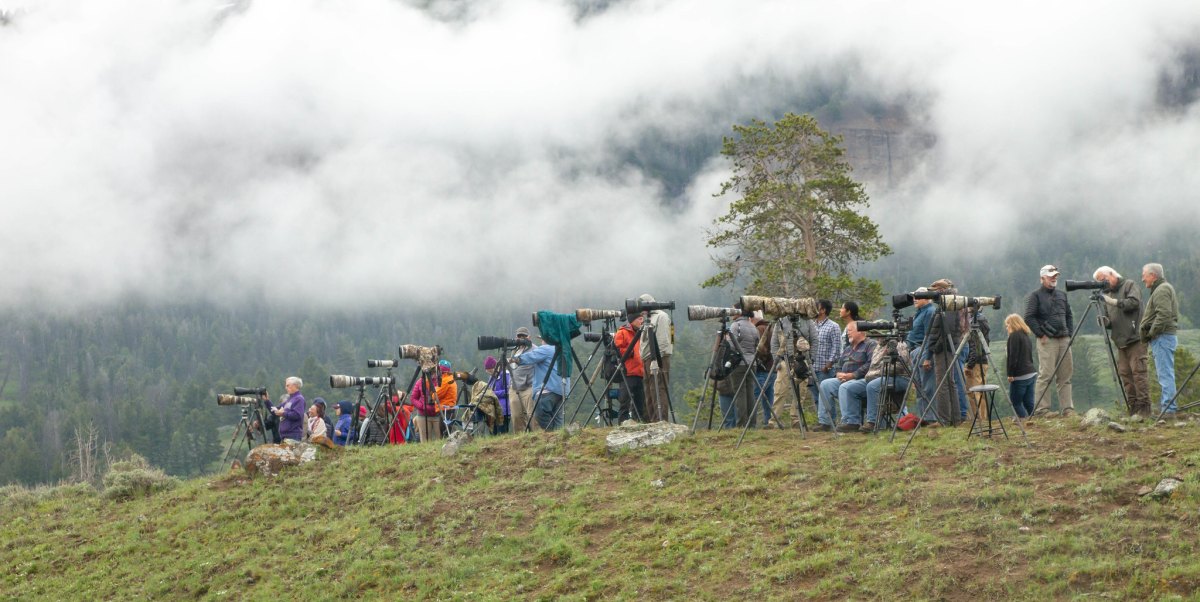
The majority of visitors to Yellowstone and Grand Teton National Parks value wildlife viewing so much that they would support a park-related fee or tax toward habitat conservation, a new study finds.
The study, “Tradeoffs and win-wins between large landscape conservation and wildlife viewing in protected areas,” was published Sunday in Conservation Science and Practice. Along with establishing support for paying conservation fees, the paper concludes that species population declines could have a greater effect on park visitation than imposing such fees.
“Visitors responded that they would be likely to visit the parks less if there were fewer wildlife to see,” said co-author Hilary Byerly Flint, a researcher with the University of Wyoming’s Haub School of Environment and Natural Resources.
The study looked specifically at Wyoming’s two northwestern national parks, and co-authors include Byerly Flint and Drew Bennett with the Haub School; migration researcher Arthur Middleton with the University of California, Berkeley; Leslie Richardson with the National Park Service’s economics program and Aaron Enriquez with the U.S. Geological Survey.
Authors say the study cements with data what many people already know: Seeing grizzly bears, elk, wolves or other animals in the wild is tremendously valuable to the public. So valuable that most would pony up to support conservation efforts beyond park boundaries.
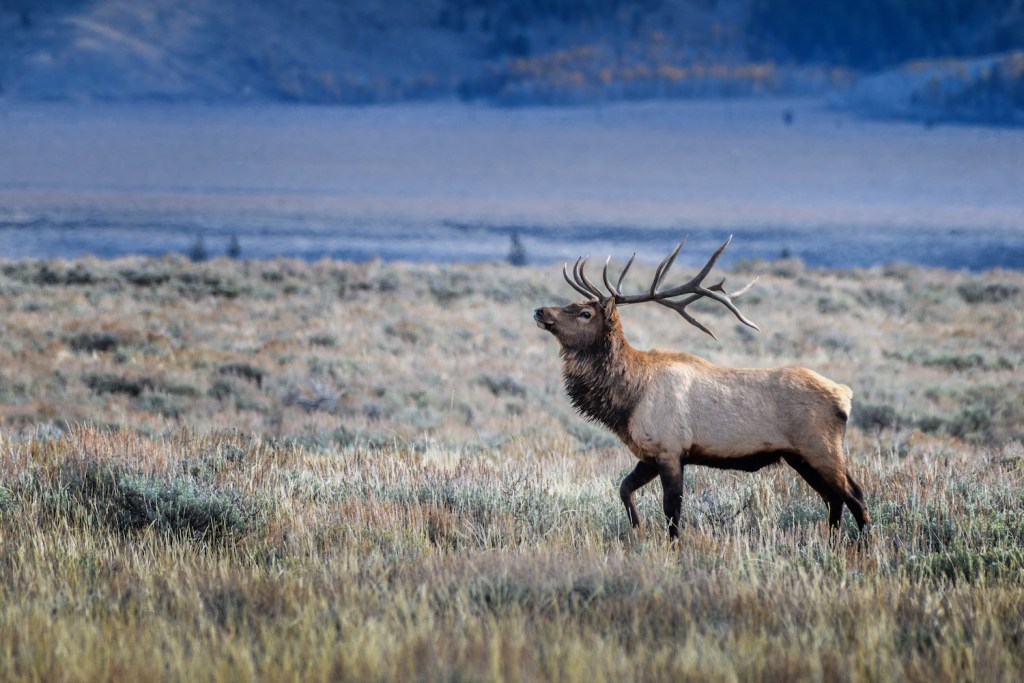
“For the vast majority of people who visit the parks, it’s mind blowing” to see something like an elk bugling, said Scott Christensen, executive director of the Greater Yellowstone Coalition, which helped fund the study. “It’s almost a once-in-a-lifetime experience for them, and it has real, tangible value.”
The concept of a conservation fee in national parks is not new, though it has yet to gain required federal traction to be enacted. Authors hope the study can be used to continue the dialogue, Byerly Flint said.
“I think we see this really as the start of a conversation about how to pay for conservation in these areas that are increasingly threatened,” she said.
“We’re seeing the loss of habitat for these migratory ungulates at unprecedented rates,” Byerly Flint continued. And that leads to the question of: “How to pay for conservation of that habitat, while also maintaining the benefits and the wonderful experiences that park visitors enjoy when they come to Yellowstone and Grand Teton?”
Genesis
In 2018, former Wyoming State Rep. Al Sommers, a Sublette County rancher, sponsored a joint resolution relating to the collection of wildlife conservation fees at Yellowstone and Grand Teton. His resolution requested that the Department of the Interior and National Park Service enter into an agreement with Wyoming to collect a wildlife conservation fee at the parks to generate revenue for conservation efforts.
The Legislature passed the resolution, and Gov. Mark Gordon signed it, but those fees have not gained federal approval.
“My priority was conflict resolution,” Sommers told WyoFile.
“Whether it’s grizzly bears or wolves, or elk or, frankly, wildlife on highways,” Sommers said, the fee was envisioned as “a way to generate money from all of the public, from the national public that enjoys these wildlife in the park, to help mitigate some of the cost associated with that and to ensure wildlife’s viability.”
Two years later, Middleton co-authored a paper titled “Harnessing visitors’ enthusiasm for national parks to fund cooperative large-landscape conservation,” which further explored the concept. That study examined legal and political challenges and estimated that a fee of up to $10 per vehicle could generate up to $13 million annually for conservation projects.

The new study takes the issue a step further, Byerly Flint said, by examining “what park visitors themselves think about the idea of contributing towards conservation and how important the animals that require habitat beyond park boundaries are to park visitor experiences.”
In summer 2022, a research assistant spent two months surveying visitors of Yellowstone and Grand Teton parks — both inside their boundaries and outside in communities like Jackson and Cody.
Researchers analyzed 991 responses. Just over 75% of respondents cited wildlife viewing as a primary reason for their trips to Yellowstone and Grand Teton. The majority also supported the idea of paying extra for conservation — with 93% supportive of a voluntary donation; 75% supportive of a tax or fee on goods and services; and 66% supportive of a mandatory wildlife conservation fee.
The study also found that wildlife viewing generates an estimated $581 million in annual recreational value in the two national parks, representing a significant economic engine. Yellowstone tallied 4.74 million visitations in 2024 — the second highest year on record. Grand Teton, meanwhile, reported 3.62 million, its third highest.
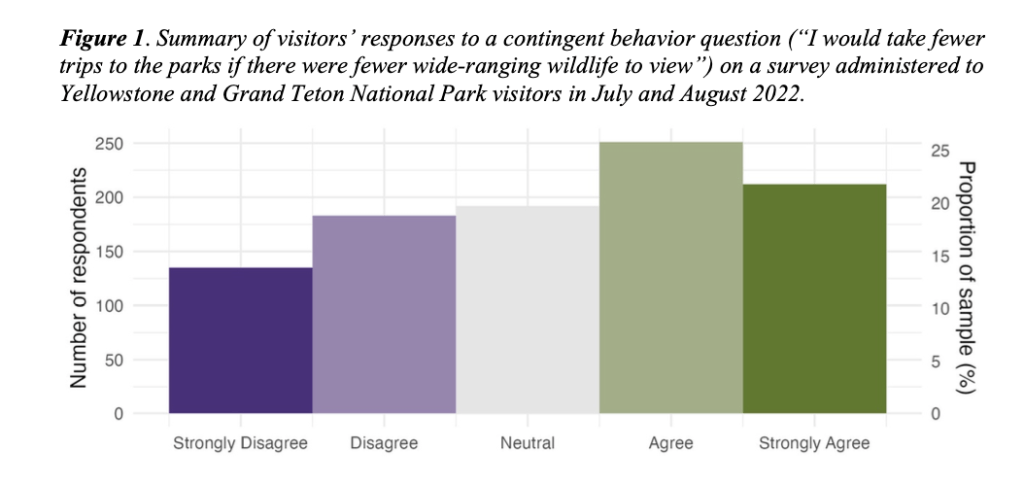
Nearly half of respondents, furthermore, said they would take fewer trips to the parks if there were fewer wide-ranging wildlife to view. That, researchers calculated, could result in about a 15% decrease in overall park visitation.
The results illustrate support for a basic trade off, the study concludes. Visitors are willing to pony up rather than risk long-term wildlife declines.
“These wide-ranging wildlife, like elk and mule deer and grizzly bears, are hugely important to park visitor experiences, to the reasons they decide to visit the parks,” Byerly Flint said.
Next steps
Sommers’ resolution, along with a similar version passed in Montana, was nonbinding. Any change in park fees falls under the purview of the National Park Service.
Wyoming’s park superintendents have indicated support for wildlife, Byerly Flint noted. Yellowstone Superintendent Cam Sholly declined to comment for this story; Grand Teton Superintendent Chip Jenkins didn’t respond by publication time.
However, Byerly Flint said, the paper underscores the point that “the value of the experience within the park boundaries is contingent upon what’s happening outside of park boundaries.”
Support for a fee or donation was regardless of income or politics, the report found. In terms of diminishing returns, researchers found that a cost increase of more than $75 would equate to the same reduction in visits that might result from fewer wildlife to view.
The study does not mean the co-authors are set on fees as a solution, Byerly Flint said. “This is one way. This isn’t necessarily the way. It’s just an idea that we’re exploring.”
Christensen of the Greater Yellowstone Coalition echoed that sentiment.
“Every animal that spends time in the parks also spends time outside of the parks and in these unprotected areas,” he said. “And so our interest in this study is really around trying to come up with some innovative approaches for how to pay for conservation long term. I think what this study tells us, and gives us some hope around, is that people are willing to do that … there’s a willingness there.”

Putting a price tag on disrespectful behaviour to wildlife is a sad excuse to justify windshield wildlife stalking. I don’t think the state of Wyoming is going to plant a forest to hide the flash mob of wildlife viewing vans. They will however use the winfall to promote tourism into a already overcrowded ecosystem. Please keep wildlife wild.
More money more money more money. It pours into a fund. Yet we get less and less wildlife. What am I missing here?
I think it’s a viable way to help grow wildlife. I’m planning a trip in early October to the park. I would actually commit to be an annual contributor to help keep the joys of seeing all the wildlife that the park has to offer.