

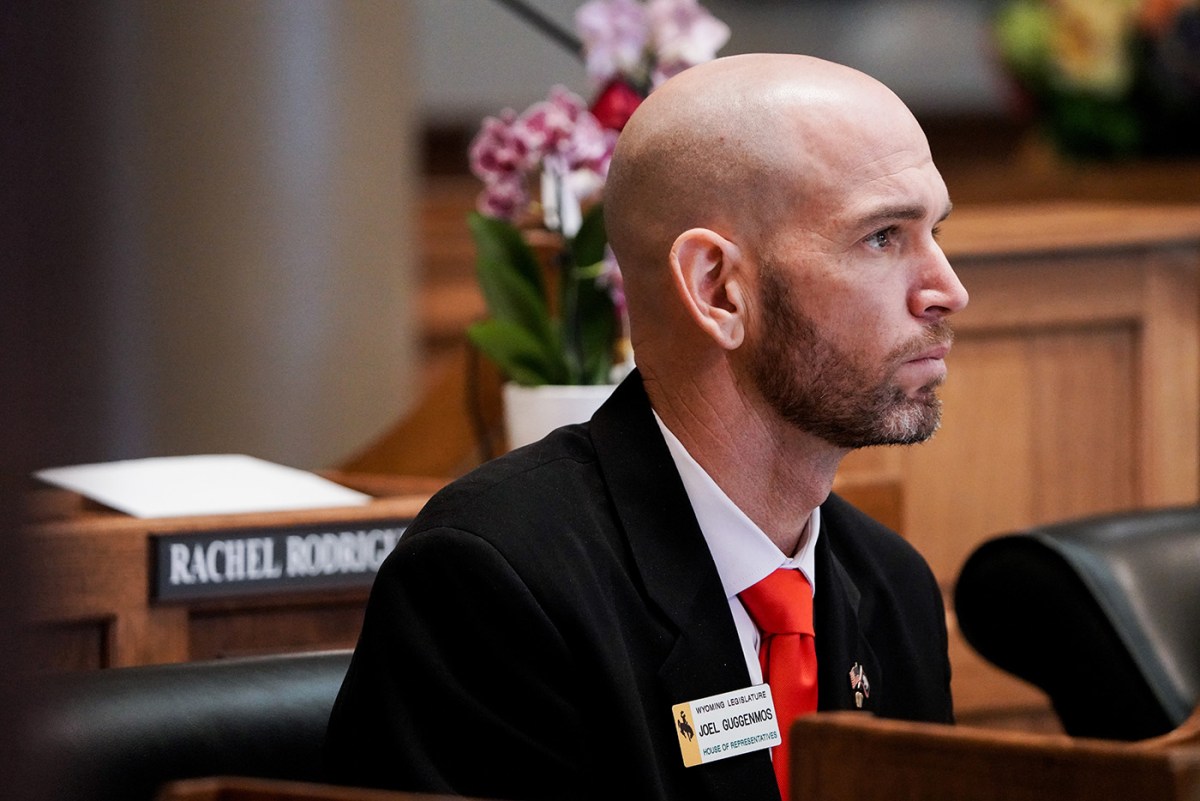
Until last fall, Wyoming Republican Rep. Joel Guggenmos lived with his wife and son in a modest log cabin on East Adams Avenue in Riverton, within the confines of House District 55, which he represents. Then in September, he says, his landlord abruptly raised his rent to six times what he had been paying.
“It was kind of a shock,” he told WyoFile on Thursday. “It was out of the blue.”
They couldn’t afford to stay, Guggenmos said, which led his family to temporarily relocate into an RV parked outside House District 55 for several months. As of last month, the family once again lives in the district, Guggenmos said, which encompasses a swath of Fremont County, including most of Riverton.
The decision to live outside the district was a product of needing a place to live fast, Guggenmos said, and made with the understanding that the Wyoming Constitution does not require lawmakers to reside in their district following their election. Even so, the Fremont County Sheriff’s Office is now investigating Guggenmos for living outside House District 55, which he has represented since 2025.
The sheriff’s office did not respond to WyoFile’s request for comment by publishing time.
“Somebody’s coming after me now to try to discredit me. And that’s fine. I didn’t do anything,” Guggenmos said. “My conscience is clear.”
When Guggenmos had trouble quickly finding a new spot, he said, a family member offered their parked RV as a temporary accommodation.
“It was just outside [my] district. Not very far, but just outside district,” he said Thursday, declining to give an address. “So that’s when I called LSO.”
Residency requirements
It was far from the first time the Legislative Service Office — the Legislature’s nonpartisan staff — was asked to weigh in on the residency requirements of a sitting lawmaker. In 2022, for example, the question arose after the Wyoming Republican Party accused then-Rep. Dan Zwonitzer of living outside his Cheyenne district.
Ultimately, the House voted against forming a special committee to investigate Zwonitzer. The Wyoming Constitution and Wyoming Supreme Court precedent leave the House to decide whether one of its members is no longer qualified to serve with that body. But before lawmakers made that decision, LSO provided them with a legal memorandum on relevant facts.
“The Wyoming Constitution does not require a member to continue to reside in his district after his election for purposes of being qualified to continue to serve in the House of Representatives,” the memo states.
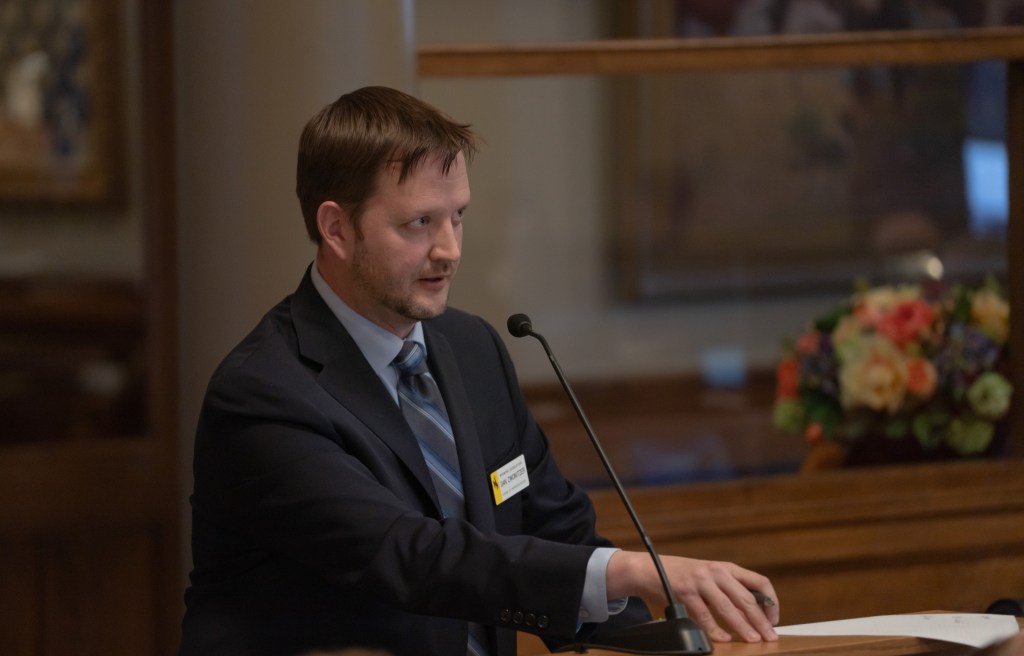
State law, “by its plain language, requires that a vacancy be declared when a member no longer resides in the district from which he was elected,” the memo stated. “However, the Wyoming Supreme Court has held that a statute cannot add qualifications to hold a constitutional office.”
As for Guggenmos, he said the LSO did not give him legal advice, but he left the conversation feeling confident that his family could temporarily live outside House District 55 without having to declare a vacancy.
Personally, Guggenmos said, he thinks a residency requirement ought to be in the state’s constitution.
“It’s only right that people live in and around the people that they represent,” he said. “That is my belief. So doing what I did was not because I wanted to. It was: I had to do something, and it was a very temporary thing from the get go.”
LSO separately confirmed to WyoFile that it provided Guggenmos its standard legal memorandum on issues surrounding legislator residency, similar to the memo concerning the Zwonitzer complaint.
Guggenmos and his family moved back to House District 55 in April, he said, settling into a spot on East Madison Avenue in Riverton. Guggenmos declined to provide the street number, saying he didn’t want his personal address to be public information.
“I hate holding information back because I have nothing to hide,” he said.
Constitutional provisions
The Wyoming Constitution contains three provisions detailing the qualifications to serve as a House member. Those include the requirement that a candidate live within the district they are running for in an election.
The constitution, however, “does not speak to maintaining residency through a member’s term of office,” according to an LSO memo. The constitution also addresses vacancies in legislative offices, but the memo states that it does not “give an indication as to whether moving from a legislative district creates a vacancy.”
State law, meanwhile, weighs in due to a decision lawmakers made in 2003.
By then, the LSO “had provided advice on at least two occasions that moving from a legislative district did not create a vacancy in office,” the memo states.
The 2003 law reads: “A vacancy shall occur in the office of a member of the state legislature when the person fails to reside in the legislative district from which he is elected.”
A year later, the Wyoming Supreme Court ruled that statutorily imposed legislative term limits are unconstitutional. More specifically, the high court ruled that the Wyoming Constitution “forbids the passage of any law making the exercise of Wyoming citizens’ political rights dependent upon a circumstance or condition otherwise than as provided.”
While the question of residency of legislators was not up for the court’s determination, “the Wyoming Supreme Court has adopted the view that statutory and constitutional provisions which tend to limit the candidacy of any person from public office must be construed in favor of the right of voters to exercise their choice and should be construed strictly and not extended to cases not clearly covered,” the LSO wrote in a memo.
Still, Fremont County Clerk Julie Freese pointed WyoFile to state law that says a vacancy occurs when a lawmaker fails to reside in the legislative district from which they are elected.
“I believe that the complaint has merit. That means it’s something we should look into,” Fremont County Clerk Julie Freese told WyoFile. “And so we did.”
The clerk’s office forwarded the complaint to the Fremont County Sheriff’s Office, which is now investigating the matter.
A public records request for the complaint was not returned by publishing time.
Freese said similar complaints were filed with the Wyoming Secretary of State and Attorney General. Neither responded to a request for comment by publishing time.
WyoFile’s Katie Klingsporn contributed reporting.


“It’s only right that people live in and around the people that they represent,” he said. “Personally, Guggenmos said, he thinks a residency requirement ought to be in the state’s constitution.” If you know what’s right, why do you need a green book to tell. Just do it. Just another example of tRumpublicans using loopholes to do whatever they can get away with.
Really, I would think they would have better things to do then criticize an unfortunate situation that was rectified and made right .
Don’t these idiots have anything better to do with their time besides “investigating” trivialities such as this?
The former Dist 55 Rep Ember Oakley, is all over the socials thinking she’s ratting this guy out. After he beat Oakley, she cut and run from Fremont County . Keep dancing that jig, Ember, this whole situation is a non event and going nowhere, but at least you have the backs of a few fakebook “friends” LOL
Sounds like a big nothingburger, with extra onions. Move on to something more substantial, Fremont County Clerk Julie Freese