

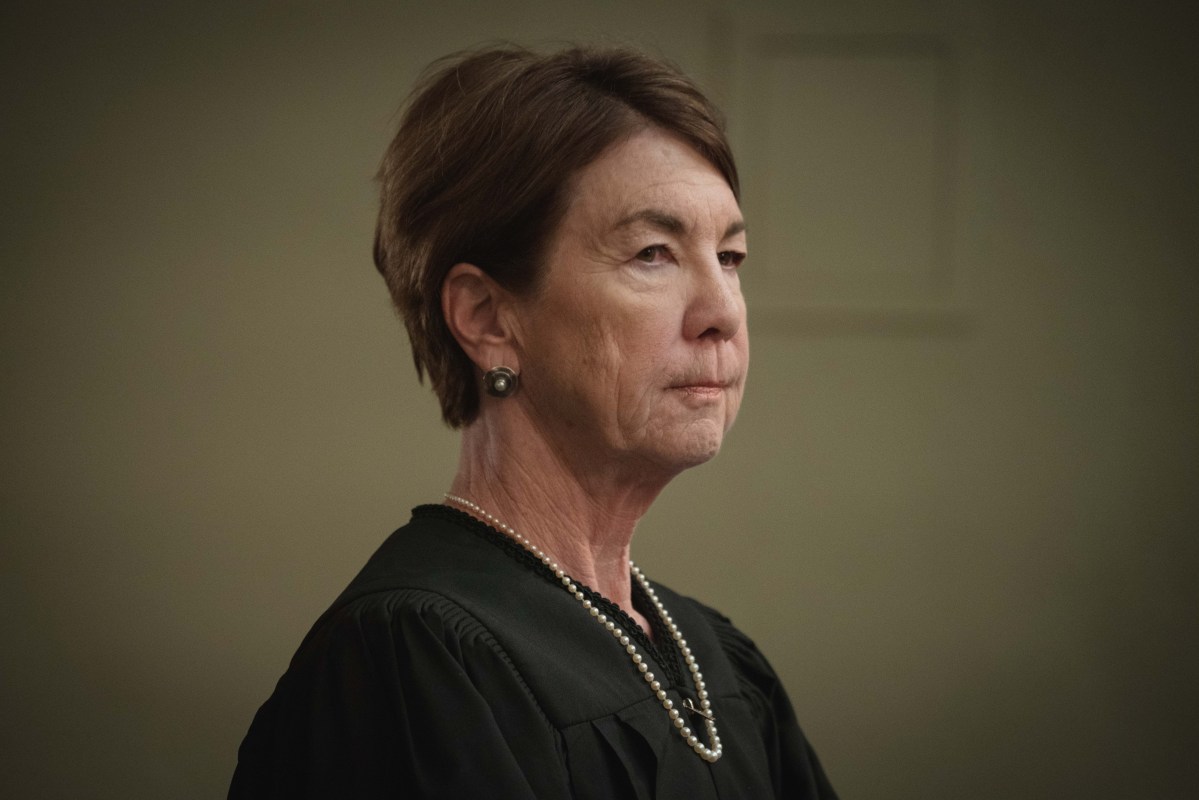
For her final official appearance before a legislative committee, Wyoming Supreme Court Chief Justice Kate Fox visited Torrington on May 19 prepared to defend the state’s judiciary system.
Weeks before the meeting, the Wyoming Freedom Caucus had criticized the judiciary in a pair of blog posts. Citing recent court decisions and some judicial nominations, the caucus’ blog post alleged Wyoming’s process for selecting judges was shaped by “political insiders” and “left-wing institutional capture.”
Fox’s rebuttal came from the book of rules governing Wyoming judges.
“A judge shall not be swayed by public clamor or fear of criticism,” Fox read from the book, drawing from a chapter dealing with questions of external pressures.
“Our job is to follow the laws,” she added. “Not to be subject to the popular will, because what we do is often not popular.”
The Freedom Caucus’ push for lawmakers to scrutinize the state’s judiciary system comes as President Donald Trump and his allies increasingly clash with, and criticize, federal judges, even calling for their impeachment in some cases. It also comes as the state waits for a momentous decision from the Wyoming Supreme Court on whether legislative attempts to block abortion access are constitutional.
And for Fox, the scrutiny comes as her time on the bench ends. After 11 years presiding on the state’s high court, the law requires her to step down at age 70. Her last day is May 27. So, in an era where a new guard is changing Wyoming politics, the Joint Judiciary Committee meeting played host to a vivid, if respectful, exchange between the outgoing chief justice and a group of mostly freshmen lawmakers aligned with the Freedom Caucus.
Those lawmakers questioned Fox as to why Wyoming’s system for nominating judges was, in large part, walled off to public scrutiny, without elections or necessitating Senate approval for appointments.
Some of the changes suggested by lawmakers would open the judiciary to the kind of “political and financial influence” its rules currently guard against, Fox said.
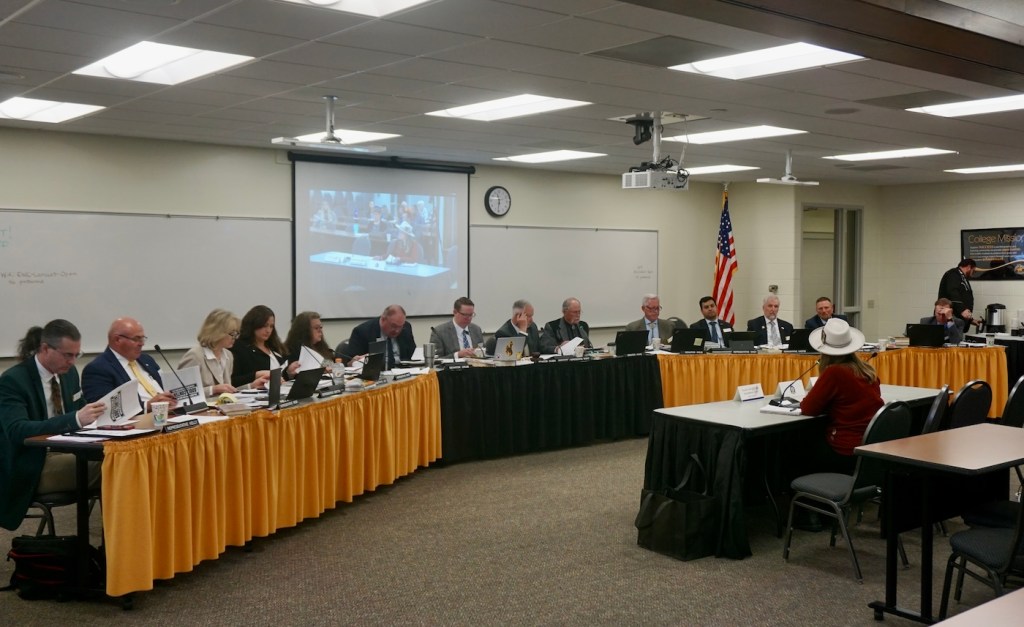
But the Judiciary Committee decided to consider a significant change to the judge-nominating process at its August meeting in Casper. The committee voted 8-6 to have the Legislative Service Office draft a joint resolution that would ask voters if they wanted the Wyoming Senate to have final approval over the appointment of new state Supreme Court justices.
It was the second of two close votes as Rep. Jayme Lien, R-Casper, sought to find a path for the committee to take up a bill draft, against the wishes of its two chairmen — Sen. Jared Olsen, a Cheyenne Republican and attorney, and Rep. Art Washut, a Casper Republican.
Lien’s first motion, for a bill that would have changed state law without going to voters, failed on a tie vote. That bill would have required Senate confirmation for all new judges, not just supreme court justices.
The swing vote between the two motions was longtime Sen. Larry Hicks, R-Baggs.
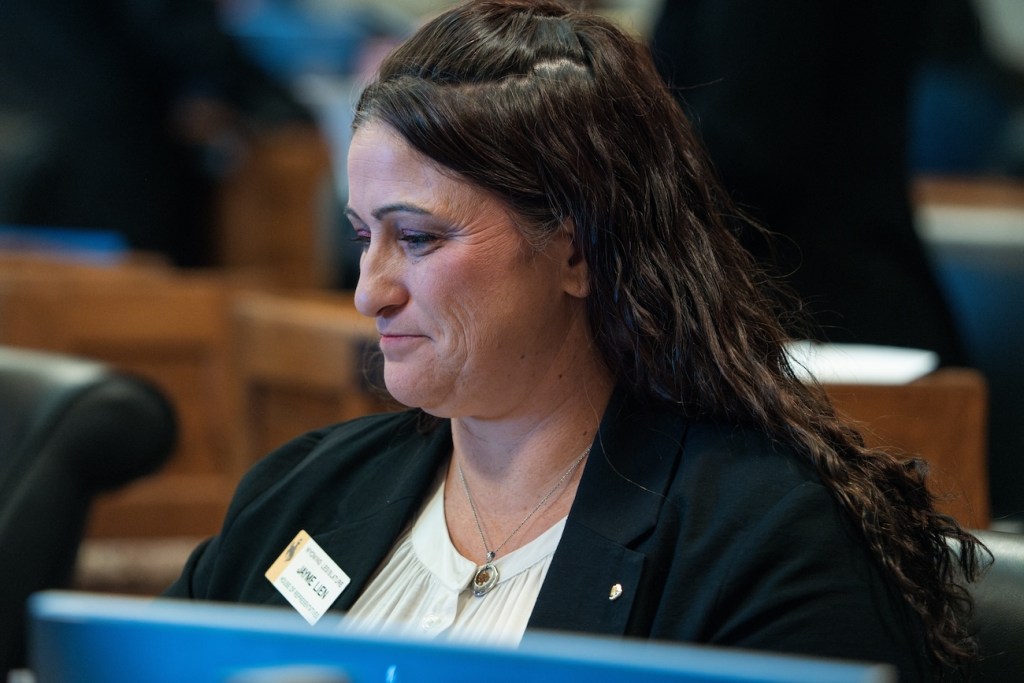
Rep. Laurie Bratten, R-Sheridan, had sought to add days to the Joint Judiciary Committee’s meeting agenda for studying judicial reform — something Freedom Caucus leaders previously indicated to WyoFile they hoped a committee would explore during the time between legislative sessions. Olsen overruled that idea. Lien said she was moving for the joint resolution to ensure the committee scrutinizes the topic.
“Ultimately, I’d like the entire nominating commission to go away,” she said before a vote on her first motion, “but … we’re not going to get enough time to discuss that.”
Wyoming selects judges today under what is commonly called the Missouri Plan, where a commission reviews applicants and sends a limited set of choices to the governor for a final pick.
In Wyoming, the Judicial Nominating Commission is composed of seven people. Three are attorneys, elected from within the Wyoming State Bar, and three are non-lawyers who are appointed by the governor. The seventh member, who serves as chairperson and tie breaker, is the chief justice of the Wyoming Supreme Court.
Fox repeatedly told lawmakers she believed there already was public input in both the selection and retention of judges. In selecting judges, that comes principally because people can weigh in with the governor, who makes the ultimate decision on what candidate to nominate for a bench seat.
When a judgeship opens, the Judicial Nominating Commission fields and reviews applications for the position.
The names of applicants are not made public. Those names stay confidential for two reasons, Fox said. One is to allow practicing attorneys to apply without signaling to their clients or law firms that they’re pursuing a new job. The other reason, she said, is to insulate the nominees and the process from political pressure. Fox and two nominating commission members previously interviewed by WyoFile described the review of applicants as a study of their merits and judicial temperaments that includes feedback from attorneys and judges.
Once the commission vets candidates, it sends three nominations to the governor. At that point, the public can weigh in. That’s an option Freedom Caucus lawmakers have exercised in the past, such as when former Republican lawmaker Tim Stubson was among the three nominations in 2023 — Stubson was involved in fundraising and campaign efforts that sought to blunt the Freedom Caucus’ rise in the Legislature.
Gov. Mark Gordon picked Robert Jarosh for the bench over Stubson.
Judges also appear on the ballot in Wyoming, Fox noted. Though they’re appointed into office, voters have an opportunity to vote them out every four, six or eight years, depending on the level of court they serve in. State Supreme Court justices only face retention elections every eight years.
Notably, Fox said she and others in the judiciary would consider publicizing the names of applicants for judgeships while they’re under consideration by the Judicial Nominating Commission. “I think the court would be open to revising that process,” she said.
But on the whole, Fox questioned lawmakers’ motivation for scrutinizing the state’s third branch of government.
“I really need to push back on a lot of the basis for this conversation,” Fox said. “What really is the problem? We have some very good judges in Wyoming. So, before we start saying ‘how can we fix it?’ I really want to know what is wrong with it.”
The most recent polling available shows more residents approve of how the state’s judges handle their jobs than disapprove. In polling conducted last September and October by the Wyoming Survey and Analysis Center, only 13% of respondents told the center they disapproved of how judges handle their jobs, while more than 40% of respondents said they approved.
In its blog posts, the Freedom Caucus cited specific court decisions they didn’t like. Chief among them was a Teton County judge’s ruling against the Legislature’s 2023 abortion ban, and a more recent decision by a Natrona County judge to pause a transvaginal ultrasound requirement and stringent regulations lawmakers sought to place on Wyoming’s only abortion clinic, which is in Casper.
Rep. Tom Kelly, R-Sheridan, told WyoFile he did not believe the Wyoming judiciary system was in need of stringent reforms. But he said a series of politically charged court decisions — in both Wyoming and nationally — drew fresh attention to the way judges are selected in Wyoming, and people found the system opaque.
Publicizing the names of judicial applicants could allow people concerned about the system to better understand who was applying and who wasn’t making the cut, he said. “Anything that government institutions can do to be open and transparent will help bolster faith in our system again,” he said.
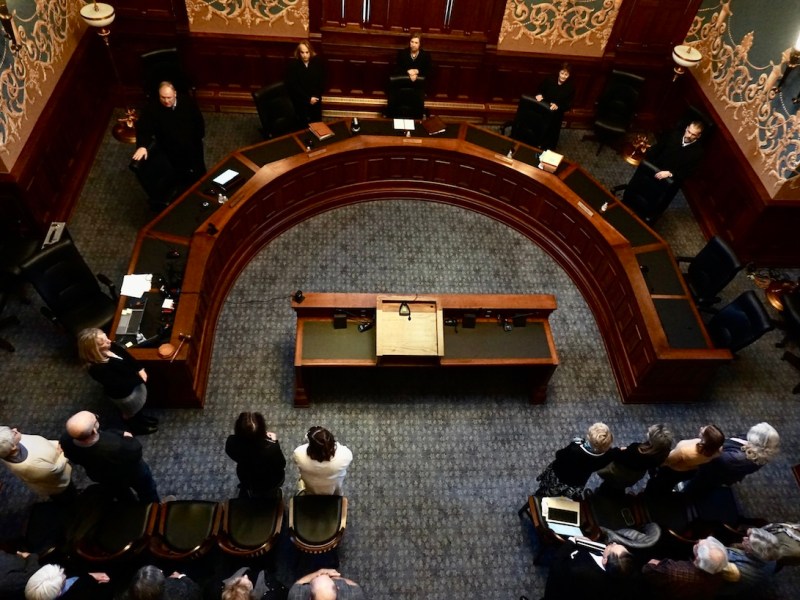

Lien’s proposal for Senate approval of new supreme court justices brings a major practical question with it: With a citizen legislature, the Wyoming Senate is only in session two months a year or less. Several lawmakers in Torrington questioned what would happen if a supreme court seat came open when lawmakers weren’t in Cheyenne.
In the moment, Lien did not have an answer for that question — saying she wanted to order a draft bill so the committee could craft a policy together at its next meeting.
While Lien only needed a majority of the committee to agree to draft the bill, there is a higher hurdle for the committee to vote to sponsor the bill when the Legislature convenes in 2026. The proposal will need the backing of a majority of the representatives and a majority of the senators on the committee for sponsorship.
And because next year’s legislative gathering is a budget session, such a bill would need to receive two-thirds support for introduction.


“Realignment” of the judicial system is the door to control of not only the courts, but elections, paving the way toward a further centralization of absolute power. “Coordination” of the judiciary in order to facilitate its alignment with a fascistic regime’s policy-making agenda is nothing new. It essentially creates a dual justice system, giving the impression jurisprudence is normal and impartial, when the due process of making decisions of guilt or innocence is never allowed to play out. The law becomes subject to the arbitrary will of a totalitarian government’s political docket—often determined by the sycophantic enablers of a supreme leader’s perverted ideology. To propagandize this transition and sustain its believability, words like “freedom” and “people” are associated with a power grab having very little to do with either.
At least it takes mystery away if any wrong doings had been done. Maybe less rules/Regulations/laws would be better
Make no mistake about the motive behind this effort to rattle the judiciary, and allow for blatantly political selection of judges. For certain it is not for the betterment of all of Wyoming. These Republicans in Wyoming are seeking to grab power and establish their White Christian Nationalist Caliphate (funded primarily by out of state interests and promoted by transplants). These Republicans have deaf ears and willfully ignore anyone or any information that doesn’t serve that agenda. These Republicans endorse efforts to squelch those contrary sources. Underestimate these true believers at the peril of us all.
Wyoming’s (Un)Freedom Caucus is aligned with the national attempt to control the courts at all levels by demanding that all judges be elected. Following the money in the states that do elect judges quickly shows who is behind this effort, and what the caucus is really working to do – destroy our democracy.
I support Judge Fox’s viewpoint. I’m quite familiar with the workings of the judicial nominating committee and I think its the appropriate way to make sure a fair system evolves.
Solutions for problems that don’t exist. Thank (non) freedom caucus for wasting time and taxpayers money.
Maybe it’s just me, but I would take a judge’s opinion anyday of the week over anybody who’s involved with the misguided and dangerous “freedom” caucus. Their “my way or the highway” mentality isn’t good for this state, especially under a president of the United States who is so obviously corrupt and mentally disturbed, that he’s trying his damnedest, to run the country into the ground for his own personal gain.
If we really want to turn this mess around, let’s retain some people who have some common sense and decency left (people in the judiciary) and show a majority of these politicians the door when they come up for re-election again.
The desire to make a change and to politicize the selection process is reflected quite clearly in the Freedumb Caucus presented reasoning. They didn’t and don’t like the decisions made around abortion. That is definitely a political stand and has no place in the judiciary selection process. In a review of their legislative work from the last session presented in Casper yesterday they made made it quite clear it is political. Especially when former representative and staunch Caucaus member Jeanette Ward stood and basically demanded it be changed because her abortion. legislation is being questioned and held up in the judicial process. She and the rest of the Freedum caucus have no respect for the Wyoming Constitution or any voter that does not support their dictatorship. It was clearly demonstrated in this open meeting.
Thank you for an excellent account of an important topic, Mr. Graham. The public should be paying attention to the ongoing effort to undermine public confidence in the judicial system. Wyoming’s judicial nomination system produces well-qualified judges and those judges execute the duties of their office faithfully and in accordance with the law. That is what the people expect and deserve. If and when people believe a particular judge should no longer serve, they have the opportunity to vote against their retention. That has happened on rare occasion in Wyoming, and it is a good safeguard to keep in place. The Nominating Commission is balanced, hardworking and productive. It is good that three ‘finalist’ nominees’ names become public toward the end of the nomination process. The people can, and do, share their views on the nominees before the Governor selects one to serve. The idea of the Wyoming Senate having the last word on a particular judicial nomination accords too much power to the legislature and is also unworkable, given how quickly nominations move and how infrequently the Senate meets. I’ve practiced in states that don’t the “Missouri plan” that we do and seeing “Vote for ____ for ____ Court” signs is disturbing indeed. Judges should be above the political fray. Wyoming does not need to copy other states’ flawed systems and it does not need to jump on the national “conservative” bandwagon of tearing down the judiciary. Rep. Jayme Lien is patently wrong to want to gut Wyoming’s system. I hope her constituents will tell her so.
She (Lein) definitely needs to be told to stop this attack on our judiciary. Let’s remember she decided along with Jeanette Ward on how to define a woman.
Woman do not need defined. They are and have always been women. The protections needed are not about restrooms or sports. The protections needed are from abuse, harassment, and stalking. The current laws are weak, don’t go far enough to protect at all. And a slap on the wrist or a fine does not deter the assailant. This is what needs addressed.
Women and girls who live here are not in fear of an incident in a bathroom or locker room from anyone of the LBGTQ community. And the definition is a definitly incorrect as it does not recognize all the XX and XY naturally occurring genetics of the human race, not just women. Ignorance of biological reality is what these bills reflect. Ignorance harms people. It never helps anyone.
I guess I am not aware of the Wyoming judiciary being as activist as the federal side. Is this legislation actually needed?
Definitely not needed.
Kate Fox has been an excellent Judge Why not listen to her? Does Wyoming really need more dark money coming to the state to influence the citizens?
Wyoming wants everything in the felons image. If we let these christofascists change anything in our state then we’re a shameful lot.