

Wyoming’s frayed mental health safety net — a system in which services are lacking and stigma against accessing them still persists — can sometimes lead to people in crisis not getting help until the police show up at their door.
But police officers and sheriff deputies aren’t trained social workers or clinicians. Such interactions can end with people jailed, where their mental health can further decline, or worse — as a spate of mental health-related police shootings and jail deaths demonstrate.
Larger American cities are increasingly pairing police agencies with trained mental health workers who accompany officers on calls, or replace a law enforcement response altogether. In Wyoming, with its sprawling rural areas and limited municipal budgets, that approach hasn’t taken off.
But law enforcement officials say the problem is growing. “Mental health calls aren’t rare anymore, they’re daily,” Sweetwater County Sheriff John Grossnickle said Tuesday.
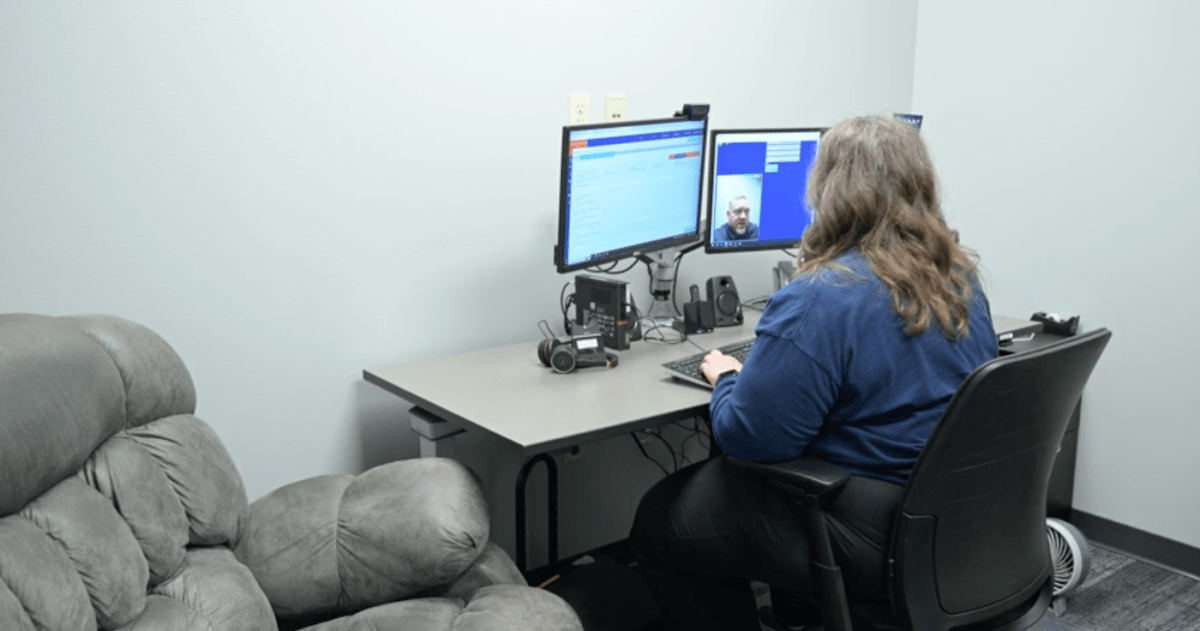
Grossnickle spoke to reporters at the statehouse, where he joined Gov. Mark Gordon and a group of fellow law enforcement officials to showcase what they hope is at least a partial solution. Through a $2.4 million grant from a charitable foundation, law enforcement agencies around the state are implementing a pilot program where officers access trained clinicians working remotely through a smart tablet. The initial investment is expected to cover two years worth of programming.
Officers can use the technology to ask questions in real time about how to approach a person who is suicidal or grappling with some other crisis. Or they can hand over the tablet and put that person on the line with the counselor directly.
“It’s not a silver bullet. It’s tablets with cell service, and a counselor on the other end.”
Green River Police Sgt. Lars Nandrup
Though officials announced the program this week, it has been in place for nearly two months, Allen Thompson, the executive director of the Wyoming Association of Sheriffs and Chiefs of Police and one of the pilot’s architects, said Tuesday. To date, the Sweetwater County Sheriff’s Office is actively using the program, as are the police departments in Green River, Rock Springs and Lusk.
Five sheriff’s departments, including Laramie, Park, Big Horn, Platte and Sublette counties, are in different stages of training to join the program, Thompson said. So are the police departments of Powell, Lovell and Wheatland. Enrollment is optional, but $2.4 million could cover as many as 70% of Wyoming’s departments for the two year period, Thompson told WyoFile.
The grant comes from the Helmsley Charitable Trust, a fund that has put tens of millions of dollars into Wyoming’s rural health care programs over the years. The trust awarded the grant to Thompson’s association. It has been funding similar programs in South Dakota and Nevada. In all three states, the calls are fielded by clinicians with a Telehealth company called Avel eCare, which is headquartered in South Dakota.
In Green River, police began using the program at the beginning of June. Since then, Sgt. Lars Nandrup has participated in two calls during which people were reported as suicidal and officers used the new tool effectively, he told WyoFile. In one case, officers called a person who had been reported as suicidal and holding a gun inside a home. When the person answered their call, they connected them to one of the remote mental health workers, Nandrup said. The counselor was able to talk the person back from hurting themselves, he said.
In a separate call from a suicidal person, officers handed the woman a cell phone, and then stood by while she talked to a counselor. Together they came up with a plan to get her enrolled in a hospital.
Neither person was arrested. That’s one way the Helmsley Foundation, and the telehealth company, have measured success. In South Dakota and Nevada, more than 80% of encounters where officers invoked the Avel eCare’s services have ended without incarceration or confinement, officials said Tuesday. Instead, counselors have crafted plans for follow-up care appointments.
But Helmsley Foundation officials also said success is tough to measure with total accuracy, given that departments don’t often track how many mental health calls in the past ended without arrests or violence.
It’s also not likely to be feasible in every police intervention of a person in crisis. For example, it was difficult to imagine officers handing a tablet to someone experiencing a psychotic break and committing property damage or acting violently, Nandrup said. Still, the sergeant said, it’s a low-cost tool targeted at a high-cost Wyoming problem, and as such, worth trying.
“It’s not a silver bullet,” he said, “It’s tablets with cell service, and a counselor on the other end.”
To one person in Wyoming who has been impacted by the intersection of policing and mental health, that sentiment seemed the appropriate one.
Debra Hinkle worked with law enforcement in Albany County on mental health interdictions for years, but lost her son in 2017 when a sheriff deputy killed him after a traffic stop went awry. Today, she runs a program for people with mental illness in Laramie and continues to monitor how local law enforcement agencies are confronting the problem.
“I like the fact that [the citizen] can immediately talk to someone, or the officer can talk to someone and get some insight,” she told WyoFile after learning of the new program.
“Telehealth is better than nothing, though I have my questions about how much it will help,” she said.
Nandrup also cheered the fact that the new program also provides officers with access to counseling. Many officers don’t have the time or inclination to deal with the trauma they might experience during the often grim work of policing, he said. In participating departments, they can now call into a counselor from the privacy of their patrol car.
To the extent it averts detentions in jails or involuntary confinement in hospitals and psychiatric facilities, the program could save taxpayers money, Avel eCare officials told WyoFile. In South Dakota, the program saved nearly $390,000 over 11 months, while in Nevada, it saved around $480,000, according to the company’s calculations.
In Wyoming, Thompson hopes the program can reduce the burden that housing mentally ill people brings to county jails. “What I hope the data will show us over the next two years is, if we can intervene with people on the front end of mental health crisis, then they’re not in that jail cell six months from now,” he said.
Sheriffs say they’re increasingly warehousing the state’s worst cases of mental illness, sometimes for long periods of time as people wait on court-ordered beds at the staff-strapped state psychiatric hospital outside Evanston. Those inmates burden jail staff and batter budgets, the sheriffs say, which are already reduced by the Legislature’s property tax cuts.
People in mental health crises can deteriorate while in jails as well, because of the conditions of confinement and the limited access to treatment.
In the long run, it will fall to state lawmakers to decide whether to continue to invest in the remote counseling program. The current Wyoming Legislature has yet to directly confront the problem of mentally ill people in the state’s jails, despite the increasing cry for help from sheriffs around the state.
Gordon has made mental health resourcing a principal issue of his second term, holding town halls around Wyoming and overseeing reforms to the state’s treatment systems.
The governor on Tuesday called on state residents to encourage their representatives to continue investment in social services to confront mental health woes around the state. “It has been my hope that the state steps up to meet the need,” Gordon said.

Good morning all! “You can’t make a silk purse out of a sow’s ear”. My family, friends neighbors ALL Americans:
“We are the government and We are here to help.”
WYOFILE thank you so much for this article and most importantly exercising our FIRST AMENDMENT!
This sow’s ear/Article can never become a silk purse, this is just a different packaging of what has been “attempted” to provide “LEO’S” with the authority to place ANY AMERICAN in or under a “physiological observation” because the LEO believes/thinks/thinking it is a needed/necessary measure forour or to “PUBLIC SAFETY” and was defeated/turned down/off before this time the packaging is colorful with tinges of what some folks would be “fear mongering”… COINCIDENCE or TACTIC…
Folks this IS NOT a direction “We the people” should give any measurement to. If you have any questions or doubts LEO’S are already well insulated by what is called “QUALIFIED IMMUNITY” do some research on QUALIFIED IMMUNITY and how it WILL impact your and every AMERICAN LIVES…
“WE ARE THE GOVERNMENT AND WE ARE HERE TO HELP”… “A SOW’S EAR WILL NEVER MAKE A SILK PURSE”…