

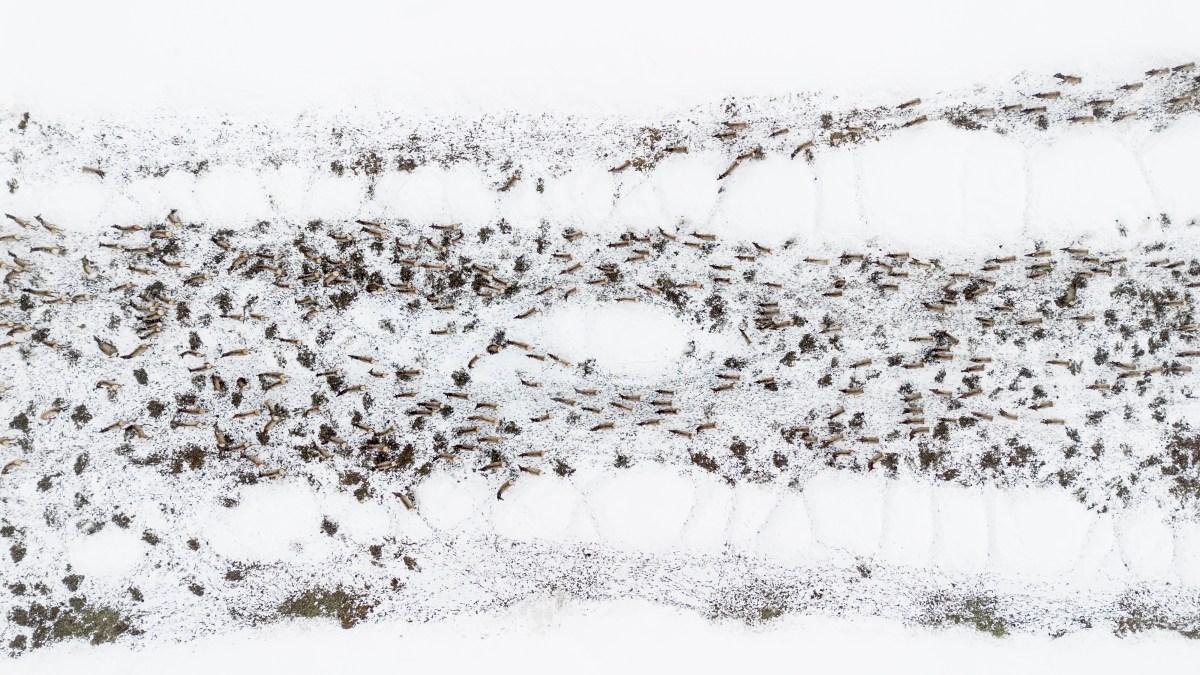
Brian Dugovich’s colleagues came up with a catchy four-word soundbite — “farming elk feeds wolves” — to sum up one finding from a study he led that investigated the effectiveness of Wyoming’s system of feeding elk in the winter.
Dugovich’s study, recently published in the journal Ecosphere, initially set out to test some of the assumptions about elk feedgrounds and their benefits. One reason why big game outfitters have been steadfast proponents of elk feeding for generations is a belief that feedgrounds improve elk hunting. But it’s a premise that’s never really been tested in the modern era using data.
“We thought it would be a good idea to revisit some assumptions,” said Dugovich, a Ph.D. wildlife disease ecologist who published the study while working at the U.S. Geological Survey’s Northern Rocky Mountain Science Center.
Dugovich and his colleagues examined several demographic indicators for Wyoming’s six fed elk herds, comparing their performance to seven unfed elk herds on the east and north sides of the Greater Yellowstone Ecosystem. Specifically, they looked at the rates of calves being recruited in a herd, the population size relative to the acreage of available winter range and the “surplus” of elk, which is essentially the huntable number that could be killed each year without reducing populations.
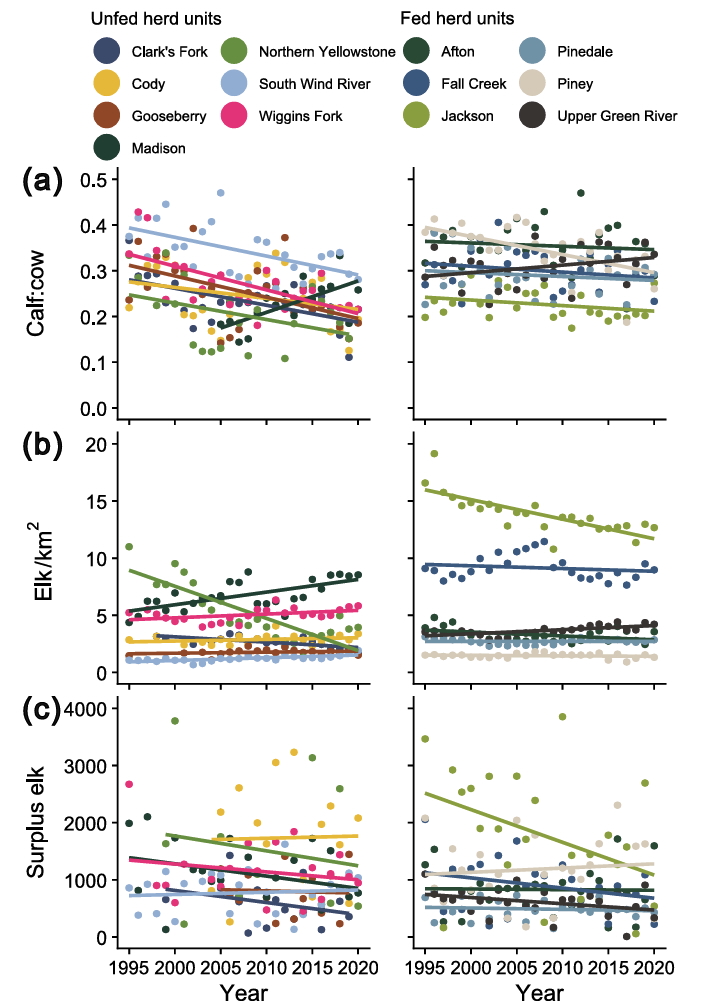
Results varied — the Jackson and Fall Creek elk herds were more stimulated by feeding than the four others — but overall, the effects of feeding were “small,” said Paul Cross, a USGS research wildlife biologist who collaborated on the research.
“The question then is, ‘Well, why is it so small?’” Cross said. “We’re proposing that it could be that predators are assuming some of that effect.”
In scientific terms, Dugovich described it as a “predator subsidization effect.” In regions where elk are fed hay and alfalfa for months during the brunt of winter, herds brought aboard about 5% more calves than elsewhere in the Yellowstone region. But those extra hooves on the ground didn’t necessarily translate to a larger surplus of elk available for hunting, he said.
“The benefit you might be getting from feeding was being mopped up by the predators,” Dugovich said. “In a more intact ecosystem [that includes large carnivores], the energy you put into the system is going to be harder to get back out again as harvest.”

The dynamics were evident in the raw data, Cross said. But a statistical model that was part of the study corroborated the findings, he said. The model used 26 years of data, included thousands of simulations and took into account factors like winter severity and the presence of predators.
The USGS research was conducted in collaboration with federal land and wildlife managers, who shared data. Co-authors listed include USGS’ Emma Tomaszewski, the National Elk Refuge’s Eric Cole, Grand Teton National Park’s Sarah Dewey, Utah State University’s Dan MacNulty, Wyoming Game and Fish Department’s Brandon Scurlock and Yellowstone National Park’s Dan Stahler.
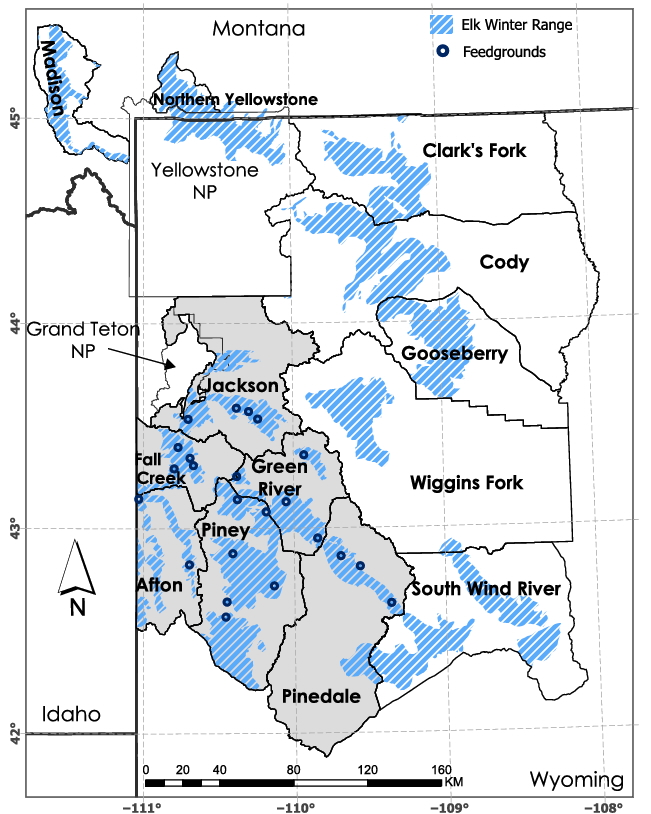
Wyoming Game and Fish, which administers 21 winter elk feedgrounds, declined an interview for this story. Its staff was not involved in the study’s analysis or conclusions about the feedgrounds, which are a political hot potato.
“Game and Fish consistently utilizes the best available data and science to inform wildlife management strategies,” Scurlock, the Pinedale Region’s wildlife management coordinator, said in an emailed statement.
The USGS has been assisting land and wildlife managers with scientific analyses to help inform what they should do about elk feeding in the long run. Although the feeding system is a century old, the recent arrival of chronic wasting disease projects to change the elk feeding equation significantly. Wildlife disease experts anticipate that keeping the historic practice going will produce the worst outcomes for the future of elk populations and elk hunting.

Dugovich’s findings about feedgrounds and elk herd productivity were not included in recent analyses that informed decisions about feeding elk on federal land, according to Cross.
In early August, Bridger-Teton National Forest Supervisor Chad Hudson made a “difficult” decision to keep feeding elk for at least three more winters on the 35-acre Dell Creek and 100-acre Forest Park feedgrounds. A decision about what to do with elk feeding on the National Elk Refuge also looms. Wyomingite and recently confirmed U.S. Fish and Wildlife Service Director Brian Nesvik will presumably play a major role in making the decision.

Let’s see, the wolves were broughht in to reduce the elk and deer poopulation and kill private ly owned livestock, there for they must be protected at any cost. The man who killed one of the wolves must be punished as terribly as possible. Wolves can destroy the livlihood and be cheered for it, but woah unto anyone who kills one of the lovely animals. Frankly I feel the wolf introduction his actions are on a par. The wolf introduction cost millions, and got awards for the people who accomplished it. This man?
There is a big difference between killing a wolf and torturing a wolf. If he had just killed the wolf most people wouldn’t have looked twice. He is not being punished for killing a wolf, he is being punished for the hours of torture he inflicted on the wolf. It worries me that you can tell the difference.
AG has cost the public BILLION of dollars. You are not the only one on the planet.
Doug nailed it.
As soon as the snow starts stacking up the elk band together, they travel/rest/eat/sleep right next to each other until spring.
Feed grounds are not changing that behavior.
Wolves and Grizzlies will continue to have far more devastating effects on elk populations in the GYE than CWD ever will.
I am thinking that the elk that are accustomed to feeding on these 21 feedgrounds no longer have that feed option they will seek out ranch land that is feeding their stock. That’s what I would do and elk are smarter than me. This would not disperse them much more. And then someone has to subsidize the ranchers.
We already are.
Feed grounds grow disease.
Funny, LOTS of other areas in Wyoming have CWD in elk at higher rates, and there are no feed grounds.
Fearmongering hyperbole.
No argument on CWD, I agree, CWD is not the reason I wrote that. I do not engage in fear mongering and rarely in hyperbole. We all know how much money those feed grounds save ranchers, and how much they cost the rest of us.
One thing you forgot. The higher the cost to raise beef either the price of beef will go up or the availability of hanburgers and steaks will go thru the moon.
Now you say it’s about money???
Feed grounds do not “grow disease” anymore than normal wintering behavior in elk.
When 2000 elk tags used to be issued in a couple areas areas south of Yellowstone up to the border of the National Elk Refuge, beef hamburger was a buck a pound. Now very poor quality beef hamburger is 5 dollars a pound and many families no longer have HIGH quality elk to fill their freezers with a grand total of 20 tags available (a 99% reduction).
What has been done to the GYE elk herds regarding wolves and overpopulated griz is criminal.
A destroyed natural resource.
Thank you Mike for your precise and tenacious reporting.
Wyoming’s elk feedgrounds are a century-old relic that should have been retired long ago. They were never built for hunters—they were a stopgap to keep starving elk out of ranchers’ haystacks. But outfitters and state managers twisted that legacy into a sales pitch: feedgrounds mean more elk, more tags, more hunting. Now the science is in, and the story has fallen apart.
The U.S. Geological Survey’s own analysis shows what many suspected: feedgrounds give only a small calf boost, and predators quickly balance it out. The supposed hunting benefit was always more myth than fact. Meanwhile, the real consequences are staring us in the face. By cramming elk together on hay piles, we’ve created perfect conditions for chronic wasting disease to spread—and that disease, not wolves or grizzlies, is what will devastate Wyoming’s herds.
Outfitters defend feedgrounds because they depend on selling clients a guaranteed elk spectacle. Game and Fish avoids the hard truth because shutting them down is a political hornet’s nest. But let’s be honest: this isn’t management, it’s negligence. It’s trading away the future of Wyoming elk for short-term profit and political comfort.
If hunters want healthy herds tomorrow, they need to stop defending feedgrounds today. Feeding elk is not saving them—it’s destroying them.
Tell me William, why are elk tags in the GYE of Wyoming and Montana an infinitesimal fraction of what they once were?
Specifically areas 79 and 75 which once allocated 1500 to 2000 tags for elk, now only hand out a grand total of 20.
Feed grounds and “disease” are not responsible in the collapse of herd numbers and calk survivability of the S. Yellowstone elk herd.
Elk gather in extremely close proximity in the winter regardless of whether it is on a feed ground or not. Feed ground opposition is a red herring due to the FACT that elk congregate in the winter regardless of whether they are being fed by humans.
Want to take away supplemental feeding? Give the elk their winter habitat back in Teton County and elsewhere.
WGFD adds insult to injury by forcing hunters to pay for this scheme via the “Elk Special Management Permit.” William gets its right – how about some honesty and call it the “Elk Negligence Permit.”