


When thin shoots of cheatgrass are the first plants to green up in the spring, mule deer might nibble the tops like any of us might idly crunch last week’s pretzels still sitting on our office desks.
Come early summer, though, that same cheatgrass turns into brown, leggy strands. At that point, mule deer want to eat it as much as we want to consume the cardboard box containing those stale pretzels. They just won’t do it.
In fact, they dislike cheatgrass so much that mule deer will avoid an area completely once it contains about 20% of the annual invasive grass, according to a study published in early September in the journal Rangeland Ecology and Management.
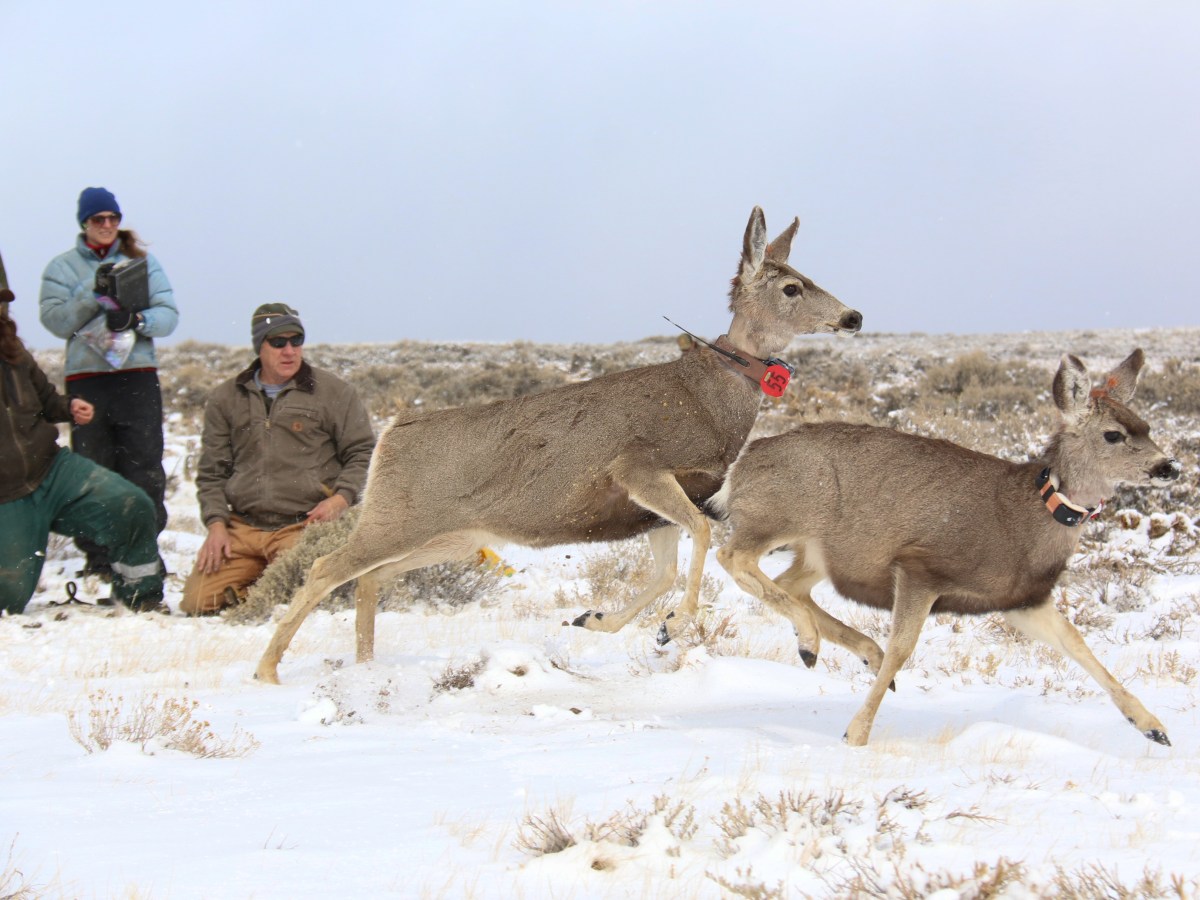
The study’s authors, all from the University of Wyoming, compared movement patterns from 115 GPS-collared mule deer with range maps showing variation in plant cover. They found that when cheatgrass covers less than 10% of an area, deer will still browse. When it covers 10-16%, they will begin to avoid an area. Anything above 20% is utterly unappealing.

Even more alarmingly, the study shows that as cheatgrass continues to spread in northeast Wyoming over the next couple decades, up to 50% of current good habitat could be rendered useless to mule deer.
The spread of cheatgrass likely won’t be the final nail in mule deer’s coffin, but it will be one of many contributing to their continued decline. Unlike many studies that focus exclusively on declines, however, this one carries a rather large kernel of hope. When treating cheatgrass with herbicides in a targeted and strategic way, land managers can start to win the fight and mule deer will also return.
A perpetual plague
Cheatgrass has been the scourge of western landscapes for well over a century, when it first arrived from Europe and Asia nestled in bags of seed and bales of straw. Like most nonnative, invasive grasses, it didn’t evolve here and quickly found a way to outcompete its native neighbors. It “cheats,” germinating over winter to be the first grass to grow in the spring, using water and resources before native grasses, plants and shrubs are awake enough from their winter slumber to start looking for nourishment again.
But by early summer, cheatgrass cures, losing any trace amounts of nutritional value. It becomes a fire hazard, another part of its evolutionary strategy. As fires whip across a landscape, aided by dry cheatgrass, the blazes kill native competitors, giving cheatgrass even more opportunities to spread.
It’s a problem that has plagued ranchers, wildlife biologists and land managers for decades, but until recently, few publications had explicitly shown at what threshold mule deer will simply avoid cheatgrass-covered areas.

UW professors Jerod Merkle and Brian Mealor along with research scientist Kurt Smith used data showing how mule deer acted in much of the northeast corner of the state, provided by Western EcoSystems Technology biologist Hall Sawyer. The researchers could see deer collar points move into and out of areas with good food and habitat and avoid those areas with increasing amounts of cheatgrass.
Jill Randall, Wyoming Game and Fish Department big game migration coordinator, who was not involved in the study, said the results make sense.
“Deer are super selective foragers, and if they can choose between native and non-native, they will go where there’s something better,” she said. “If cheatgrass is scattered in and among things, they will nibble, but 20% or above is pretty dominant. If they can go elsewhere and eat other native species, they will.”
The problem then becomes when deer start to run out of other places to go.
Hope for conservation
Losing half their potential habitat in the next 20 years sounds dramatic. And it is, especially for a herd already suffering from energy development, highways, fences and drought.
But solutions exist, the authors say, particularly in an herbicide called Rejuvra, which was approved by the EPA in 2020 and is being used on rangelands across the West.
The herbicide works by killing annual seeds and leaving perennial grasses and plants relatively untouched. It’s expensive, Randall said, and requires repeated treatments. But she and many other experts say it’s critical for maintaining sagebrush ecosystems upon which countless mule deer, sagegrouse, songbirds and even lizards depend.
A study published in August used camera traps to show that mule deer will return to areas with native plants after cheatgrass removal.
That’s also what Smith, Merkle and Mealor’s models showed. In fact, mule deer will return in abundance following treatment of cheatgrass-covered acres, potentially reversing much of that 50% of habitat that was otherwise lost.
The authors say the paper isn’t meant to cause alarm but to explain the direness of the situation and hopefulness of potential solutions.
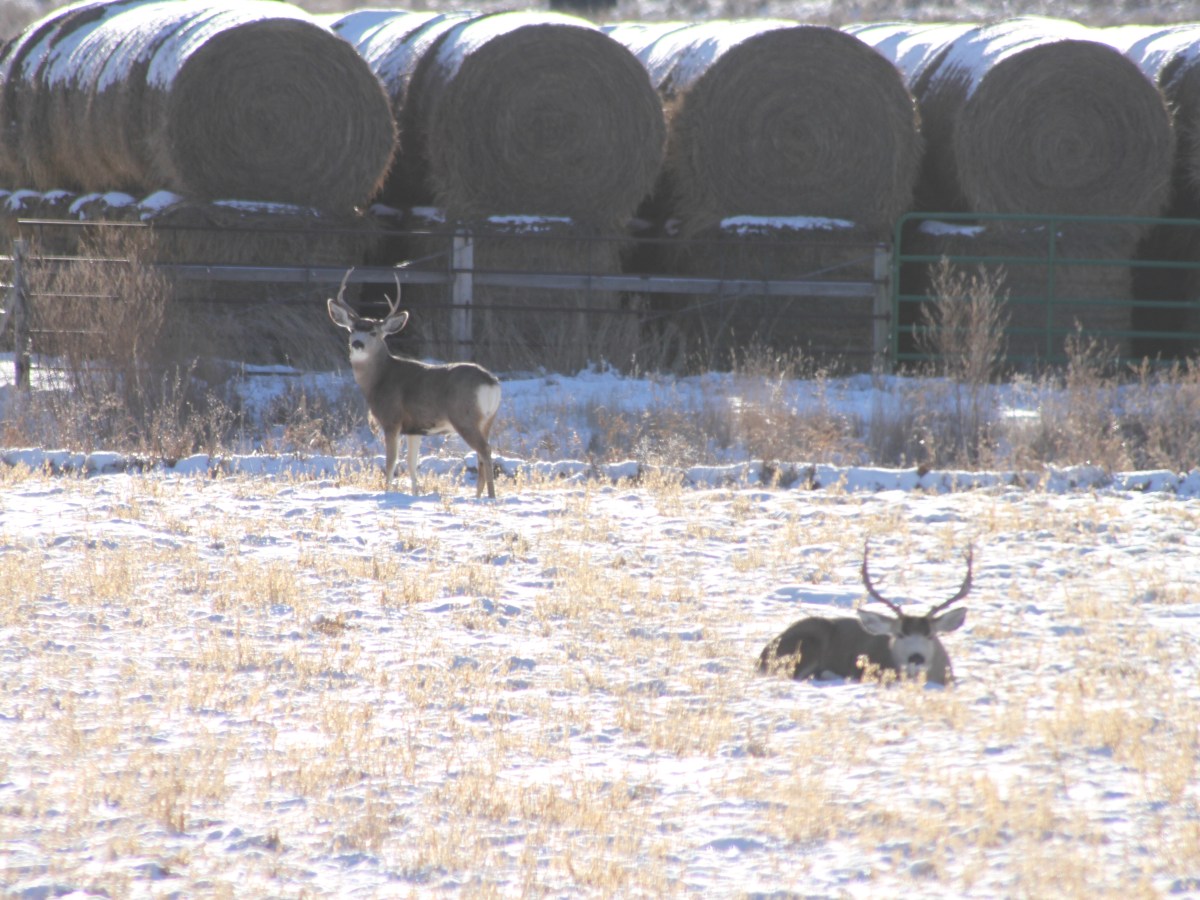
Gov. Mark Gordon and state lawmakers agree, and earlier this year, provided tens of millions of dollars in grants and loans to fight invasive grasses.
Bottom line, Smith said: “If we do nothing, we’re in trouble. But there is hope.”
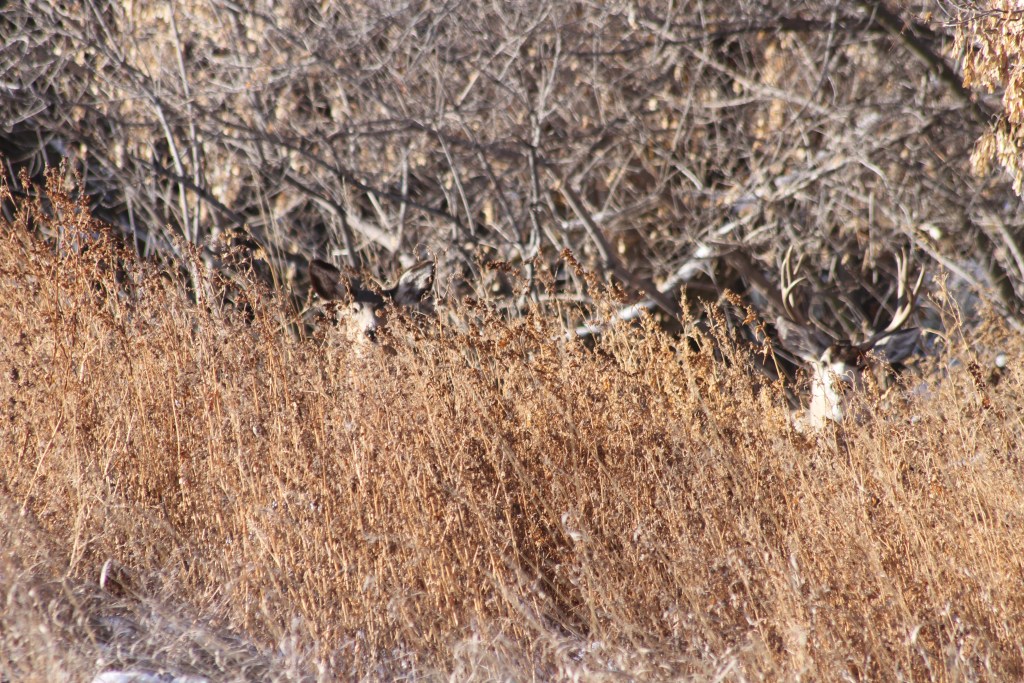
The top picture appear to be white tails. Not Mule deer.
Look again at the antlers (forked), tail (smaller and black tipped), stature (big, muscular) and finally the ears (like a mule’s, almost) — and that would be a rare sight to see white tail in a dry barren patch of cheat.
Cheatgrass CAN be controlled with spring mowing. We’re seeing a lot of it due to drought and wind erosion. The constant wind exposes perennial grass’s roots, killing off the grass.
We’ve restored rangeland with aerial applications of an herbicide called Plateau. It was not expensive.
Cheatgrass is highly invasive and is not given a foothold by “overgrazing,” as many incorrectly believe. Lots of old-timers believe it came to Wyoming as a quick cover crop applied by WyDoT after road construction.
Can’t mow in most mule deer habitat, and if you could, would be mowing brush and some good bunch grasses that can’t handle it (like basin wildrye). Plateau (imazapic) for us only worked two years at the most, which might be ok after a fire but often not. Some people mix with Rejuvra. Also seems to have done a number on antelope bitterbrush seedlings. But yeah definitely much cheaper if it does work for you as the patent for imazapic has expired, whereas Rejuvra has until 2040. BLM has used a lot of imazapic, and well you can see for yourself that it often hasn’t worked well.
Severe overgrazing from domestic livestock along with the continued soil degradation accelerates the growth and spread of Cheatgrass. Apparently the public land grazing stock growers have the land agencies and our Game and Fish scared spitless of them, hence the welfare cowboys takes no blame and no agency will hold them accountable. There will be no permanent “fixes” until the grazing abuse is terminated
Typical uneducated response. Not all cheatgrass is due to overgrazing. Fires, drought, disturbed soils due to creating new roads by ATV/vehicles, rural ranchettes, etc. I have two meadows, one that continues to pick up cheatgrass because it is dryer, the other not so much because it is more sub-irrigated. Most of the cheat grass is coming from previously burned areas – the result of 100+ years of fire suppression and restrictions against logging that resulted in effectively a scorched earth fire because of the built up fuels.
So it’s a number of factors, not just the so called welfare cowboys.
Ha! Cheatgrass and cheat the public land owner welfare cowpoke go hand in hand but you knew that, Rob. Meanwhile, you’re grazing a cow and calf pair on my public land for 4.5 cents per day.
Coming soon, the cowboys will expect taxpayers to fund the control of cheatgrass on public lands, which they pay a mere pittance for grazing “rights”.
Great article, Christine. Another bad aspect of cheatgrass is that fact that it is a fire accelerant and often burns hotter than other wildfires and scorches the earth for future plant growth. Well, except for more cheatgrass, of course. Seems I read that cheatgrass was a major factor in the rapid growth of the Red Canyon fire near Thermopolis. Yet another reason for it’s eradication. I rank invasive weeds and highway fatality as the top two factors affecting mule deer today. Time to spend the money on more over/underpasses and cheatgrass eradication. Not just for the mule deer, but for less human tragedy as well. Seems like maybe the insurance companies could give a little kickback on these projects-less payouts for vehicle/wildlife accidents. JMO.
Why isn’t cheatgrass on Wyoming’s noxious weed list?
In my limited experience, I mostly got rid of the cheatgrass on my 20ac place by improving the irrigation and overseeding with pasture grass. Cheatgrass thrives in low moisture situations, but the grass will outcompete it if you give it a chance
Interesting research. Cheatgrass is nasty, even though it has saved an occasional rancher without enough hay from losing their herd in the late winter. In similar circumstances mule deer may rely on it as well — but that means the range is already highly degraded.
My guess is that avoidance of cheatgrass infested areas, may not translate fully to a reduced carrying capacity as cheatgrass expands and the deer are less able to select more desirable ground. Nonetheless we should do everything we can to stop it. Rejuvra is very very expensive, and not a silver bullet even if the best herbicide so far. Where more ground is already covered by winter annuals, it can be difficult to establish native competitors those post application, as the herbicide suppresses about all new successful germination, and if cheatgrass remains nearby, it will likely beat the good guys back. So a dilemma — treat large areas (just imagining, since we never had the $$) with the intent of removing cheatgrass seed bank and slow down recolonizing, but then you best have the manpower to establish natives in the few years window over all that ground; or treat small areas that you can manage but then you have the risk of nearby cheatgrass. I think generally the latter is better, even if you have the $$, as Rejuvra might do a number on soil crusts as well and observing how it is acting on your ground critical.
If you think cheatgrass is bad, just wait until medusahead starts coming up elevation.
Can Cheat Grass be mowed in the Spring when it starts growing? Will that allow the Native Grasses to grow and suppress the Cheat Grass from seeding?
On a pasture that can work, but pastures and hay meadows are typically irrigated in this country so cheatgrass isn’t really an issue. But no chance on native mule deer habitat.
There has been some attempt to control by hard grazing of cattle or sheep in the early spring. The problem though is that cheatgrass can survive and go to seed at a few inches tall on years with very little moisture, in which case that herd is going to go hungry, but in years with more moisture you would need a vast herd to control it — and how would you keep that herd sustained in the summer or during lean years without destroying the good native perennials. I’ve heard there are some big ranches in Nevada that have experimented with moving and concentrating cattle hundreds of miles to hit cheatgrass hard, but I don’t know if it worked out. Maybe in theory but we would probably need to directly subsidize ranchers, or a coalition of ranchers, to try this, and careful monitoring would be critical.
Strive on for the control of nature is won….not given.
” The highly adaptable, opportunistic plants we call “weeds” moved nearly as fast as the caribou—a stray gust of wind can send some seeds spinning miles through the air—but other plants are much slower,”
John Michael Greer has a distinct distrust of selecting for the corporate solution and this piece would be a nice companion to this article.
https://www.ecosophia.net/mitigation-and-other-unspeakable-horrors/
Cheatgrass and the other exotic winter annuals (medusahead, and in some places closer to disturbance, even escaped cereal rye) don’t fit into that paradigm of plants moving due to climatic shifts. For whatever quirk of history there are no native winter annual grasses in the sage steppe here in the Rocky and Intermountain West that can also exploit the niche well enough to compete. Cheatgrass or anything like it wasn’t here 6000 years ago — we brought it here from Asia. Long term it will entirely destroy more arid sites by creating a near monoculture supported by frequent fire. There are already millions of acres lost to it in Idaho, Oregon, Utah, Nevada. It’s as bad as kudzu in a swamp but most people don’t even recognize it.
There are plenty of ‘weeds’ that I’d agree do little harm and may even have benefits that outweigh their non native status but these grasses are not those. Go out and walk some low elevation cheatgrass dominated landscape and your senses will tell you that it is highly degraded. Fewer birds, insects, lizards, and yep deer.