

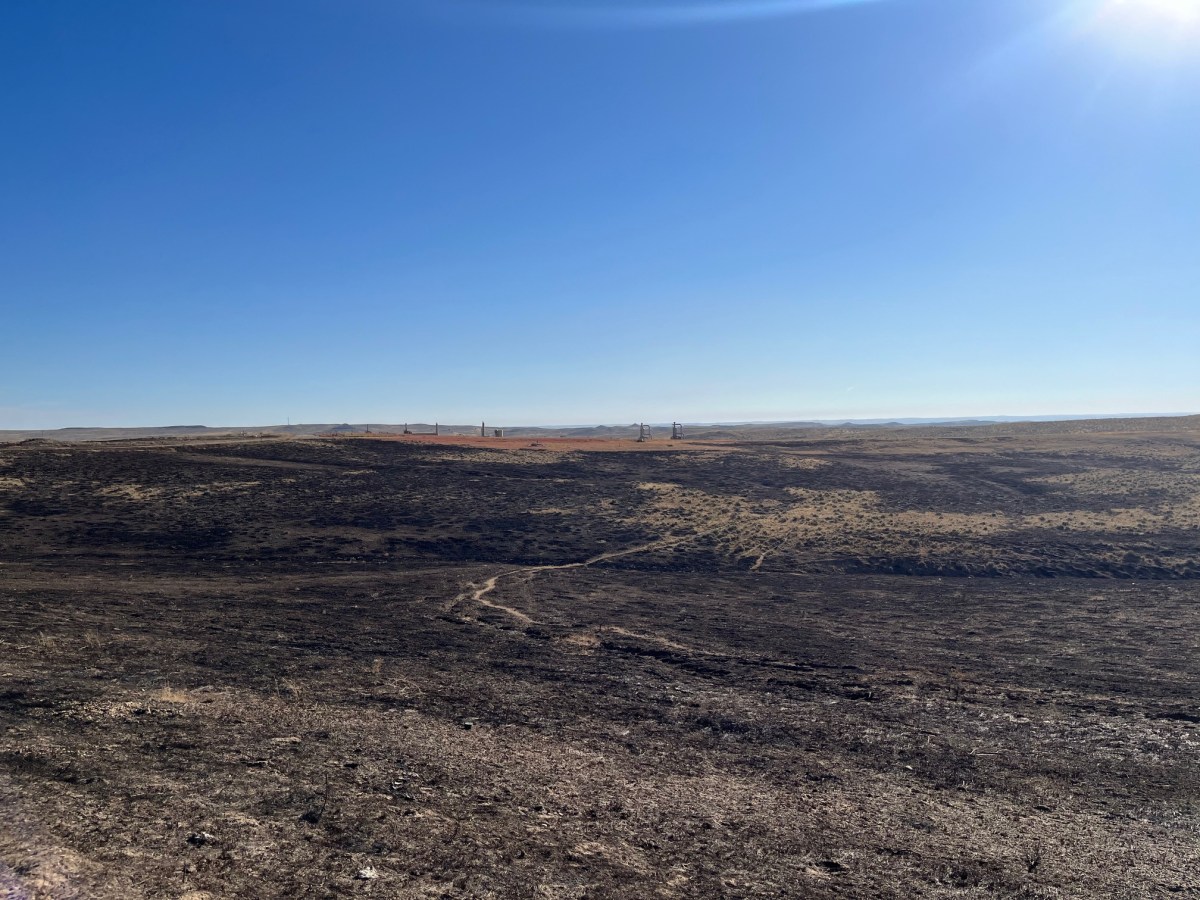
After a historic wildfire season, Wyoming lawmakers spent much of the 2025 general session debating whether to fund recovery efforts via loans or grants. Ultimately, the Legislature decided to do both.
Senate File 152, “Wildfire management-amendments,” designates roughly $49 million in grants for various special districts to restore grasses and habitats, and to prevent invasive vegetation like cheatgrass. Senate File 195, “Small business emergency bridge loan program,” authorizes up to $25 million for short-term loans after natural disasters, including but not limited to wildfires.
Together the two bills provide slightly more than half of the $130 million that Gov. Mark Gordon requested in the supplemental budget to help landowners restore grasses, replace fences and rebuild structures, among other things. Of the 850,000 acres burned last year, 70% was state and private land.
Neither bill was originally intended to include such appropriations, but both were amended to do so when the Senate tanked the budget and forced lawmakers to find other vehicles for top spending priorities.
From the start, Gordon was firmly in favor of grants, warning lawmakers that loans — as favored by the Joint Appropriations Committee — would not be flexible or responsive enough to meet the needs of landowners.
The governor reiterated that in a letter to Senate President Bo Biteman, R-Ranchester, explaining his decision to let SF 195 become law without his signature.
“Because the risk of fire can affect many more than one landowner, I believe the best approach to expediting a landscape scale restoration of last year’s burned areas … would be optimally facilitated through grants,” Gordon wrote. “Some landowners might make use of a generous loan program such as the one envisioned in this legislation, but others may not or could not.”

Still, Gordon said he was willing to let the legislation “come to fruition.”
Once the bill goes into effect July 1, qualifying small businesses will be able to apply for loans up to $750,000 through the Office of State Lands and Investments. The loans will require a 2% origination fee and incur an interest rate equal to the interest rate earned on specified state investments.
The money can only be used for certain business purposes, such as fencing repair or replacement of livestock and buildings, and it must be paid back to the state within three years. The loans are not limited to wildfire recovery, but are only available to recipients in counties declared under a natural disaster by the governor.
Meanwhile, the ball is already rolling on SF 152.
The process for dispensing the $49 million in grants for special districts has begun, according to Bob Budd, executive director of the Wyoming Wildlife and Natural Resource Trust.
“I’ve met with the weed and pest districts, and I’ve met with the people who are going to be involved at other levels [like] the conservation districts. I’ve talked with fire folks and everything else,” Budd told WyoFile. “So we’re basically asking for proposals at this point and seeing what level of impact we’re going to need to be ready to address.”
Time is of the essence, Budd said, to halt the spread of invasive species that threaten Wyoming’s sagebrush and the inhabitants that depend on the native plant. Cheatgrass, in particular, poses a high fire risk since it dries out quickly. That reality is also likely to guide where the grant dollars go.
“We’re probably not going to have enough money to do everything that we might like to do,” Budd said. “So we need to have, as I have described it, somewhat of a triage system that says, ‘What are the highest priorities if we run low on funding? What do we do and do now?’”
Budd said he expects his office to have proposals back by April 1.
When the bill was sent to the governor’s desk it included $100 million in loans for natural disaster recovery efforts. Before he signed it, Gordon line-item vetoed that section to account for the loan program already put into law with SF 195. Gordon also axed a section that would have diverted Energy Matching Funds to pay for the bill’s loan program.
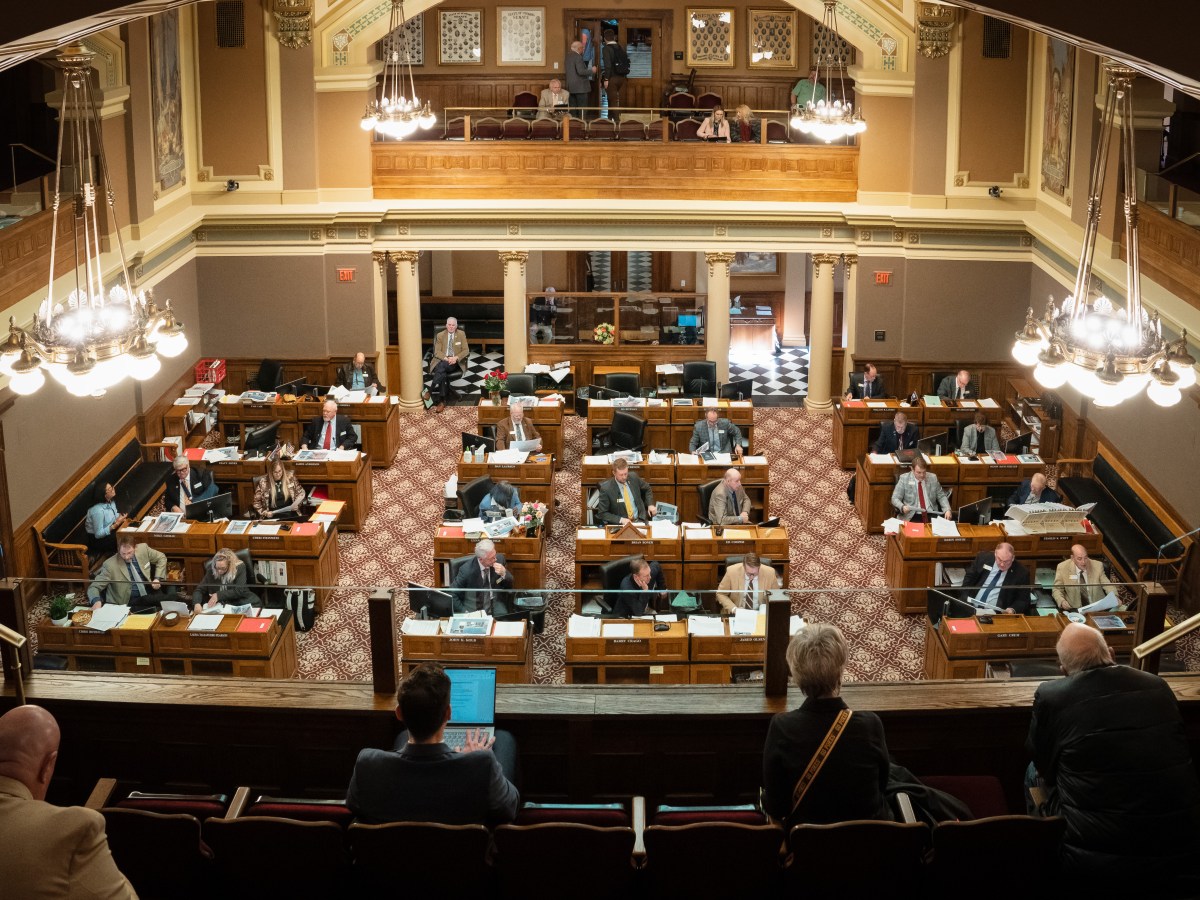

“These funds are used to support our essential core energy industries as well as to underpin the future of Wyoming’s most vulnerable traditional energy industries,” Gordon wrote in his line-item veto letter to Secretary of State Chuck Gray.
“After decades of work to put Wyoming in the forefront of innovation to make sure Wyoming coal, uranium, oil, and gas — our core industries that built our schools and secured our state’s financial wellbeing — stay an essential part of any energy future; it seems foolish at best and self-destructive at worst to abandon the very industries that are our lifeblood,” he wrote.
The bill also restores funds that were depleted in 2024 and authorizes the governor to borrow up to $30 million from the state’s rainy day fund as needed to fight wildfires in the event the reserves are once again exhausted.

Good luck on “controlling” the cheat grass invasion. Cheat grass has invaded million of acres in the West. ranchers will get a short period of spring grazing on cheat grass and then the range will become worthless. Cheat grass fires will be more common.