

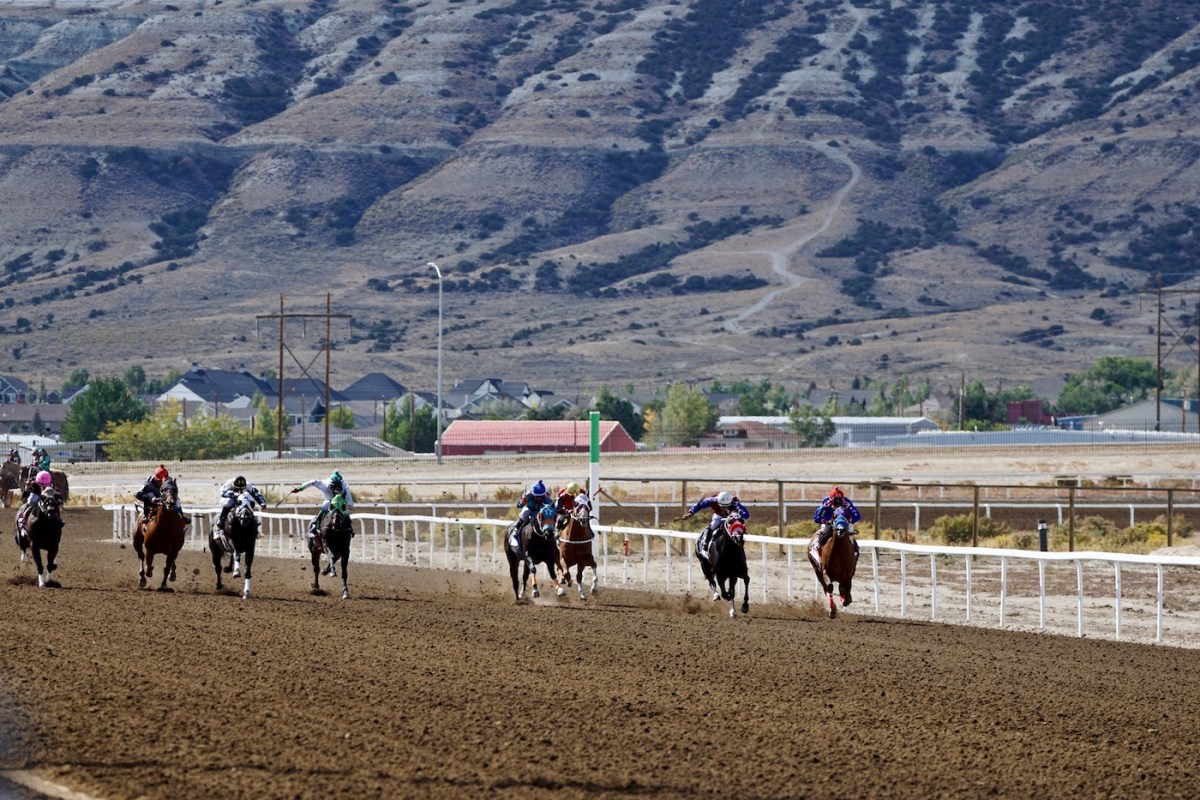
ROCK SPRINGS—It’s about an hour before the final day of the 2025 Wyoming horse racing season begins, and Ron Moorhouse is manning a scale in a backroom of an administrative building.
The 72-year-old is responsible for weighing jockeys ahead of the races at Sweetwater Downs, a blue-collar track outside of Rock Springs. Moorhouse was a jockey himself for 12 years. He used to weigh in at 110 pounds and developed a stomach ulcer from purging what he ate to stay slim. One season he raced in 13 different states.
“It becomes a lifestyle,” he said.
Now Moorhouse weighs in young jockeys like Brayan Juarez. After stepping off the scale, the lithe 23-year-old from Utah stands in a small locker room and mentally prepares himself for the five races ahead. “You have to slow your mind when you leave those gates,” Juarez said.
There’s a lot more jockeys for Moorhouse to weigh in Wyoming now. Fifteen years ago, the Cowboy State hosted zero races. This year saw more than 50 days of racing. More could come next year.
“This is one of the few, best, success stories right now in horse racing,” track owner Eugene Joyce said. “No doubt about it.”
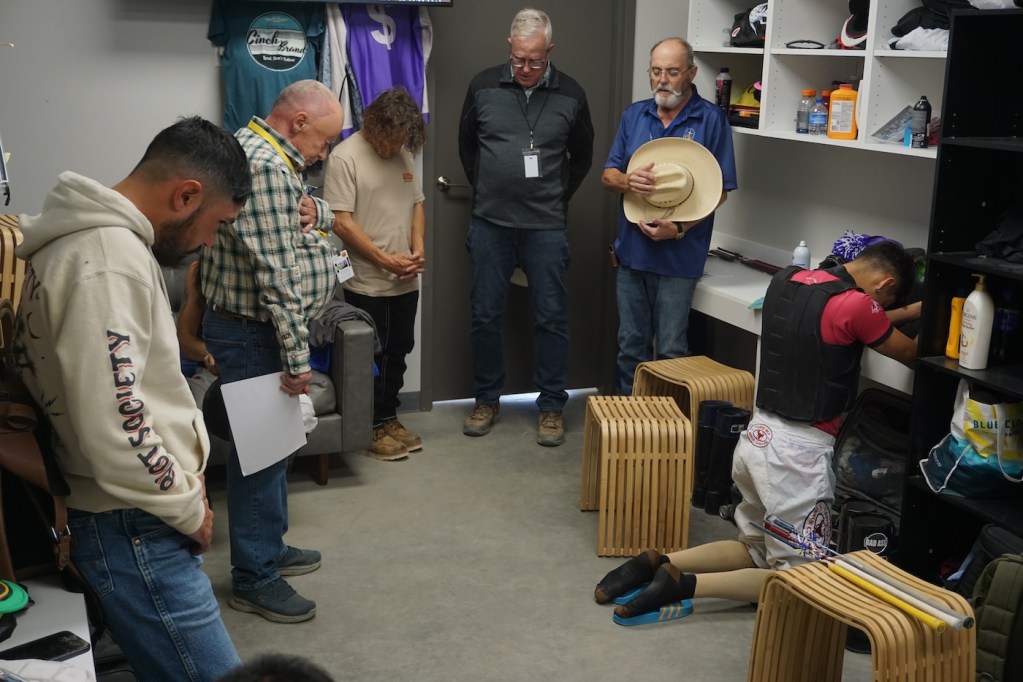
Outside the administrative building, pickups slowly fill the sprawling dirt parking lot as race time approaches. Local fans trickle in. Since it’s the last day of the season, a beer costs $2 and the cheeseburgers are half off. Everything must go.
High above it all, Liam Molinaro is trying to launch his career. In an announcer’s booth with a bird’s eye view of the track, Molinaro studies the names and weights of horses and riders. He marks which jockeys showed up heavier than billed on the rosters bettors will use to make their picks.
At 21 years old, Molinaro called his first horse race a year ago in Humboldt County, California. It was toward the end of a rapid collapse of horse racing in Northern California. Molinaro bounced around for a time afterward, but has been calling races here at Sweetwater Downs for several weeks.
Molinaro grew up with the sport, he said. His father trained race horses.
Horse racing is a family affair. That’s old news to Rick Hillstead, a horse breeder from Star Valley who later in the day will be standing in the dirt track after a race. His voice chokes with emotion as he describes what horse racing has brought to his family ranch, which he works with his son.
“We don’t have to scrimp,” he said. “It’s just been such a blessing.”

All four men, Moorhouse, Juarez, Molinaro and Hillstead, are at a seasonal racetrack outside Rock Springs because, though the grandstand that day will never get beyond a third full, horse racing in Wyoming is a rapidly expanding endeavor while, nationwide, attendance and betting are in steady decline.
Around the country, 50 tracks have closed since 2000, according to Horseracing Wrongs, a group of activists who oppose the sport because of the numbers of horses that die and are hurt racing. Wyoming is going the other way.
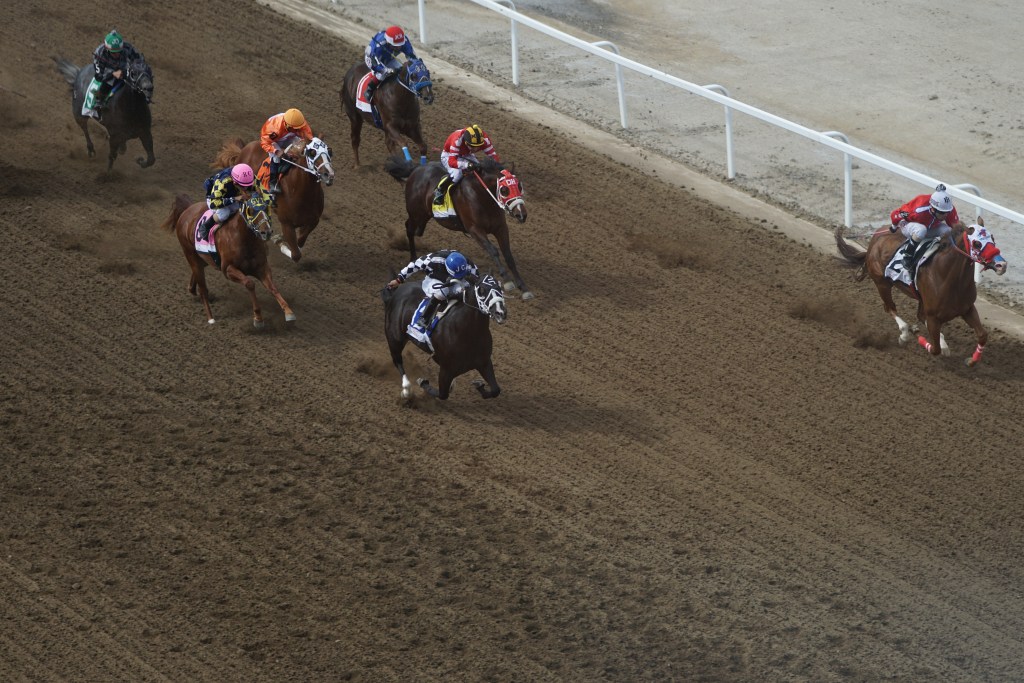
The race season began in mid May at Energy Downs in Gillette, carried on through the heat of the summer at Wyoming Downs in Evanston and ended Sept. 28 at Sweetwater Downs.
A fourth track is under construction outside Cheyenne. In a stark demonstration of the industry’s revival here amid its decline elsewhere, Wyoming’s tracks are buying equipment from more famous race courses as they close in more populated parts of the country.
Eugene Joyce, who founded Sweetwater Downs, acquired equipment from closing southern California tracks. Thunder Plains, the track rising outside Cheyenne, bought items at auction from Golden Gate Fields, a famed track in the East Bay outside San Francisco, according to a report in the Cowboy State Daily.
A day at Sweetwater Downs reveals an industry where both the devotion and the nomadic lifestyle it inspires are evocative of Wyoming’s more traditional equine pastime — the rodeo.
The industry is giving back to the state that has so far embraced it, Joyce, Beirn and other horse racing boosters say. They point to the industry’s growing impact on Wyoming’s ranching and agricultural businesses. It’s a good selling point in a state where ranching still maintains a strong grip on the state’s ethos and politics, even as it lags as an economic sector well behind the energy and tourism industries.

Hillstead, the Star Valley rancher, used to milk a lot more cows, he told WyoFile. When horse racing began to grow, “I happened to have some stallions, I happened to have some mares, I happened to have a son who was interested in it.”
Now, he earns much of his living through a program administered by the state that distributes money to breeders who raise horses in Wyoming, based on how often their animals race and how well they perform at the track. In the last 10 years, his horses have earned over a million dollars through that program, according to public records kept by the Wyoming Gaming Commission. Though raising and training horses carries significant costs, Hillstead said the program has changed his family’s financial outlook.
And more importantly, he said, the money keeps his ranch viable and has helped him draw his family closer around that lifestyle — what some would consider the Wyoming dream.
But the competition keeps growing, Hillstead said, as Wyoming’s growing winners’ purses increasingly attract jockeys and horse owners from out of state.
On Sept. 8, Sweetwater Downs hosted a race with a $250,000 purse, “the richest race run in Wyoming history,” according to a press release from Wyoming Horse Racing LLC, the company that owns Sweetwater Downs.
The money fueling this growth did not come from the handful of fans attending today’s race.

Instead it is generated in the thousands of brightly lit slot machines that have proliferated throughout Wyoming’s towns and cities.
But under Wyoming law, it’s not quite a slot machine. It is, instead, a terminal for placing a bet on a historic horse race.
That distinction can be difficult to understand. Put money into the machine, press the button and a reel of images rotates until they align into a winning combination. Just like a slot machine. The result, however, is not random. Instead, it’s dictated by the results of a real horse race run sometime in the past. Gamblers can handicap the games based on anonymized stats about the horses and jockeys, according to industry officials.
To own and operate historic horse racing terminals, you need to own a race track. There are three companies in Wyoming doing so. The fourth entrant on the scene is Cowboy Racing. That company is building Thunder Plains, a new race track 10 miles east of Cheyenne.
Large amounts of money are changing hands through the historic horse racing machines. In 2024, the total “handle” or sum of bets placed in the state’s burgeoning horse-based gambling industry, was more than $2.1 billion, according to a report compiled by the Wyoming Legislative Service Office. Joyce, however, cautions that the handle is swelled by people who win money and keep their winnings riding on the next bet. He estimates his industry’s revenue at around $200 million a year from the historic horse racing, far from the billions.

Just how much these companies are earning, and should be able to earn, is a question lawmakers have struggled with this year, as they take a new interest in an industry that reshaped Wyoming towns as more than 40 gaming halls cropped up around the state.
Lawmakers are driven in part by the concerns of county and municipal officials, who say they lack statutory authority to regulate where the historic horse racing machines are placed. There’s also, among the members of the socially conservative Wyoming Freedom Caucus, some trepidation toward gambling itself.
Legislative bids to increase taxes on the gambling industry failed in committee votes this summer. But the Wyoming Legislature’s Select Gaming Committee advanced other measures for lawmakers to consider when they convene in February. Those bills include a measure requiring local approval for betting facilities in towns, and legislation that would cap the number of historic horse racing machines a track operator can manage throughout the state, according to the Wyoming Tribune Eagle.

Wyoming Horse Racing, the company Joyce cofounded, is behind Swan Ranch, the large casino-like facility that has risen outside Cheyenne, and a similarly large-sized facility planned outside Evanston. It also operates nine other gaming locations around the state.
Horse racing’s opponents, like those behind the Horseracing Wrongs website, describe the modern iteration of racing as largely government subsidized — through the rerouting of gambling revenues that could go to public schools or other programs but instead supports the racing industry.
Joyce argues that in Wyoming, lawmakers have seen the value that industry brings to veterinarians, farriers and other subsidiary agricultural businesses.
Local authorities skeptical of gambling’s impact on their communities have questioned whether horse racing is propping itself up on the backs of Wyoming’s poor. A study in Laramie County, conducted by the public health division of the Cheyenne Regional Medical Center, found that gambling venues there were “disproportionately concentrated in lower-income neighborhoods.”
Joyce and his partners point out that their large facilities are targeting the large populations around Denver and Salt Lake City.
“The point is to attract tourists from out of state and take their money, not our own people’s money,” Laurie Urbigkit, a lobbyist for Wyoming Horse Racing, told the Select Gaming Committee at its Oct. 14 meeting.
Beirne, the track manager, described Joyce as “the godfather” of Wyoming horse racing. The moniker has some veracity. Joyce first came to the state in the late ‘80s, when his father purchased Wyoming Downs, the track outside Evanston, out of a bankruptcy. His father sold the track a decade later, but not before Joyce met his wife in Evanston and developed an affection for the state.

He went on to a career in horse racing around the country before returning to the state in 2010.
When he got back, Joyce planned for a race track that would run a handful of days a year, paid for by a couple of off-track betting locations around the state, he told WyoFile. When he first entered into an agreement with Sweetwater County to use the fairgrounds, the area that today is a track was being used for demolition derbies. Joyce’s crews had to dig the shrapnel of wrecked cars out of the soil to build a circuit safe for pounding hoofs.
Historic horse racing has allowed something far more expansive than his initial vision. Joyce said he operates the track at a loss of nearly $800,000 a season, even as his company pulls far more than that in revenue from its gaming business.
Legally, he needs to have a race track in order to run the lucrative gambling businesses around the state. But both Joyce and those around him say the horse racing, for him at least, remains the point.

Joyce spoke with disappointment about one reason he saw behind the national trend of tracks closing — as cities have grown, he said, what was once cheap land for track building on their outer limits has become valuable real estate. For some companies, there’s more value in selling the land under the track than in running it.
“They’re supposed to be in horse racing,” he said, adding “But you know they’re making business decisions on this stuff.”
Joyce does not see a negative social impact from the historic horse racing machines he said. He sees gambling as often traveling hand in hand with other addictions, like alcoholism or drug addiction.
“I’m a horse racing guy, not a gaming guy,” he said. “My partners are gaming guys. They’ve really supercharged the amount of money we can put into horse racing which gets me excited.”
There’s less betting at the track on race days than on the historic horse racing machines. In the last few days, the handle there averaged around $34,000 a day, Joyce said. But it still has its adherents.
Pete Radakovich and Jolene Endres are Rock Springs residents who describe themselves as track “lifers” now that Joyce has rebuilt the industry here. They make their bets on each race just before the horses enter the starting gates, after consulting the brochure and the jockey’s past performances, and assessing the horses during a walk-by for the fans.
Radakovich says he’s come out ahead on his horse racing bets. Endres isn’t so sure. “I want to win, but it’s not the reason we’re out here,” she said.
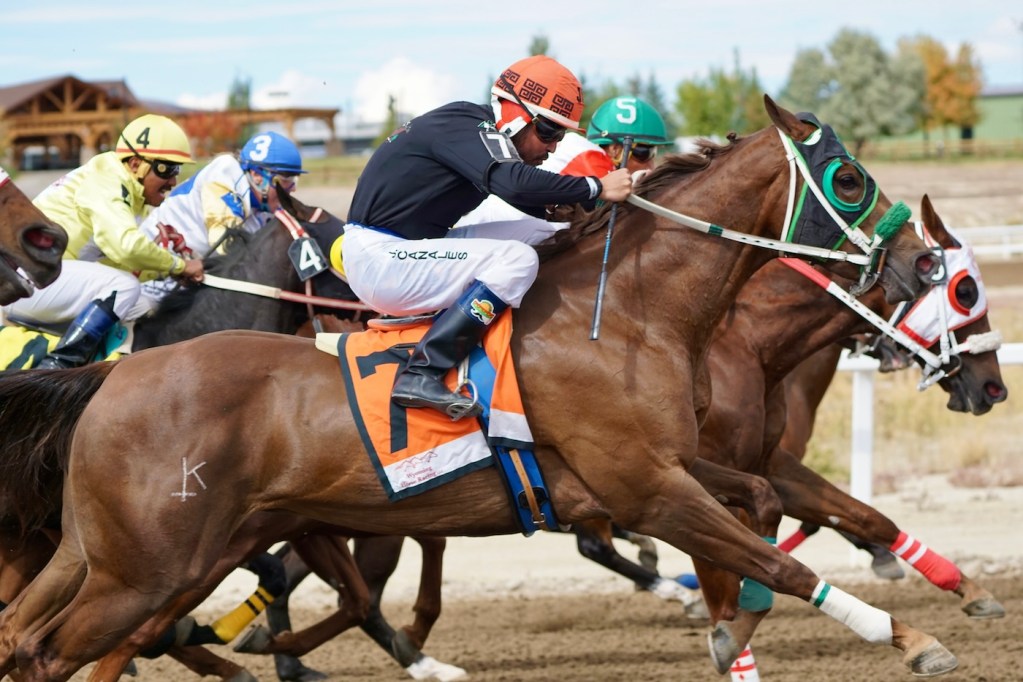

Once folks came to understand the abuse of the horses being raced, lower attendance and public pressure closed the tracks at Gold Gate and Pleasanton CA.
Horses are run to young, drugs are used regularly, horses dying at the tracks regularly, make horse racing a sport that is not controlled and only done for the money. There is no animal welfare!
Once the horse stops making money, it’s off to the kill buyers and then tortured shipping and abhorrent killing in Mexican slaughter houses.
Look at the bigger picture to understand what horse racing really is now.
I’m in favor of live horse racing. I think it would be fun to go to a horse race. I’ve never been to one. I mean, there are many the Kentucky Derby and on and on. I guess we’re getting a horse track out at Hillsdale area. looking forward to going to it And betting on a horse. As far as the poor people are betting so what they were poor when they went in will probably be poor when they come out their adults let them make their own decision. Some of them might win a couple bucks. Something else for the public to enjoy.