

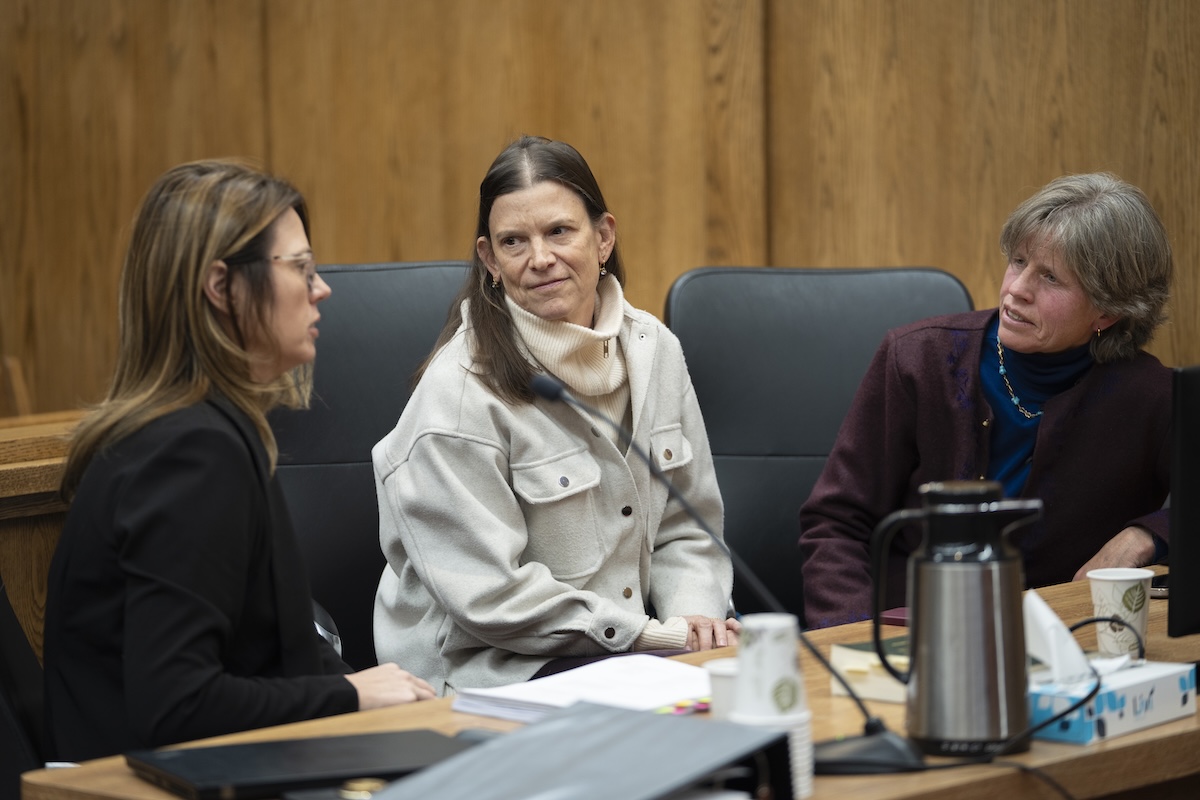
Jackson OB-GYN Giovannina Anthony received a text Wednesday from a fellow Jackson obstetrician asking her if she could see a patient. The patient, who was five weeks and three days pregnant, was seeking an abortion. The other obstetrician couldn’t get her in.
Anthony, however, is out of the country and won’t return until next week. But by that time, she said, the patient “is past the six-week mark.”
And Wyoming’s newly signed Human Heartbeat Act could very well make abortion after that point illegal.
The law prohibits abortions, except in the case of a medical emergency, if the fetus has a detectable heartbeat, which can occur as early as six weeks. If abortion providers fail to make a determination of a fetal heartbeat, they could face up to five years in prison or a fine up to $10,000 plus loss of license.
Gov. Mark Gordon signed the measure into law Monday, warning that the legislation would likely extend a legal battle over abortion’s constitutionality that began in 2022. On Tuesday, the same group of abortion rights advocates who successfully defeated Wyoming’s abortion bans in January filed a new legal challenge against the state, asserting the heartbeat law is unconstitutional. (Anthony is one of the plaintiffs.)
The legal challenge asserts that the Human Heartbeat Act “involves the same fundamental problem as the prior laws before the Court,” in that it “transgresses the constitutional guarantee” of individuals’ ability “to make health care decisions without interference from the government.” The plaintiffs asked a state judge to block the new law while the legal challenge proceeds.
In the meantime, Anthony said the new law’s combination of vagueness and “draconian” penalties creates what she calls a trap law for providers.
“Trap laws create a scenario where you’re like, ‘wow, it’s just not worth it,’” she said.
Speaker of the House Chip Neiman, a staunchly pro-life Hulett Republican and sponsor of the bill, championed it as a lawful restriction of a practice he would like to abolish entirely.
Between the huge risk for medical professionals and the tight time window — many women do not realize they are pregnant in the first six weeks — Neiman’s Heartbeat Act accomplishes his overriding goal, critics say, because it’s a de facto ban.
“Clearly, almost no one is able to access abortion care within Wyoming borders at this time,” said Janean Forsyth, executive director of Chelsea’s Fund, an organization that helps pay for abortion services. “It’s so rare that someone, No. 1, would know they were pregnant at six weeks,” she said. Then to be able to “figure out the appointment, the travel, child care and access that care,” before the heartbeat is detectable, she said, isn’t feasible.
Chelsea’s Fund, which is also a plaintiff, supports around 30 people per month in accessing abortion care in Jackson or Casper, Forsyth said.
With this new law, she said, “I would say we’re looking at between 20 and 30 people a month, either not getting the care they need or having to travel way more. And those are only the folks that need financial assistance from Chelsea’s Fund.”
Wellspring Health Access in Casper, the state’s only medication and procedural abortion clinic, and another plaintiff, will continue to see patients “in a greatly reduced capacity during this period,” according to a GoFundMe page set up to support the clinic during the legal fight. “We need support to support our staff while we are unable to see patients in a regular capacity,” the page reads.
Court decision and constitutional amendment
The new abortion restriction comes in the wake of January’s Wyoming Supreme Court decision that struck down two 2023 anti-abortion bans as unconstitutional. Central to arguments challenging those laws is a 2012 amendment to the Wyoming Constitution that protects people’s rights to make their own health care decisions.
In deciding the case, “all five Wyoming Supreme Court justices agreed that the decision whether to terminate or continue a pregnancy is a woman’s own health care decision protected by Article 1, Section 38,” the court’s summary stated.
Following the decision, Gordon called on the Legislature to pass a constitutional amendment during the session and deliver it to his desk. That way, he said, Wyoming voters could settle the matter once and for all and the state could take the matter out of the courts.

A constitutional amendment bill related to abortion failed introduction in the Senate, however. The measure would have asked voters to amend the Wyoming Constitution to empower the Legislature to define health care.
Neiman’s bill did gain traction, however. The legislator doesn’t view the court decision as a reflection of his state, he said when presenting the bill in Cheyenne.
“I believe that, based on Wyoming’s history of being very pro-life and always supporting life issues, that that is not actually the determination of the people of the state of Wyoming,” Neiman said.
The bill passed the Legislature with relative ease. When Gordon signed it, however, he did so with caveats about the law’s durability in light of the January court decision.
“Regrettably, this Act represents another well-intentioned but likely fragile legal effort with significant risk of ending in the courts rather than in lasting, durable policy,” Gordon said in a statement. “Rather than finding a remedy that saves the unborn, I fear we have only added another chapter to the sad saga of repeatedly trying to force a specific solution.”

Still, anti-abortion activists celebrated. Wyoming Family Alliance called it “a huge win for life” in a Facebook post.
“But we also know this is not the finish line,” the post read. “At Wyoming Family Alliance, we believe every unborn child deserves protection from the moment of conception, and we will keep working until abortion becomes unthinkable in Wyoming. Today, we celebrate a major step toward that goal.”
A day later, plaintiffs filed their new legal challenge.
Practical limitations
In terms of determining a fetal heartbeat, the act states that it “shall be made using standard medical practices and techniques, including ultrasound measurement if necessary.”
The most accurate method for early detection of a fetal heartbeat is a transvaginal ultrasound, in which a wand-like transducer is inserted into a woman’s vagina. After around seven to eight weeks, depending on the pregnancy, a less-invasive abdominal ultrasound or handheld doppler can detect a heartbeat.
Gordon vetoed a bill in 2025 that would have required patients seeking abortion medications to first undergo a transvaginal ultrasound and a 48-hour waiting period. Gordon and others objected to the invasive nature of the procedure, among other things. (The Legislature later overrode Gordon’s veto, and that law is now tied up in the courts.)
“He came out and said, and rightly so, ‘that’s traumatizing to a lot of people, and unnecessary,’” Forsyth of Chelsea’s Fund said.
Even if a woman discovers she is pregnant before that six-week point, Wellspring Health Access Executive Director Katie Knutter testified to lawmakers in Cheyenne during discussion on the bill, research shows factors like distance, poverty, youth and lack of access often force delays.
“Across the U.S., over 60% of abortions take place at or after six weeks,” Knutter said. “This means that this law would effectively ban the majority of abortions.”
For providers, the law’s gray areas create a morass of legal questions around abortion care, Anthony said. For example, she said, what if a pregnant patient came in experiencing heavy bleeding and miscarrying, “but there’s still a heartbeat on ultrasound.” Then the choice would be providing the care necessary to stop the bleeding at the risk of a felony, she said.
“The ban does give this very vague medical exception,” Anthony continued. “But who’s willing to make that call when the state could come back and say, ‘Hey, you, you ended this pregnancy with a heartbeat present and that patient wasn’t sick enough.’”
Without court intervention, Forsyth worries Wyoming will follow in the footsteps of Idaho, which lost roughly one-third of its OB-GYNs following abortion bans. Maternity care gaps have widened in Wyoming with the closure of several labor and delivery services.
“This could really hurt our state, not only abortion seekers, but anyone seeking reproductive health care,” Forsyth said.


Reproductive Rights are Human Rights. True freedom includes freedom to make your own heath and reproductive decisions. This law can only do harm to women and does nothing to ensure proper care, nutrition and education for the children pro-life illusionists claim to advocate for. This leaves pregnant women on their own; if they have life threatening pregnancy complications, they better be able to prove it beyond a reasonable doubt or take their chances. The christian slight of hand; advocate for the unborn, who don’t complain, don’t have an agenda, and who are born after the required 9 months and can be quickly forgotten.
The same politicians that once again voted down a program to feed hungry kids in the summer also push for more hungry kids. Also, if I read correctly there is no exception for rape or incest. Truly our politicians treat their livestock better than women and children in this state. There is nothing Christian in Christian nationalism.
“Abortion providers: Wyoming’s heartbeat law creates untenable hardships”
What else would someone in the Abortion business say?
Chipper thinks he’s God. He, and the other freedumb caucus christian nationalists need to be voted out. I see where Jeanette Ward is trying to sneak back into office. She will push the same unfreedom, fake christian ideas.
Gordon, do you realize that branches of Islam and Orthodox Judaism that also oppose abortion except in the cases where the mothers life is in danger?
It’s about human LIFE, and many people of different religions dont believe that it is disposable.
So what
Good old Chip Neiman, the guy who takes campaign donations in the Speaker’s office, is so moral that he gets to tell everyone how to determine their own healthcare. How long is it going to take for these legislators to realize that they swore to uphold the Constitution and not their own version of the bible.
Never. Christian nationalism is their goal. Cheered on by the fake piousness of the freedumb caucus.
“I like your Christ, i do not like your christians” -not determined
Mahatma Gandhi. The full quote: “I like your Christ, I do not like your Christians. Your Christians are so unlike your Christ.”
Gandhi was expressing his admiration for Jesus’ teachings, particularly the Sermon on the Mount, while criticizing the hypocrisy and lack of Christ-like behavior he perceived in Western Christians and colonialists.
https://www.snopes.com/fact-check/did-gandhi-say-this-about-christians/
I’ve often attributed it to ghandi as well. Regardless of who first said it, it still rings true. Fake christians are hypocrites… the pro-birth crowd are included.
Chuck, how about people that are pro-human being?
Would you have said slavery abolitionists were “fake Christians” because they were standing up for Human Beings that many considered to not be???