

Author's Note:
Like many of you here in the Cowboy State, I’ve spent much of the last year thinking, writing and speaking about the importance of public lands. I always thought their importance was self-evident, and that no one would dream of selling them to the highest bidder. I was wrong. They are squarely fixed in the crosshairs of scheming politicians and their sycophants who would do just that without a second thought. It will be up to us to deny them this evil. But in the meantime, let us renew our bodies and our spirits by being out there on these lands. This is the first in a series featuring some places that are important to me. I share them with you now so that you can share them with your friends and family. This is the only way we can hope to keep them.
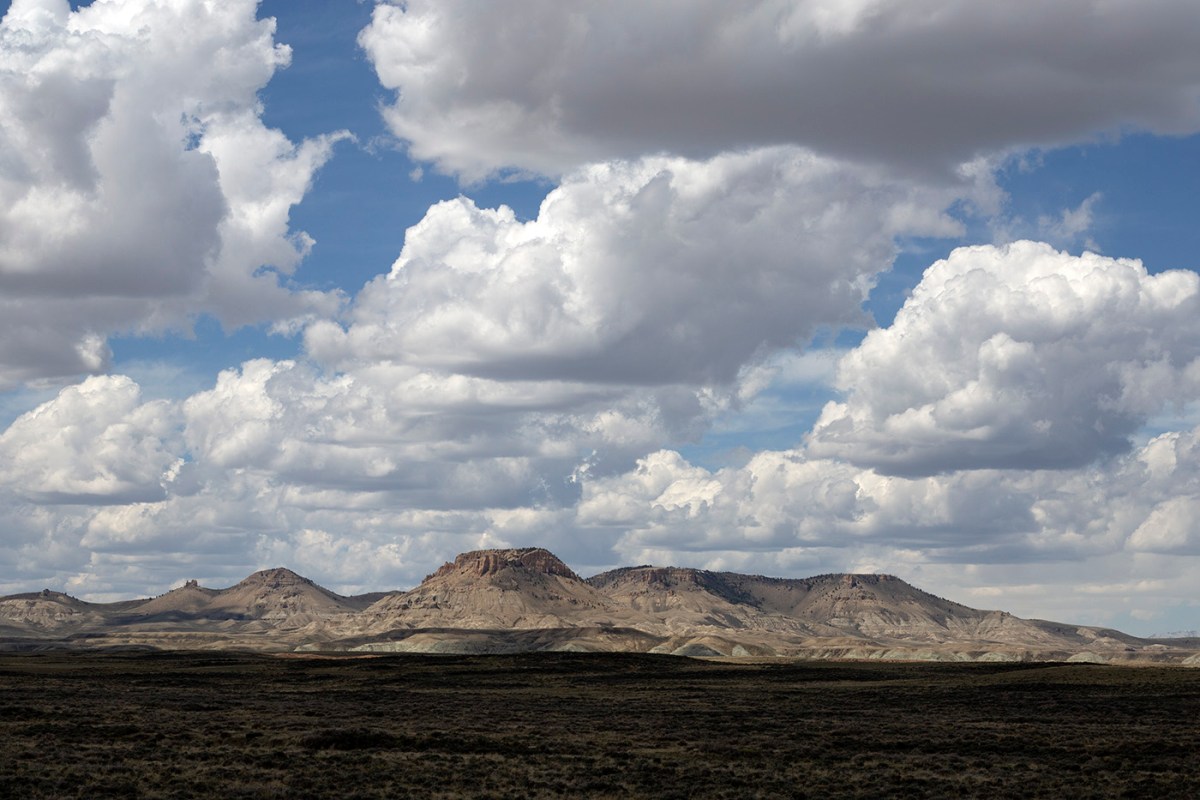
On the crown of the continent just west of South Pass, the Oregon Buttes rise like battlements out of the vast sagebrush sea. My friends speak of them as being part of eastern Gassonistan, my family’s homeland in this hard country. The Shoshone people knew them well, as did the old-timers like Jedediah Smith and Benjamin Bonneville. Travelers on the Oregon-California and Mormon trails steered by these landmarks in the days long before maps on your phone, or even maps folded up haphazardly on your dashboard.
Opinion
I don’t remember the first time I went to the Oregon Buttes. But I remember getting up long before daylight, when the nights were just beginning to turn cool in late summer. I remember the smell of coffee from my dad’s thermos and the green glow from the dashboard of the pickup on his face as Old Gus and I headed out into the night. The moon was still out as we drove through Rock Springs and up the highway, bearing right at Farson before leaving the highway just shy of the Sweetwater. Even in the mid-20th century, the roads were few and far between here. So were the people. They were rough and rutted.
Sometimes the creek crossings were washed out after a rain, and even a short cloudburst could turn them into greasy gumbo mud. But we had shovels, tire chains, two spare tires and lots of food and drinking water. The desert kept a hard school, but it was my father’s alma mater. When the dawn came to the sagebrush sea, it was like no place on earth.
There were sage grouse in the country then, but they were still called sage chickens. And there were a lot of them. In southwestern Wyoming, the opening day of sage chicken season was, to a 10-year-old boy in the mid-1960s, at least as good as Christmas. It might have been as good as Christmas, my birthday and Easter all rolled up in one. It was the first hunt of the year, usually in late August. We hunted in the early morning when the birds were moving to and from water. It’s cool at that time of day in the desert, and the smell of the sagebrush was intoxicating. The excitement of the first hunt of the season was like fire in my soul. I still remember the smell of the gunpowder and the feel of the dead birds, warm in my hand. We’d see maybe 200 or 300 birds on a good day in those years. It’s hard to see more than two or three bunches now. I haven’t killed one in years.
Not all our trips were hunting trips. The old man liked to go to Oregon Buttes just about any time of year. One time, we were headed up the west side of the north butte, and the old man was far in the lead. My legs were shorter then, and I was huffing and puffing as I brought up the rear. When I finally caught up with him, he was puzzled. He had just seen a small mammal unlike anything we’d ever seen before in our part of the country. It wasn’t a weasel, but it was sort of weasel shaped. It wasn’t a raccoon, but it had rings on its tail. We went home and looked through the field guide, finally concluding that it was a ringtail (Bassariscus astutus). These members of the raccoon family are common in Utah and Arizona, but way out of their element this far north in Wyoming. What the poor ringtail was doing on Oregon Buttes is still beyond me, but he and Gus met pretty much eyeball to eyeball, and it was hard to tell who was more surprised. Old Gus loved the critters of the desert.
For me, I love the little seeps and springs, the fragile tendrils of green that wind through the gray monochrome of the northern Red Desert country. These muddy little waterholes and miniature streams are the arteries that support life in the desert. If you fly over this wild country at 30,000 feet, especially in the late summer, it’s rough and gray-brown like the hide of some enormous beast. But those little green tendrils stand out. Tiny little seeps bubble up from deep in the earth and make up the capillaries that feed the larger gullies to form the veins and arteries – the circulatory system that sustains this harsh landscape.
They have sustained it for time out of mind. From the first people living in pit houses, hunting and gathering to make a living, to the Shoshone people who knew every inch of it, people have been on this land for a long time. It’s easy to feel a kinship with them when you take the time there to shed the layers of 21st-century living. You feel them there, with the elk and the antelope and the spirits of the long-gone buffalo. If you just sit quietly and alone, you can still feel the magic of the place. You feel it in the silence, in the night so dark you can see the stars from horizon to horizon. You feel it in the chill of the sunrise, and in the great emptiness as it is revealed by the morning light.
The magic of the desert country is in its great loneliness. It is the great, silent emptiness of the place that has drawn us there for years. It is the chance to feel small in the overwhelming scope of the land. Those of us who have always known it have probably taken that quality for granted. But how many places are there in America where you can still feel this small? Feeling small is humbling, and 21st-century Americans struggle to find humility. But I wonder sometimes if an occasional reminder of our own insignificance might not be just what we need.
Oregon Buttes: 42.26076, -108.85133
Leave WY 28 just south of the Sweetwater Rest Area. Head southeast on the county road about nine miles. It’s not like you can miss them. You can get there in any vehicle when the weather is good. You’re on your own if it’s not. Bring plenty of water and appropriate clothing.

Great article Walt. You bring out experiences that many of us who live in Wyoming have experienced. From Horse Cock Butte to Sunlight Basin; from the Med Bows to the Wind Rivers…..I can’t think of what Wyoming would be like without public lands.