

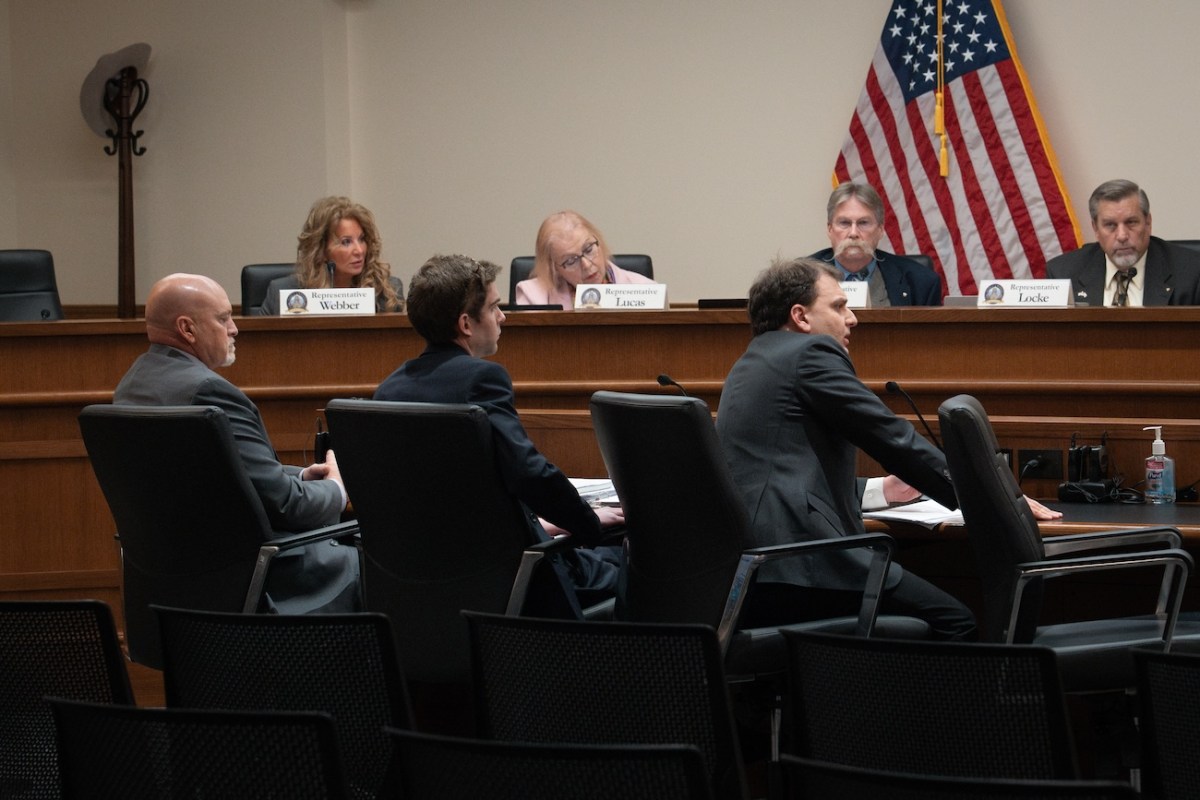
As the earliest stages of Wyoming’s 2032 redistricting process get underway, state lawmakers showed little interest in calls from Secretary of State Chuck Gray to immediately reexamine electoral boundaries.
The Wyoming Legislature’s Joint Corporations, Elections and Political Subdivisions Committee declined to take action at its Friday meeting in Lander.
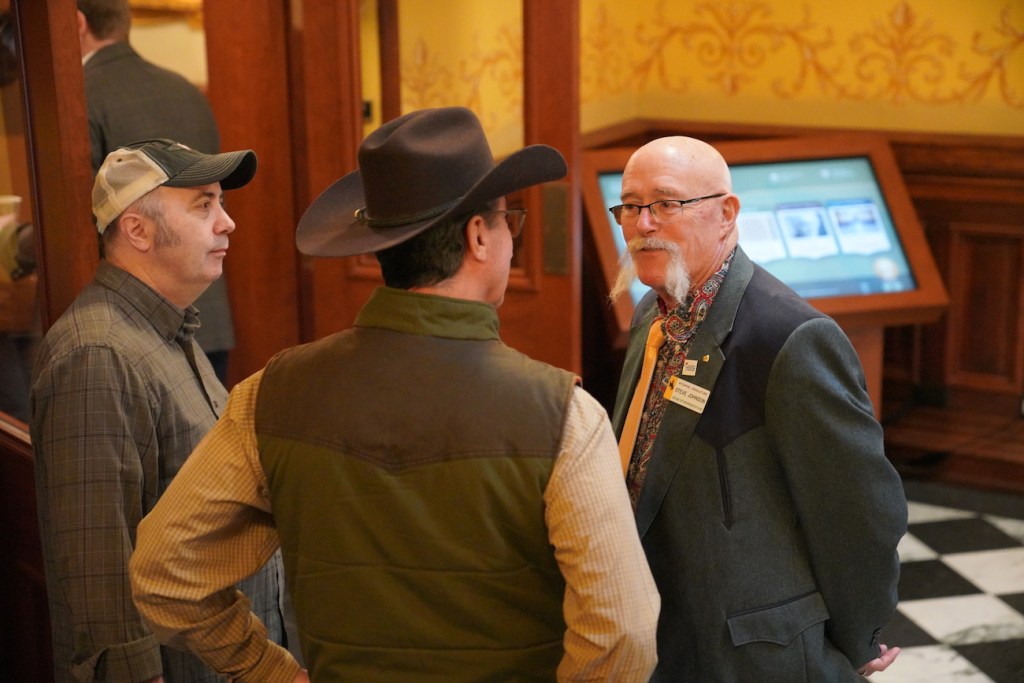
“I think we’re better off to not poke the dog, the sleeping dog. And just let it go,” Rep. Steve Johnson, R-Cheyenne, said at the meeting.
In recent letters to the Fremont County Commission and Gov. Mark Gordon, Gray pointed to a recent U.S. Supreme Court decision, which narrowed states’ ability to use race as a determining factor in creating election districts. Gray argues that certain maps that overlap with the Wind River Indian Reservation ought to be reexamined now in light of that ruling. More specifically, Gray is taking aim at the Fremont County Commission’s district maps and House District 33, which is represented by the sole Indigenous member serving in the Legislature, Rep. Ivan Posey, D-Fort Washakie.
Business councils for the Eastern Shoshone and the Northern Arapaho tribes have since denounced Gray for what they call a “direct attack on Native voting.” Some attendees at the meeting held up signs, pushing back on the secretary.
Gray has stopped short of demanding the governor either suspend the primary election or call a special legislative session — two things southern GOP-controlled states have done in response to the ruling. Instead, Gray has criticized the governor for not taking action. He can now criticize lawmakers for that, too.
“My recommendation would be: take a deep breath. For all of us to think about this. Weigh it. Have lots of public input,” Senate Corporations Committee Chairman Cale Case, R-Lander, said at the meeting. “It took us a year or more to redistrict the state of Wyoming.”
Case, who represents Senate District 25 and the Wind River Indian Reservation, said the committee had several options, including waiting to sort things out during the next redistricting process.
Like Case, Rep. Mike Yin, D-Jackson, pointed out that changing the boundaries of one House district would upend the rest of the Legislature’s map. Besides, Yin said, he’d already completed the task Gray had requested.
“To answer the secretary’s letter directly, I examined [the U.S. Supreme Court ruling] and I examined our maps. And I find them to be in compliance,” Yin said.
“I would suggest that we just put this topic to bed and leave it as is because we have plenty of other bills to work on,” Yin said, referring to the topics the committee has been tasked with during the legislative off-season.
Pointing to another discussion surrounding the constitutionality of the Legislature’s maps, Rep. Johnson said, “I would tend to agree with my colleague from the other side of the aisle that we need to just let this go.”
With one exception, the public testimony was either explicitly against Gray’s proposal or encouraged the committee to proceed with caution.
Rep. Nina Webber, R-Cody, asked that the topic be carried over to the committee’s next meeting, “just as a ‘let’s revisit it.’” Otherwise, the committee put the discussion aside.
Meanwhile, the process for refreshing the state’s legislative maps in 2032 is beginning. The Legislative Service Office updated the committee Friday on its work with the federal government to create census blocks, which function as the smallest geographical unit collected by the federal government.
When it comes time for lawmakers to begin drawing maps in 2030, census blocks function as the building blocks. And as roads and developments are built and people move around the state, those census blocks must be updated to give lawmakers greater flexibility in drawing maps that accurately reflect their communities.
The county commission
Wyoming law gives county commissions the latitude to use a district, at-large or hybrid system. Under a district system, commissioners represent certain areas within a county. In comparison, at-large commissioners represent the entire county.
Since 2010, when a federal court judge ruled in favor of five enrolled Eastern Shoshone and Northern Arapaho members, the Fremont County Commission has used a district system.
In Large v. Fremont County, the plaintiffs argued that the at-large system diluted Native American voting strength and violated the federal Voting Rights Act. Ultimately, the court ruled in their favor.
However, Gray is asking the commission to revert to an at-large district, arguing that the U.S. Supreme Court’s recent ruling in Louisiana v. Callais makes the district system unconstitutional.
After receiving Gray’s letter, the commission referred it to the Wyoming Attorney General’s Office for guidance. In the meantime, at least one lawmaker at the meeting made it clear they were uninterested in revising the statute.
“I have no interest in changing that statute, nor do I have any interest in telling the county commission what they have to or have to not do,” Yin said.
Doug Thompson, a former county commissioner and a defendant in Large v. Fremont County, spoke at Friday’s meeting. He urged caution.
“My counsel for all who will listen is: Take your time,” Thompson said. “Don’t jump one way or the other. Don’t say no districts. Don’t say at-large. Don’t do either one. Because this is a complex issue.”
Northern Arapaho Business Council Chairman Keenan Groesbeck and Eastern Shoshone Councilman Clinton Glick both told the committee not to take action to remake the commission or the legislative electoral map.
The Legislature
The other electoral map Gray takes exception to is House District 33, which stretches across Fremont County and encompasses the tribal towns of Fort Washakie, Ethete and Arapahoe, as well as the small non-tribal communities of Atlantic City, Crowheart and Hudson.
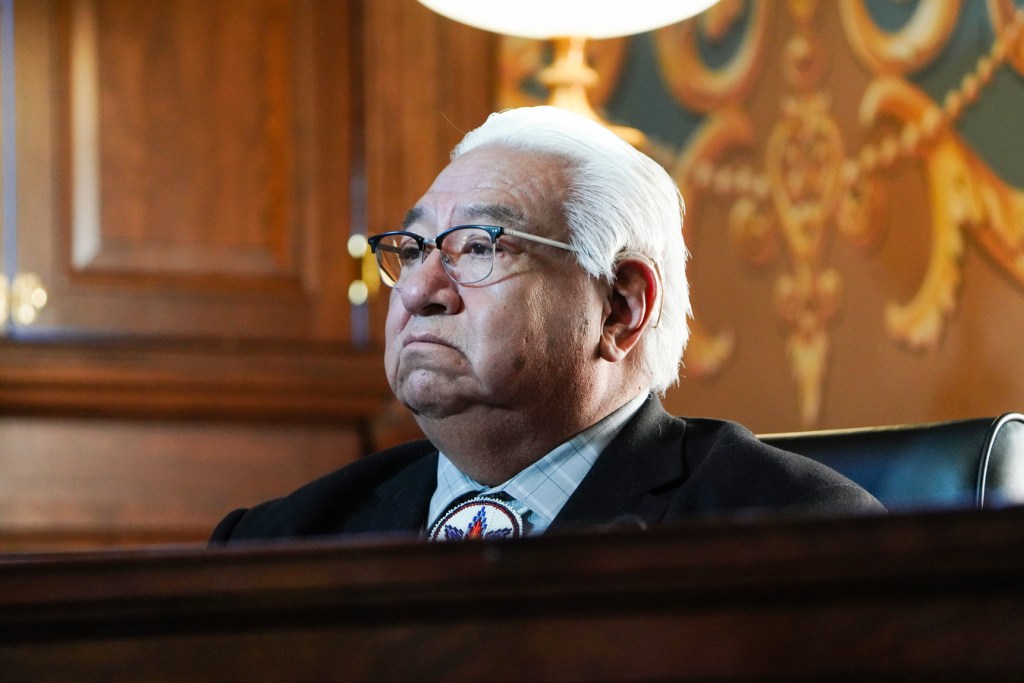
Several of the district’s constituents, including non-tribal members, attended the meeting and spoke in favor of the current maps, arguing that the boundaries weren’t simply drawn with consideration to race but also — and officially — to keep communities of interest, such as sovereign governments, intact.
“To suggest that this very narrow [U.S. Supreme Court] decision has this broad brush that requires you take some immediate action is not quite accurate,” Mark Harris, former Sweetwater County lawmaker, told the committee.
Harris served in the Legislature as it shifted from strict adherence to county boundaries and toward population, and as such, has direct knowledge of the 2001 legislative session “that essentially created House District 33 as it is today.”
“This district is based on community of interest and always has been,” he said.
The shift away from county alignment was spurred by a 1991 federal court ruling that Wyoming’s legislative maps violated the Equal Protection Clause of the U.S. Constitution — also known as “one person, one vote.”
Friday, Gray told the committee he doesn’t “think we should wait for a lawsuit to engage” in the examination of the state’s electoral maps.
Whether the Wyoming Attorney General’s Office agrees remains to be seen. The governor’s office previously told WyoFile it sent Gray’s letter there to be reviewed. Gordon himself has not offered an opinion about Gray’s call to reexamine electoral maps.

So one lone Native Representative is too much for Mr Grey? Good lord sir. What a pity. But I agree that it’s good that most of the rest of the legislators decided not to “poke the bear”. Sadly that seems the best we can hope for…..for now.💔🇺🇸
This reeks of another attempt by maga Gray to create distrust in our voting systems and smells of racism. The percentage of active voters is already shockingly very low. Can this bipartisan committee use its authority to encourage more voter engagement, especially for younger voters, in Wyoming? It’s their future on the ballot.
Will SoS Gray ever stop being a pest?
Gray is a clown and we the voters made Wyoming his circus. Won’t make same mistake twice, see you 8/18/2026, Chucky
Yup.
Gray reminds me of Don Quixote, always jousting with windmills, spurring old, worn out Rocinante like he is a mighty stallion, and pining for Dolcinea as if she is a Victoria Secrets model. Just pick any non-issue, and Gray is obsessed with it.
Thank you legislators for not be willing to take on this useless project. The intent seems mean spirited and self-serving for someone. There is much more the legislators need to be focusing on and do not need to take on busy work