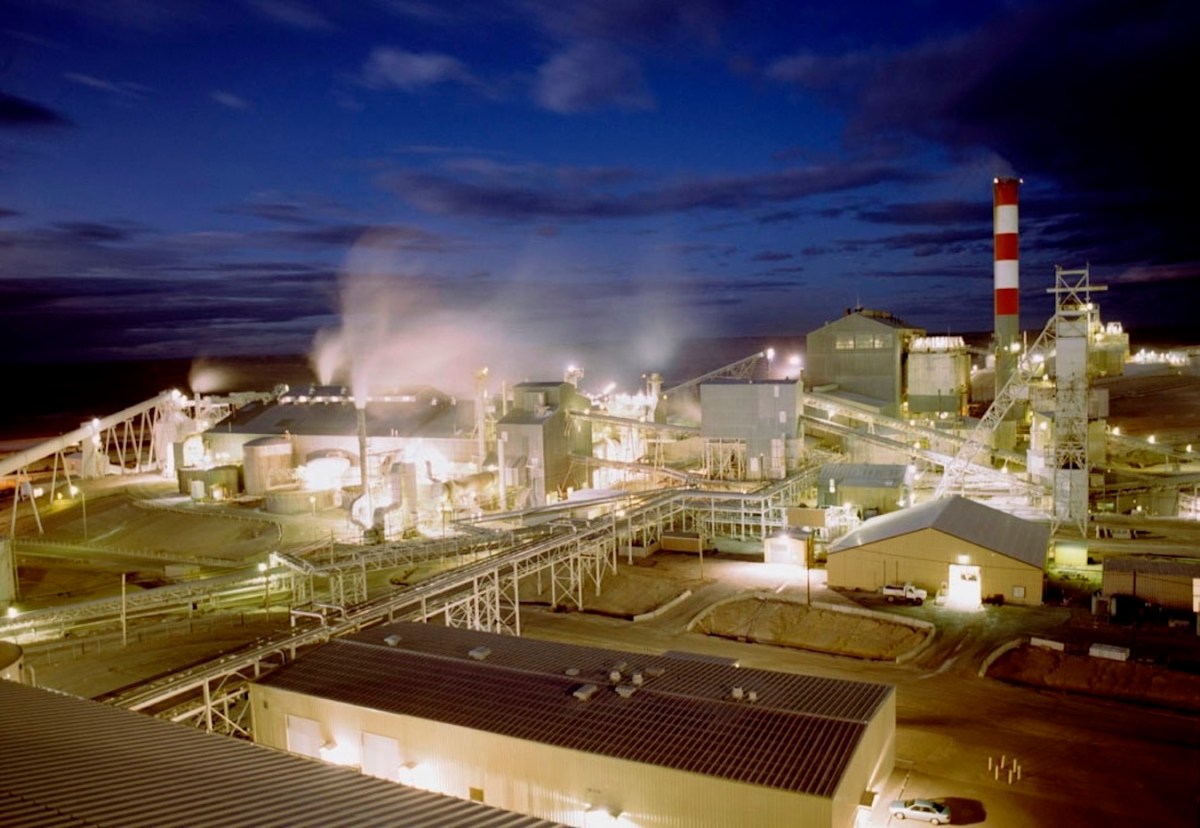
After decades of quietly chugging along as the state’s largest global export commodity, reaping an annual $1.3 billion, Wyoming’s trona mining and soda ash industry is navigating troubled waters.
In addition to diminishing demand — primarily for glass derived from soda ash — China, in only six years, built a super-efficient soda ash industry the size of Wyoming’s. In contrast, it took decades for the Cowboy State to corner 14% of the global market.
The industry employs some 2,500 people in Wyoming.
Now China’s flood of cheaper-to-produce soda ash — combined with softening demand, high transportation and rising material costs — is eroding margins for Wyoming’s industry clustered outside Green River in the southwest. Producers here are losing money on every ton of soda ash shipped to market, WE Soda CEO Alasdair Warren says, forcing many to delay ambitions for massive solution-mining expansions necessary to achieve efficiencies in an increasingly competitive global market.
Twice in recent years, WE Soda has pushed back the construction start time for its Project West solution mining expansion — once a $2.5 billion investment supporting hundreds of new jobs that’s now been scaled back into phases to weather the storm.
Pacific Soda has similarly tapped the brakes on a multi-billion-dollar expansion.

“There’s a lot of headwinds,” Warren told WyoFile. “Historically, any downturn in the industry had typically been resolved as demand picked up over 18 months. We’re now in year four, and it looks like it’s going to roll on for at least another couple of years. This is a long downturn.”
For now, the industry in Wyoming — which makes up the bulk of U.S. production — is in a holding pattern. Every operation is trying to operate as efficiently as possible to avoid having to cut production. That’s both a market survival strategy to maintain clients, as well as a logistical one. Companies don’t want to cede a workforce that’s vital to future growth, and their aging facilities here simply weren’t built to run at vastly reduced capacities, Warren said.
In fact, if it weren’t for another soda ash producer’s shutdown and bankruptcy reorganization this year in California, he said, Wyoming producers might be weighing those difficult options today.
WyoFile spoke at length with Warren about changes, challenges and potential opportunities for an industry that has — for too long, according to Warren — avoided the spotlight. “It’s time to make some noise,” he said. Here’s an overview of that interview, which has been edited and condensed for readability.
WyoFile: What has fundamentally changed in the global soda ash market?
Warren: The pace of growth for soda ash, globally, has slowed because global economic activity has slowed. But it’s slowed most profoundly in China because there hasn’t been new construction there, and that has had significant knock-on effects for demand for soda ash. At the same time, new capacity additions have continued apace and, in fact, where those capacity additions have come — they have not been in Wyoming, or in Turkey — they’ve all come in China, and they’ve used a production method which is very low cost. It’s primary [greenfield] solution-mining. Nobody in Wyoming uses it today, and the consequence of that is we’re in a very significantly oversupplied market, which means that export prices — particularly into Southeast Asia, but to some extent, all export prices — are at or not far from all-time lows. So every Wyoming producer is losing money on every export ton, that’s not a sustainable position.
I don’t think it’s a Wyoming question or even a WE Soda or a Solvay or a Tata [Chemicals] or a Sisecam issue. This is a federal issue. Does the U.S. want to see the supply chain for soda ash controlled by the Chinese in the same way that it has so many others, when [China] sits on maybe 5% of the world’s trona resource? It cannot be that that’s what the United States wants. It can’t be good for U.S. industry jobs, anything.
WyoFile: You say that Wyoming’s industry needs more greenfield solution mining expansions to stay competitive in the long run, but what is it doing in the meantime?
Warren: We continue to try to do two things. One, continue to be disciplined and drive down the cost of manufacturing as well as the cost of delivering our products. [Getting Wyoming soda ash to sea ports includes expensive railroad fees.] We’ve also spent a lot of time working with our customers to try to figure out better products and solutions that solve their needs, to create greater margin opportunities.
WyoFile: What about the longer-term strategy of more greenfield solution mining in Wyoming?
Warren: If you were to measure the quality of the purity of the trona, Wyoming’s the best in the world. No question. Thickest beds, highest purity, highest quality. But what China’s got in its pocket is more modern [facilities] that can produce a lower cost-of-production, and it can get it on a ship at a lower cost. So when you look at quality-of-product, everybody pretty much produces to the same [client specifications]. It’s how you get it out of the ground effectively. That’s why this solution mining is important. Because there’s a lot of maintenance cost and reliability issues you get with operating old [facilities]. You need the latest generation [of technology] like the Chinese have built in solution mining, like we built in Turkey. It would work perfectly here, but that’s billions of dollars of investment.

WyoFile: So how does Wyoming’s industry get there?
Warren: I think this requires a strategic response at a state and federal level, as much as it does at a company level, to decide what we want this industry to look like in 10 years’ time. It’s supporting investment. The great thing about the United States is that there’s access to huge amounts of capital. But you’ve got to be able to do it in a way that the cost of that capital is attractive, so the returns on the project make sense in a low-pricing environment. It’s hard to get bankable financing right now. You could have [the Export-Import Bank of the United States], as an example, provide the lending. You could have tax breaks on that lending. You could find ways of ensuring that the [Union Pacific Railroad] is at least comparable with other commodities in North America, which would mean that the cost of transportation of soda ash would drop by two thirds. So there’s lots of things that could happen and, interestingly, you’re starting to see lots of different stakeholders talking about the same stuff. The unions are talking.
Everybody is facing similar problems, right? So I think there’s a groundswell that’s building, but at some point somebody’s got to make some decisions, and they need to be made, in my opinion, over the next year.