

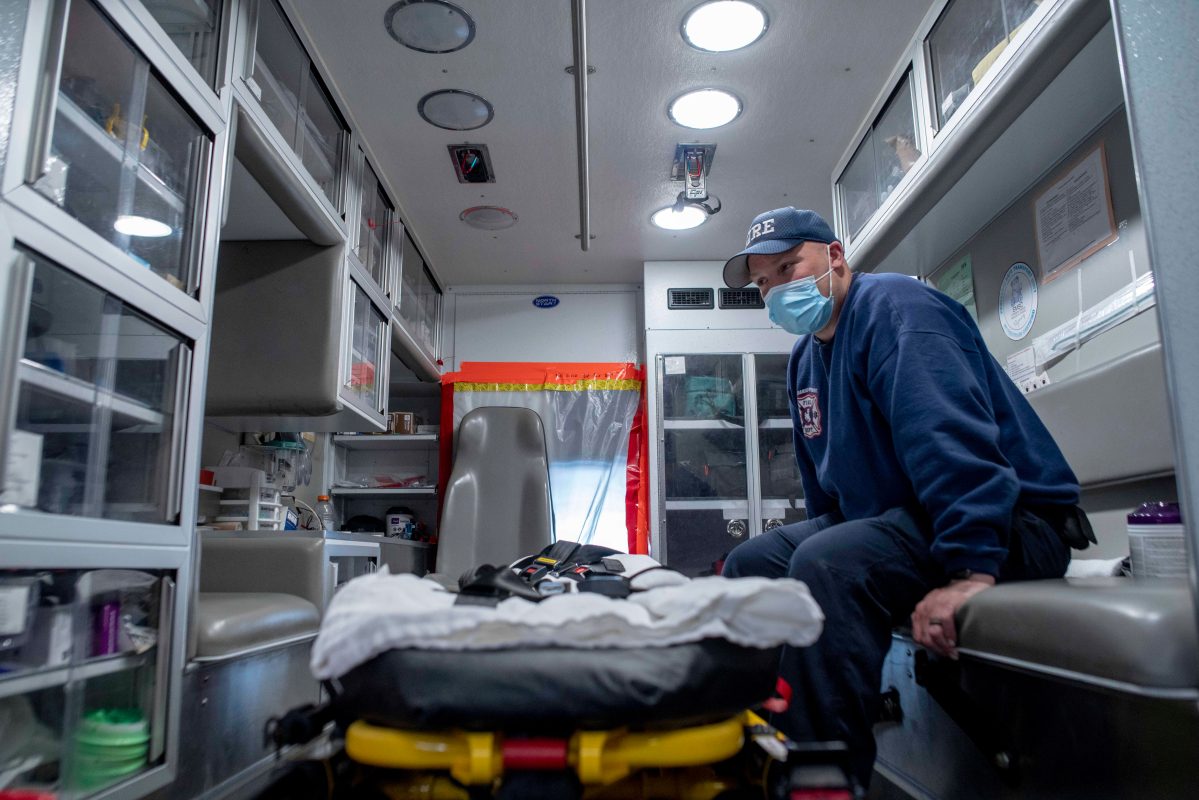
Spanning 8,000 square miles of sparsely populated southern Wyoming infamous for its brutal weather, Carbon County is a tough place to provide healthcare.
Memorial Hospital of Carbon County faces challenges experienced in much of Wyoming: low patient volume, high costs involved in 24/7 emergency care and difficulty recruiting and retaining a workforce. The Rawlins hospital in 2022 closed its labor and delivery services, and today local residents routinely drive 100 miles to Laramie for obstetrics.
Given these realities, Memorial Hospital CEO Kerry Ashmant said Friday, $5.8 million in Rural Health Transformation Program funds will have a significant impact. The federal dollars will bolster the hospital’s EMS services and help it deliver critical hemodialysis to patients with chronic illnesses, he said.
“For a rural hospital like ours, funding of this kind represents much more than financial assistance,” he said. “It represents a commitment to the people who call rural Wyoming home, to the families who depend on local healthcare and to the principle that access to essential medical services should not be determined by zip code.”
The hospital is among the clinics, ambulance services and workforce development programs that will benefit from the new federal program. Gov. Mark Gordon, U.S. Sen. John Barrasso and healthcare officials on Friday celebrated Wyoming’s $205 million in year-one awards, which were finalized barely a year after the state began to put together its application.
“I can’t believe the level of teamwork and thoughtfulness that’s gone into this in a super tight timeline,” said Matt Dammeyer, CEO of Memorial Hospital of Converse County in Douglas. His facility will receive more than $5 million for hospital and EMS services.

Given the tasks involved for Wyoming — including collecting public input, negotiating with federal administrators, getting legislation passed, publishing requests for proposals and assessing provider applications — it’s an impressive feat. It’s one that has required agility from the Wyoming Department of Health and others, Gov. Gordon said.
“We’ve moved very expeditiously,” he said.
Wyoming stands to receive up to $1 billion over the program’s five-year funding period, which advocates like Barrasso, an orthopedic surgeon who practiced in Casper, say will truly transform the state’s fragile rural health system. “We’re going to be able to work to improve high-quality care, close to home,” said Barrasso, who was a major champion of President Donald Trump’s “One Big Beautiful Bill Act” that created this initiative.
The Rural Health Transformation Program aims to offset some of the federal healthcare dollars cut by the act, which is expected to result in more uninsured Americans.
An additional challenge for Wyoming is finding ways to deploy program funds that will sustain beyond the five-year funding window. That is why Wyoming didn’t produce a wish list of shiny products and new buildings, said Department of Health Director Stefan Johansson, but focused on innovating around the basics.
“It’s very Wyoming,” he said. “Balance the ideal with the practical.”
Breaking down the awards
In its approval, the Centers for Medicare and Medicaid Services gave the Wyoming $5 million more than it requested — the second-largest award per capita, behind Alaska.
Wyoming’s original vision for how it could spend the federal dollars has evolved to fit federal rules as well as state lawmaker appetite. Notably, the state removed two core proposals: a system of “perpetuity” investments that could generate revenue for Wyoming healthcare programs indefinitely and a state-operated public catastrophic insurance plan.
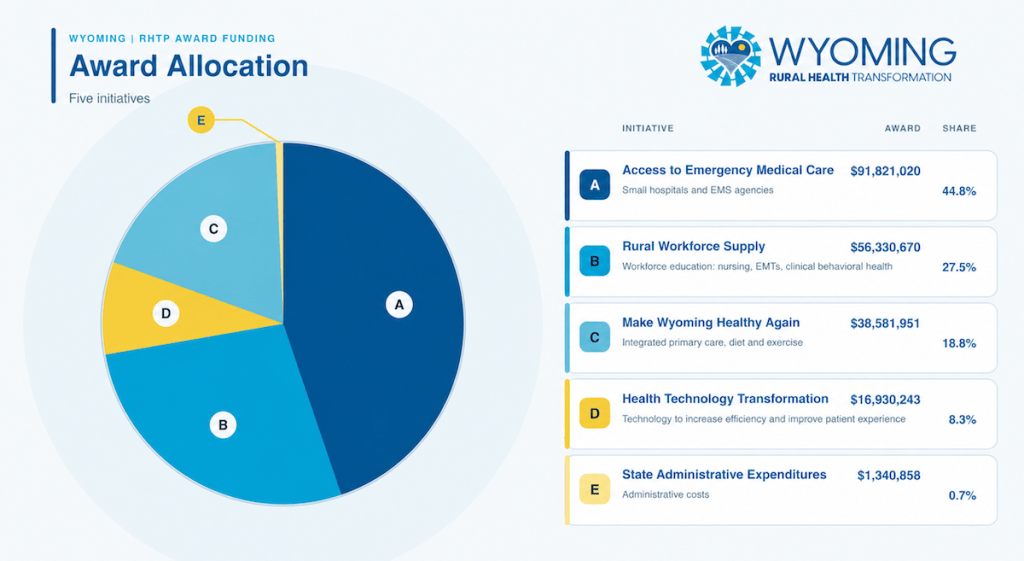
Of the award pie, Wyoming is serving the largest piece to initiatives under the category of “improving access to emergency medical care.” The $91.8 million slice aims to incentivize hospitals to provide essential basic services and to regionalize and strengthen EMS services.
Warm Valley Health Care in Fort Washakie, North Lincoln County Hospital District in Star Valley and Cody Regional Health are among significant award winners in that category.
The second-largest pie piece, $56.3 million, will support programs that increase rural workforce supply. These range from individual awards for education boosts to grants given to education organizations for expanding programs.
The Wyoming Innovation Partnership, a workforce development program Gordon launched in 2021, will act as the fiscal agent for the majority of this section. The partnership will invest more than $35 million into workforce projects. In addition, the University of Wyoming will receive $6.2 million for graduate medical education and the University of Utah will receive $9.3 million for a similar program.
The third-biggest pie slice, $38.6 million, will go to the “Make Wyoming Healthy Again” category. These programs aim to improve physical and behavioral health with interventions including integrated primary care, diet and exercise.
The final pie chunk, $16.9 million, will go toward transforming health technology. This will entail updating systems and employing telehealth to improve access. Along with individual awards to places like Evanston Regional Hospital and Powell Valley Health Care, the state will fund a statewide telehealth specialist program with $3.5 million.
Once a state advisory committee finished first-round award recommendations in August, there was $17.6 million leftover. The panel earmarked those to support targeted EMS and labor and delivery efforts, and Wyoming is partnering with the Wyoming Hospital Association to deploy the money.
Health department administrative costs will use 0.7% of the total award, which amounts to $1.3 million.
What’s next
Now that Wyoming has finalized its year-one funding obligations, it will move on to next steps in the program, which has unfolded with rapid and aggressive deadlines.
In year-two, Wyoming hopes to continue the work, officials said, with some expansion. The health department is also tasked with monitoring the deployment and reporting on outcomes to the federal government.
Recipients, meanwhile, are preparing to implement their awards.

Johnson County Hospital District will receive $4.8 million for technology.
“It’s going to be super meaningful for us,” Luke Senden, CEO at Johnson County Healthcare Center in Buffalo, said of the award. The facility currently functions by patching together three separate medical record systems, he said, which creates many inefficiencies.
“No one joins healthcare because they like paperwork and they like cumbersome processes,” Senden said. “The ability for our providers to have a unified system for each one of our patients, no matter what setting they’re in, is going to do so much for transforming the way that we deliver care inside of our community.”

