

[box type=”note”]NOTE: This is the third profile in a series on UW presidential candidates. Follow these links to read about candidates Laurie Nichols and Duane Nellis, and provide your input to trustees.[/box]
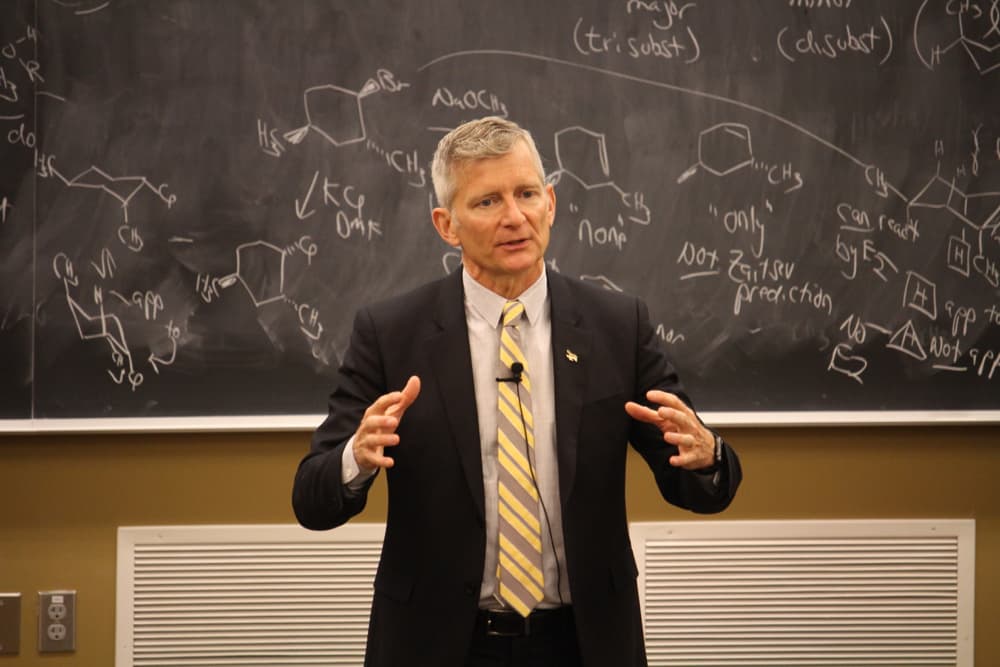
University of Wyoming presidential prospect Jeremy Haefner spoke to the benefits of an open search at the third and final public forum with candidates Monday. The provost from New York’s Rochester Institute of Technology said he liked meeting students and faculty in public.
“I love the inclusivity of this whole process,” Haefner said. “I want to know what kind of university I am getting involved with. … I got to learn a lot more about this university than if I didn’t go through this process.”
Faculty, students, and staff who participated in candidate forums held over the last two weeks at the campus in Laramie also liked the opportunity to meet and question the top three presidential candidates.
The open interview process contrasted with the 2013 search for UW president that hired Robert Sternberg before he had even visited campus. Sternberg served for five months before resigning amid criticism.
“It’s been very well-received,” Staff Senate president Arron Sullivent said of this year’s open search process. “In my opinion, I think it will help the general Wyoming community because everyone has had a chance to give input.”
Sullivent said the Staff Senate will give trustees feedback about candidates in a few days. The group plans to list strengths and weaknesses of each candidate, but won’t offer a numerical ranking or select a favorite.
The Faculty Senate will meet Wednesday to develop a similar report. Trustees hope to select UW’s next president after meeting Friday.
Mark Northam, the director of UW’s School of Energy Resources, said trustees have three strong candidates to choose from. “It’s a tough decision they are going to have to make,” Northam said. “Nobody’s perfect, and nobody’s a total write-off.”
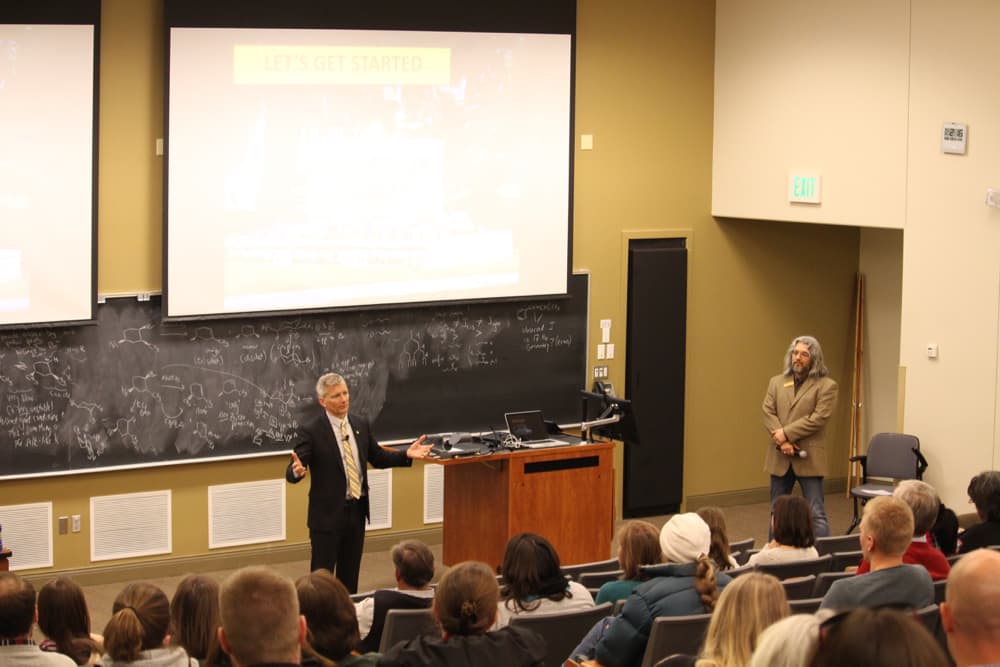
In delivering comments at Monday’s community forum, Haefner casually stood to the side of the lectern and spoke with a wireless mic. His slide presentation listed UW’s strengths, including that the school is the only four-year institution in the state.

“[Wyoming is] the only state in the union that has that characteristic,” Haefner said. “How cool is that? That’s what we call an unfair advantage.” With that advantage comes the responsibility for UW to be the “intellectual engine of the state,” he said.
Haefner’s academic expertise is in mathematics. He worked for 20 years at the University of Colorado-Colorado Springs, where he finished his service as dean of the College of Engineering and Applied Sciences in 2008.
While in that position the school won an award for increasing the number of women graduating with engineering degrees, and built a pipeline of prospective engineers that started in elementary schools, Haefner said.
Since 2008 Haefner he has served as provost at Rochester Institute of Technology in New York, a private school with 18,000 students, including 1,500 who are hearing-impaired.
“We have aspirations of having 20 student startup companies a year,” Haefner said of his RIT economic development programs. “They can put together a product, get funding from the university, go into our incubator, and then spin off and create jobs.”
UW has the potential to boost its economic development efforts, Haefner said. “A lot of businesses might be interested in being in proximity to the university,” Haefner said. “We can serve as a recruitment tool for the city of Laramie.”
Haefner used the word inclusivity to describe both his leadership style, and his approach for working with marginalized groups. As provost at RIT, he oversees a committee of students and faculty to address challenges facing the hearing-impaired.
Nationally, universities are having a “great dialog” on how to address the concerns of minority students, Haefner said. Administrators need to open lines of communication early so they can address concerns before they get out of hand.

“Some of the things that happened in Missouri happened because there wasn’t a mindset to deal with these kind of issues proactively,” said Haefner of the University of Missouri’s recent protests that made national headlines.
With the University of Wyoming facing a 5 percent budget cut under Gov. Matt Mead’s proposed budget, Haefner said he would work to improve compensation. The previous two candidates, Laurie Nichols and Duane Nellis, also made that promise.
“One of the shortcomings you’ve had over the last three years is consistent, powerful advocacy through the office of the president,” Haefner said. “You’ve made great progress over the last two weeks to select the president who will be a champion for [compensation.]”
As for UW’s open search, Haefner said he initially had some “trepidation” about how his colleagues in New York would respond to the news he was seeking the job at UW. Those fears were unfounded.
“I didn’t have anything to worry about,” Haefner said. “They were so supportive of me and they of course expressed reservations about having me leave.”
Nellis and Nichols also described having similar experiences of collegial support when the news broke that they were seeking UW’s presidency.
The open search process gave Haefner a chance to get to know UW, and see that the school is “willing to go somewhere great.” That benefits him as well as the school, he said.
“For me it has been a great experience, and richly rewarding … one worthy of the University of Wyoming.”
UPDATE: Faculty Senate summary of candidate attributes
In an interview with WyoFile, UW Faculty Senate president Tucker Readdy gave a synopsis of faculty impressions of each candidate, paraphrased in condensed form in the chart below. He stressed that candidates Laurie Nichols and Jeremy Haefner had “a balance” of support from faculty and there was no clear preference for either. Both of those candidates received higher reviews that Duane Nellis.



While I respect the academic freedoms that are inherent in an institution of higher learning, I also insist, as a tax payer, that the concurrent responsibilities of a tax payer supported institution be met, that is to produce graduates that are capable of entering the workforce with enhanced basic skills in reading, writing and ‘rithmatic and have inquiring minds that question everything, taking nothing for granted.
I feel that one of the greatest failures of today’s educational system is its inability to produce graduates with critical thinking skills, who tend to accept as true anything that is published in any form, instead of using the scientific method to question everything until it cannot be proved false. The world is awash with misinformation that is gaining far too much traction.
Additionally, I feel that while student input should certainly be considered, adults with life experience should be in charge. It is very common for students being exposed to higher learning to over estimate their actual knowledge as it applies to the real world experience. I should know as I am a college educated 72 year old retiree, who is watching his 35 year old attorney daughter, with 5 year old twin children, as she morphs.
Thank you for listening and allowing me to express my views.
George Spettigue