


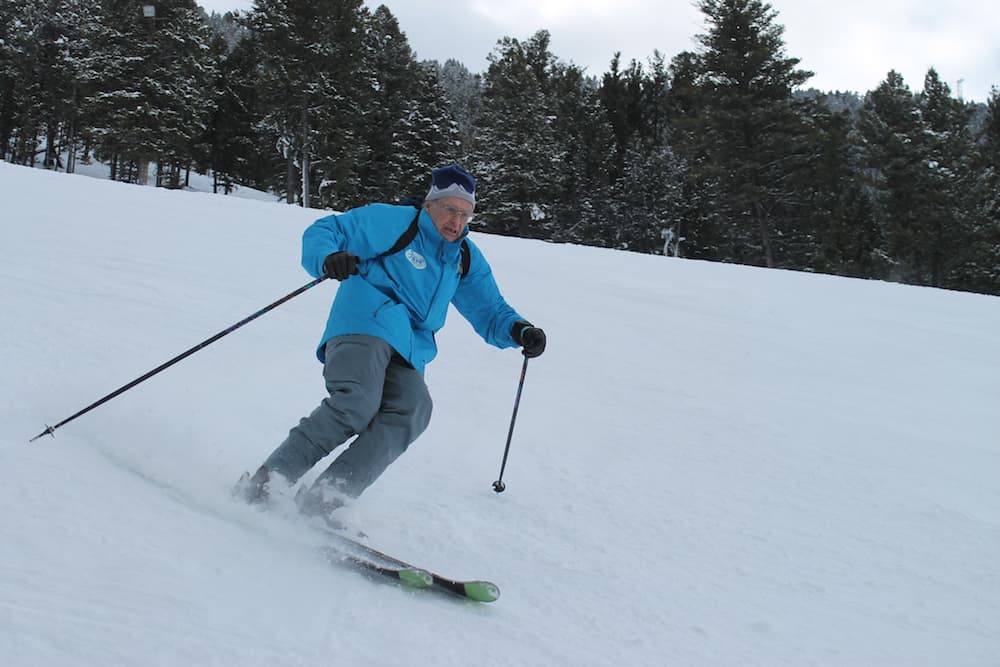
Ten years ago Sheila Sandubrae Davis was a self-taught skier. “It wasn’t pretty, but I could get down the mountain,” she said. Barely.
Two years later, however, she was teaching others to ski.
She is a product of legendary ski mountaineer Bill Briggs’ instructor clinic that he holds each week at Snow King Mountain in Jackson.
In June 1971, Briggs made history as he skied off the summit of the Grand Teton, jamming his edges into the hard crusted snow and making turns that would take him down the mountain and into the record books as the first to ski the towering peak.
A lesson with Briggs doesn’t prepare you for skiing the Grand. His program is for instructors who in turn will help beginners standing on skis for the first time, novices trying to develop from a wedge snowplow to a parallel turn, and intermediate skiers trying to move to steeper terrain.

“I have a mountain of knowledge and I’m trying to find a way to offload it,” Briggs said.
Briggs, 84, taught himself to ski when he was about 8 years old. He circled a pond near the family home in Maine then advanced to a hill above the cemetery where he carved turns to avoid grave markers.
In his early 20s Briggs took a ski instructor course on a whim with a friend and then started teaching at Sugarbush in Vermont.
Briggs was born without a hip socket and when he was 30, he had his hip fused into place. During the time of his surgery and his recovery, he started thinking about teaching and why some students didn’t improve in his ski classes. It began a mental shift for Briggs.
When he returned to teaching he went back to the basics with his pupils — as far back as he needed to go to find tasks students could complete easily and successfully. It could be as simple as gliding on a ski on flat ground. He built upon each movement, but without an explanation of how it would all fit together. They didn’t know what bigger skill they were learning until they were carving turns.
This is instructing, not teaching, Briggs said. It’s a nuance he’s adamant about and one he says made all the difference. It’s a philosophy he brought with him when he started instructing at Snow King in 1965.
He purchased the ski school in 1967. Until recently Briggs still worked with students. He now only works with instructors, running a clinic every Sunday on the hill. There are always at least a few that show up, sometimes as many as 10.
Briggs used Sandubrae Davis as an example during his lessons on teaching novice skiers. He totally re-taught her how to ski, starting from the very beginning, never skipping a step no matter how basic it seemed.
“He’s a skiing genius,” she said. “He understands every movement. You master each part and then all of a sudden you’ve mastered a skill.
Sandubrae Davis has been teaching at Snow King now for eight years. She still attends his weekly instructor clinics and she learns something each time that helps her as both an instructor and a skier. “I’m skiing stuff now I never thought I’d be able to,” she said.

Her husband John Davis has attended Briggs’ clinics for about 13 years, as long as he’s been a ski instructor. It was Briggs who encouraged him join the ski school.
Even though he’s been to hundreds of Briggs’ clinics, he still learns something he uses in his classes.
Briggs’ method is different than others in that it starts at the very beginning, showing kids how to carry their skis to the hill.
Davis has known Briggs for more than 40 years. He is of course aware of Briggs’ impressive resume, which in addition to the first descent of the Grand also includes a famous 100-mile ski traverse of the Bugaboos and a place in the U.S. Ski and Snowboard Hall of Fame. He knows he’s learning from a legend. “I consider it a privilege to have been taught by Bill Briggs,” he said.
Skiing is an evolving sport and even after all these years, Briggs still tweaks his instruction plans and adapts to the changing times.
What doesn’t change is how he instructs, using the small progressions, emphasizing the difference between teaching and instructing.
It might not be as flashy as a descent of a major peak, but Briggs sees it as part of his legacy and contribution to the future of the sport.

Bill taught me back in 1968.
]
I remember the Teton Tea Parties in the Climbers Campground in the early 1960’s and Bill Briggs singing, yodeling and banjo strumming while we drank Teton Tea into the wee hours of the morning.