

Wyoming and other Upper Colorado River Basin states would be spared mandatory cuts, while the Lower Basin states — Arizona, Nevada and California — face significant water use reductions under a new federal proposal for future management of the beleaguered western water system.
The U.S. Department of the Interior issued Friday its final environmental impact statement, guiding how water will be divided during a shortage. The rare federal intervention came after stakeholder states and tribes failed, so far, to agree on a plan of their own. The current drought contingency plan, which is intended to prevent Lake Powell and Lake Mead from shrinking below “minimum power pool” — the point where water releases won’t flow through electric-generating turbines — expires at the end of this year.

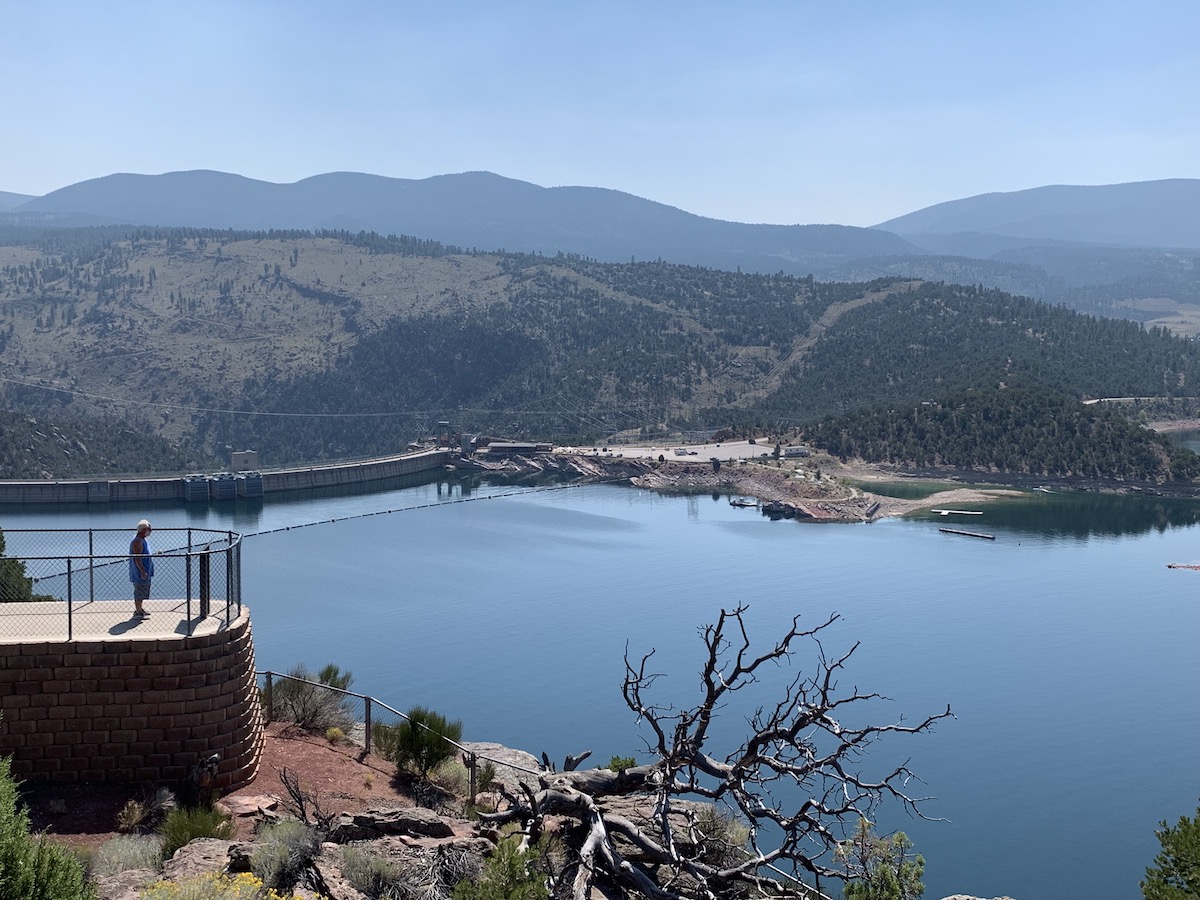
The new federal plan, administered by the Bureau of Reclamation, could force an annual reduction of 3 million acre-feet of water consumed by Lower Basin states, depending on the severity of the water shortage. Upper Basin states avoid mandatory cuts — at least in the short-term — but would have to collectively conserve up to 200,000 acre-feet annually. The plan also calls on Flaming Gorge Reservoir, which straddles the Wyoming-Utah border, to remain a primary backup, potentially tapped for up to 1 million acre-feet of extra annual water releases, according to federal documents.
Federal officials appear to have been swayed by a particular argument from the Upper Basin states regarding the split in water-use reductions, according to some analysts. Because they are headwater states, their farmers, ranchers and other water users already suffer significant cutbacks in times of drought because they generally get what Mother Nature delivers, whereas the Lower Basin states reap the benefits of balancing deliveries via a network of reservoir storage.
“While the final details are still being analyzed by Upper Division States, we are encouraged that new operating guidelines will better reflect existing water supply, which must underpin any practicable plan going forward,” Gov. Mark Gordon and his fellow Upper Basin state governors said in a joint statement Friday.
Wyoming State Engineer Brandon Gebhart put a finer point on the division of the federal government’s and Mother Nature’s authorities.
“In the Upper Basin, water use is already limited by available supply, administered under state law, and the Secretary [of Interior] does not have comparable authority to mandate reductions,” Gebhart told WyoFile via email. “That does not mean the Upper Basin has no responsibilities — it means those responsibilities are carried out through different mechanisms, including reservoir operations, state-led programs and collaborative efforts to maintain system reliability.”
Wyoming and the other Upper Basin states are advancing water conservation efforts to improve long-term resilience for the river system, Gebhart added.
Historically low snowpack this past winter, combined with a searing heat wave across much of the West, has wreaked havoc on the Colorado River system, sapping it to just 32% capacity, according to federal data. Lake Powell measured 23% capacity on Sunday while Lake Mead measured 27%.
Lake Powell is expected to continue shrinking this year, despite reduced releases and extra flows from upstream Flaming Gorge, according to the Bureau of Reclamation.
“The combined contents of Lake Powell and Lake Mead have not been this low since before Glen Canyon Dam began filling in 1963, and since 2000 water use has exceeded total system inflow in most years,” the agency stated in a press release Friday.
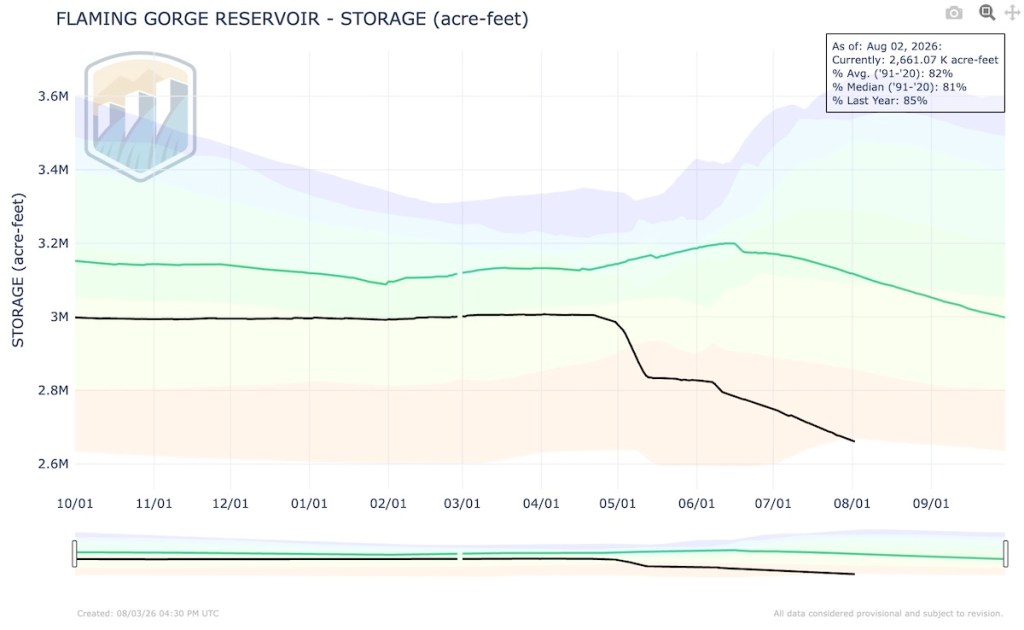
In coordination with the Upper Basin states, the bureau announced in April it would release up to 1 million additional acre-feet of water from Flaming Gorge through April 2027. At the time, water managers predicted the extra release would drop the reservoir by about 35 feet to a capacity of 59%.
Barring a last-minute agreement among Colorado River stakeholders, the Interior is expected to issue a record of decision later this year that would put into motion a 10-year drought contingency plan.
“We are witnessing the lowest reservoir levels in the Colorado River System’s history and there is no guarantee regarding the future water supply,” Gordon and his Upper Basin counterparts said in a prepared statement. “Today’s framework does not represent a final solution, but enables the river to be managed in the short-term while the seven states and [Department of Interior] continue to negotiate a consensus solution.”

It would appear we are going to be stuck with lower water levels at Flaming Gorge for quite a while to come. As such, the state needs to lengthen a number of boat ramps on the Wyoming side. If they don’t and we are forced to launch at Lucerne, we will also be forced to take an online mandatory Utah class on AIS and purchase a Utah non resident AIS sticker, even if we only boat in Utah for the 200 yards it takes us to get back into Wyoming. Those are the facts and folks need to get hold of the governor and let him know.
We Wyomingites should be rightly proud that we are doing our part to assure Arizona’s 461 golf courses have enough water ( even if only 59 of those courses are fully public links). Plus the 50+ additional golf clubs in greater Las Vegas NV that depend on water from our Upper Green River. And let’s not forget that 60 percent of Colorado River water used in Arizona is for forage crops… hay and alfalfa… out there in former desert land.
Please conveniently ignore that all 180,000 acres of cotton farmed in Arizona cannot be sold anywhere near a profit , costing 90 cents a pound to produce but sells for 60 cents a pound at the entry level commodity market.
In fact, if you play ‘ Follow The Money ‘ in the Lower States of the Colorado Basin by following the water, you find that a lot of it simply doesn’t pencil out . The archetypal explorer of the Colorado River – John Wesley Powell who included both botanist and sociologist in his resumé – warned us back in the 1870’s that any attempt to commercially irrigate the Southwest Desert would be a losing proposition. Seems we haven’t learned much about wise water management in the ensuing 150 years as we went about colonizing the cactus with 40 million thirsty hominids and their livestock.
Thank you for this perspective on several issues. Being informed and following the money: best ways to understand and to make policy for the common good!
“That does not mean the Upper Basin has no responsibilities — it means those responsibilities are carried out through different mechanisms, including reservoir operations, state-led programs and collaborative efforts to maintain system reliability.”
In a place like Wyoming where the Beaver used to store water on the land, create wildlife habitat, enhance ground water recharge and create fire breaks, prior to their wholesale slaughter in the early 1800s and instead of learning or correcting that wholesale slaughter, Wyoming Game and Fish collects approximately $140,000 dollars a year from those that continue to eradicate this keystone species from our lands. Then a bunch of ranchers want our public lands and tax dollars on the order of hundreds of millions of dollars to pour concrete pools all over Wyoming to replicate what Beavers would do naturally.
Strive on for the control of nature is won not given. We are one stupid species and we do not deserve to get off this 3rd rock from the sun.