

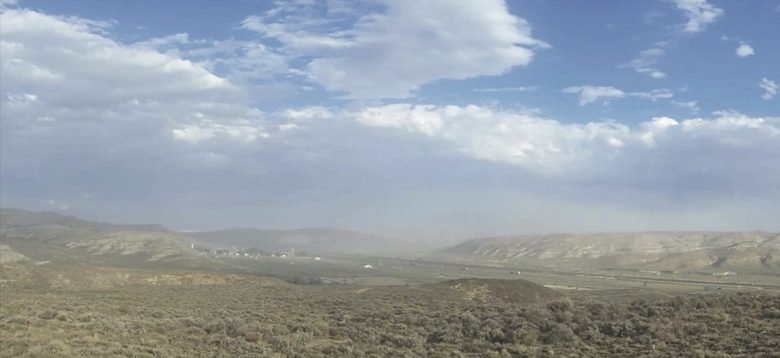
ROCK SPRINGS—The Wyoming Department of Environmental Quality has initiated an investigation into the Jim Bridger Power Plant and a foul smell that seems to be coming from the plant’s evaporation ponds.
Residents living near the power plant have considered the operation a good neighbor, but over the last 12 to 18 months, an increasingly foul odor resembling sewer gas and rotten sulfur has left the nearby communities of Superior and Point of Rocks demanding action.
Residents and an elected official took their concerns over air quality and environmental impacts stemming from the industrial evaporation ponds at the plant — and the foul odor and white powder that is allegedly coming from the ponds — and reached out to the DEQ.
‘Unbearable’ smell
For Point of Rocks resident Roger Varley, whose family has lived in the area for 60 years, the change in air quality has altered daily life.
“All they had to do was open the windows and let the fresh, cool air in,” Varley said of his parents’ home, which lacked air conditioning. “We can’t do that now. It smells like rotten sulfur, and it’s unbearable. I have a 3-year-old granddaughter, and I’d like her to breathe fresh air.”
While the plant has maintained a strong relationship with the community for many years, the management of its wastewater and evaporation ponds has become a major sticking point, Varley said.
The industrial evaporation ponds hold liquid waste, including wastewater and soda liquor — a concentrated alkaline solution used in plant scrubbing operations, he said. Because of the massive volume of water present, relying on natural evaporation to dry out the beds so heavy equipment can drive on and cap them could take decades.
“There are days we feel we can’t live like this,” Varley said, stressing that engineers and specialists must account for the immediate human impact on small communities as they find solutions. “I’d like them to reassure us that it’s temporary.”
Superior Mayor Dominic Wolf said he received his first complaint regarding the smell roughly a year to a year and a half ago. Since then, the issues have escalated from sporadic nuisances to an ongoing problem.
“You notice the bad sewer smell more when the wind blows,” Wolf said, noting visiting construction crews at first thought the odor was a sewer backup.
The smell became particularly severe in late July, prompting Wolf to reach out to state regulators directly.
“We’ve been doing a water study for the last couple of months, and the crew said they couldn’t stand the smell. So I had enough and called the DEQ,” Wolf said. “I just wanted to be proactive and make sure everything’s protected.”
Wolf expressed worry for plant workers breathing the fumes daily, as well as local wildlife, noting a recent influx of sage grouse in the area.
He said he hopes everyone’s involvement will help bring health and environmental risks back down to safe levels, restoring peace of mind to residents.
Sweetwater County Board of Commissioners Chair Keaton West said Wolf reached out to the commission. The commission contacted the DEQ Air Quality to put its officials in touch with Wolf and also forwarded Wolf the contact information for the Air Compliance Inspector in Lander.
“Our latest understanding was that an investigation was initiated and inspectors would likely be out soon,” West said. “Although this is a DEQ matter, we share the same concerns for health and safety and want to ensure residents and workers in the area are safe and well-informed.”
In response to public inquiries, the Wyoming DEQ emphasized the importance of community involvement when environmental concerns arise.
Keith Guille, outreach manager, said it is crucial for residents and local leaders to reach out whenever something seems amiss.
“It’s our job to ensure the public is safe from the type of things that we regulate, but if we’re not the regulatory agency on that, we try to work with other partners as well,” Guille said. “If there’s ever a concern or something they see doesn’t make sense, they can always reach out to us, and we will definitely look into it.”
According to Guille, the DEQ has initiated an investigation. The Wyoming Oil and Gas Conservation Commission will be involved as well.
The DEQ acknowledged reports of a white powdery substance blowing over several areas. Guille said the smell and the substance are not connected.
Soda liquor is a concentrated liquid solution made of alkaline chemicals — typically sodium carbonate (soda ash) or sodium hydroxide (caustic soda), Guille said.
In local industrial uses, such as coal-fired power plants, it is used as a neutralizing liquid in flue gas scrubbers to strip sulfur dioxide (SO2) out of power plant exhaust before smoke leaves the stack. It creates a white powder when soda liquor spills or drains into evaporation ponds and dries out. High winds can whip up the leftover dry crust, dispersing a fine white, dusty powder across the area.
Guille said while soda liquor residue creates the visible white powder blown by wind, state regulators note it is odorless, meaning any separate sulfury or “rotten egg” smells in the area stem from a different source.
Jona Whitesides, a spokesperson for Rocky Mountain Power, said he was unaware of an upcoming investigation but noted the utility regularly coordinates with the DEQ, as waste streams and ash ponds require continuous monitoring.
“The smell has been on and off since the ‘80s,” Whitesides said. “Anytime you have a power plant and the scrubbers remove the sulfur dioxide and other pollutants from the exhaust, it doesn’t eliminate the odor, so you get that smell.”
He added that wind direction and weather conditions can make the odor stronger on given days.
“There are pros and cons to living near a power plant,” Whitesides said. “Your electricity is close and it employs a good workforce, and then there’s the smell from coal and other industry smells — it is an industrial facility.”
Whitesides said to remain environmentally conscious and comply with state and federal laws, scrubbers on the coal units actively strip sulfur dioxide and other pollutants from exhaust, which naturally generates a sulfur smell.


I am a Superior resident, the odor is increasing and getting worse. Then the wind hits and creates dust so bad that the hills and grasslands are coated in it, which can’t be good for anyone, let alone the wild life that eat the grasses. HUGE PROBLEM
That is like being a farmer or a baker and the smell of the end products. Every nutritionist tells you to eat your greens eat more Broccoli… but dang those farmers 🥦fields stink to high heaven. But the smell of a fresh Donut or Maple bar is delightful 🥯 especially to the pot head like Cheech or Chong who just inhaled their favorite skunk smelling blunt. C’mon man can’t we just all get along 🍻🏁🇺🇸
What point are you trying to make?