


With more than 2,500 animals, the Whiskey Mountain bighorn sheep herd was once the world’s largest and the most renowned in the Lower 48, said Steve Kilpatrick, executive director of the Wyoming Wild Sheep Foundation.
The sheep, which live near Dubois, were nationally important and used as a source for transplants throughout the West, said Daryl Lutz, the Lander region wildlife management coordinator for Wyoming Game and Fish Department.
Then pneumonia hit. A 1991 outbreak decimated the herd, killing about 30 percent of the animals. Normally a herd will recover to at least 80 percent of its original numbers after such an incident, but the Whiskey Mountain herd continued to decline, Kilpatrick said.
“For more than 20 years, we’ve wondered why won’t this herd get on its feet and get going again,” Kilpatrick said.
Now he has reason to hope he’ll soon have an answer.
A group of wildlife organizations — Wyoming Game and Fish, the Wyoming Wild Sheep Foundation, the National Bighorn Sheep Interpretive Center and the University of Wyoming’s Ruckelshaus Institute are partnering in an effort to learn more about the herd and help it thrive.
“Bighorn sheep are iconic and represent the wildness and the wonder of Wyoming,” Kilpatrick said.
They are also frail, sensitive ungulates, whose immune systems can’t fight pneumonia, often introduced by domestic sheep.
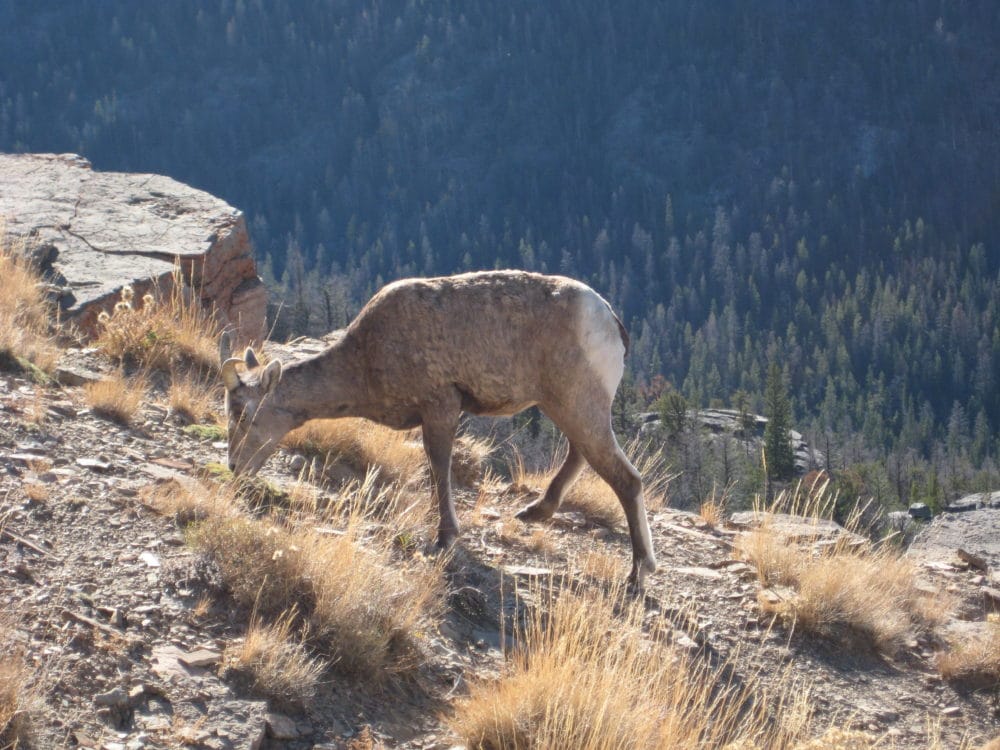
Today the Whiskey Mountain herd has about 750 animals, Lutz said.
“Lamb survival has been about nil in the last few years,” he said.
Ewes in the herd have about an 80 percent pregnancy rate, but in recent years, most of the young have died by late fall, he said.
Several different strains of the pneumonia-causing bacteria have been found in the herd. Adult sheep can harbor the pathogens and pass them to lambs, which aren’t strong enough to survive the disease, Lutz said.
The Whiskey Mountain ewes are also smaller than those in other herds, Kilpatrick said. The animals don’t put on the 25 percent body fat sheep in other herds acquire in the summer. Lack of maternal mass can lead to smaller-than-average lambs.
“Why aren’t these sheep doing well in the summer, when it appears they are in a rich nutritional environment?” Kilpatrick said. “A comprehensive look at nutrition, disease and possible genetics would help us out a lot.”
A University of Wyoming study, which began this week, will provide some of that needed data, researchers hope. The study will collar ewes and fit them with vaginally implanted transmitters. The transmitters will come out when the sheep give birth, alerting researchers who will then try to collar the lamb. Ideally the collared lamb will survive to adulthood. But if it dies, the scientists can find the collar immediately and determine the cause of death, Lutz said.
This intensive study is only one piece of the collaboration. The groups will work on community engagement with people in Dubois and also bring together bighorn sheep experts from around North America for a summit.
Never Miss a Peaks to Plains. Subscribe for free.
“I hope we come up with some novel solutions and untested ideas,” Lutz said.
The Whiskey Mountain herd isn’t the only wild sheep population in decline. In the 1960s there were tens of thousands of bighorn sheep in Wyoming and an estimated 1.5 million in the West, Kilpatrick said. There are now about 6,500 in the state and 85,000 in the region.
What’s learned studying the Whiskey Mountain herd can be used to help manage other sheep populations — pneumonia was recently discovered in Dall sheep in Alaska, Lutz said.
“If we can understand why [the Whiskey Mountain] herd is so dramatically affected by these bacteria then we may have a better understanding of the ecology and the disease effects on curled-horned, mountain sheep throughout the continent,” Lutz said.
It’s also helpful for wildlife managers to know what problem they are trying to solve, Kilpatrick said. For example, if the collaboration discovers an issue related to available nutrition, managers could employ prescribed burns to provide forage, he said.
Lutz said within a year he expected some tangible results from the collaboration, but helping the herd was a long-term process that will take years.


Kelsey
How can we help with this study.
Curtis King
President, North American Pack Goat Association.