

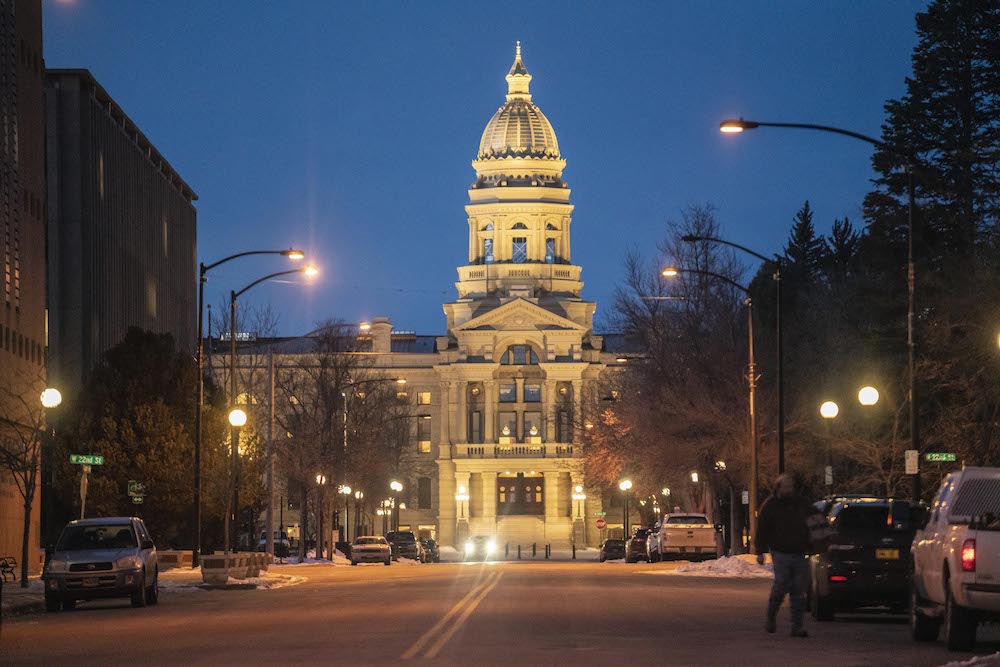
In his July 2019 remarks during the re-opening ceremony for the renovated Capitol building, former Gov. Matt Mead declared the building to be “The People’s House.” Current Gov. Mark Gordon stated that as an elected official, he “walked into the building with … a sense of obligation and a sense of duty to the people of Wyoming… ”
Some members of our state Legislature apparently see the building in which they serve and their duty as elected officials differently from Govs. Mead and Gordon. They appear to be working to keep the Capitol from being “The People’s House” by actively preventing the public from meaningfully participating in the legislative process.
First, some background. When the Joint Corporations, Elections & Political Subdivisions Committee addressed net-metering — the law that allows for small-scale home renewable systems, such as rooftop solar — in the run-up to the 2020 legislative session, it followed the appropriate transparency practices.
Two bills came out of that process and were made available to the public. The committee’s agendas — published during the summer of 2019 — made it clear when the topic would be discussed and how the public could participate in the discussion.
As a result, the public was able early on to email state legislators to express their views on the topic and draft bills. They were also able to show up at the committee hearing prepared to testify. At that hearing, the room was packed, overflowing into the hall, with members of the public waiting to add their voice to the four hours of testimony, mostly in opposition to the proposed net-metering legislation. Those bills died due to this public engagement.
The process in 2019 was not totally balanced. Utility representatives were allowed to speak at length during the committee hearings, while members of the public, including small-scale-solar-business owners — folks who make their living off of solar in Wyoming — were allowed only two to three minutes to speak. Still, the committee handled the topic with transparency from the beginning.
In contrast, this year the topic of net-metering was never publicly noticed as part of the committee’s interim study agenda. Instead, the topic was first raised at the end of the committee’s second meeting in September — after the opportunity for public comment had closed. Then after formal motions and committee votes on two pieces of draft legislation involving wind taxes, the committee gave Rep. Danny Eyre (R-Lyman) the nod to draft a bill on net-metering for consideration at the committee’s November meeting.
There was no discussion about the content of the proposed bill, no formal motion made and no vote taken to allow Eyre to proceed.
Allowing a committee to bring up a new sponsored bill on net-metering at this late stage, without public notice or an opportunity for input from the public, violates the Legislature’s own guidelines for identifying and working on interim study topics.
The committee chair’s handbook states: “committees should be especially wary of requests late in the year from individual legislators (seeking added impetus for their personal bills) to take over sponsorship of bills which have not been the subject of committee study.” It further states: “Interim studies generally focus on ‘major’ problems or proposals which require significant research, discussion and opportunity for public comment.”
Contrary to these guidelines, the Joint Corporations Committee accepted the request of an individual legislator late in the year to bring up a new bill.
The public was then left in the dark about the contents of this new bill until just last week, when Rep. Eyre’s draft was posted on-line. The legislation does not reflect any public discussion or input from stakeholders from this interim and would effectively kill the rooftop solar economic sector of our state. The public’s only opportunity to participate will now come at the very end of this interim process, on the third and last day of this committee’s last meeting this year in an eight-month process.
Support civic discourse — donate to WyoFile today.
The committee knows from past experience that net-metering is an important topic to the public, small businesses and homeowners. Yet, the committee has preempted the public from meaningful participation, contrary to the legislature’s own guidelines.
To proceed with a bill with such lack of transparency raises the specter of a committee that does not want public comment, nor fair and robust involvement by the public. It raises the specter of a committee trying to slip legislation through while leaving the public in the dark.
Does the Joint Corporations Committee consider the public unwelcome in “The People’s House” when we are likely to show up to oppose a bill? Do the committee members have any sense of obligation or duty to the people of Wyoming to conduct legislative affairs openly and fairly and to invite our input into the process? What is happening in this legislative committee suggests the answers to these questions is a firm “no.”

It is exhausting to not just have to speak up for what should be an obvious good for the future of Wyoming but also to have to do it year after year on the same topics that we the people strongly objected to already & thought settled!
Here it is again: trying to take away a net metering system that is working perfectly. And tomorrow at the Oil & Gas Comm, another attempt to allow a company that will be bankrupt in a few years to use the Madison aquifer as their sewer.
Sadly I think that is the tactic: sneak it by quick, wear us out, hide the process, ignore the data, try it again & again or just plain break the rules. Honestly, boys, it is tedious.
It sounds like many of our legislators practice the old adage “it’s easier to seek forgiveness than to seek permission”. Or is it “Why bother the public? They elected us to make decisions for them.”
The numbering in this proposed bill is wonky, but as I read it the legislature intends to allow electric companies to “authorize” consumer generators, independent of the contract that they make with them. It isn’t clear to me that consumers will have the right to generate their own electricity independent of “authorization” by a privately-held company.
If recovering infrastructure costs “fairly” is really the issue, simply move all that cost recovery to the monthly fixed charges per household (raise the monthly fixed fee), and lower the retail rate.