


True to its species’ reputation, the undersized smallmouth bass lacked neither ambition nor aggression: The roughly 10-inch fish attacked a nine-inch streamer.
The Montana State University student who hooked it would later regret letting the bronzeback paddle away when he learned that the nonnative warmwater game fish had never been found so far upstream in the Yellowstone River watershed. He’d plucked this one from the Gardner River on the doorstep of Yellowstone National Park, where smallmouth could wreak havoc on native fisheries.
Todd Koel, Yellowstone’s supervisory fisheries biologist, heard about the historic catch from his son, and tracked the young man down to verify his location. “I spoke to the angler who provided a video of his catch that leaves no doubt where he was,” Koel wrote to federal and state fisheries biologists and conservationists in emails sent this week that were later acquired by WyoFile.

Yellowstone’s longtime Native Fish Conservation Program leader hinted at the gravity of the situation in the subject line: “Invasive Predatory Smallmouth Bass Caught from the Gardner River.”
“My understanding is that smallmouth don’t do well in waters colder than [50 degrees],” Koel wrote. “The problem is, of course, that Yellowstone has many warm waters similar to the Gardner.”
Koel described smallmouth potentially reaching one of Yellowstone’s premiere native cutthroat trout fisheries, the Lamar River system, as a “nightmare.” And he suggested that scenario is likely in the future.
“There is a good chance that smallmouth in the Yellowstone River will eventually be able to pass over Knowles Falls in the Black Canyon,” he wrote. “If that happens we will one day see them at Tower, the Buffalo Ranch, and the Slough Creek campground. This will be the only nonnative fish species in the park capable of preying upon semi-aquatic animals such as snakes or fledgling waterbirds.”
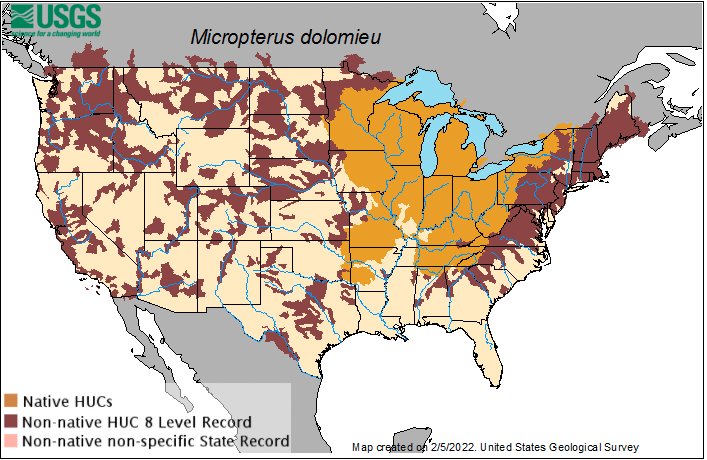
Smallmouth bass are native to eastern North America, including the Mississippi River basin, Great Lakes, Hudson Bay basin and St. Lawrence River watershed. They thrive in flowing water and are known for withstanding relatively cool water temperatures.
Often welcomed as a game fish where they don’t overlap with trout, introduced populations of smallmouth have spread across Wyoming. They’ve been observed in the Big Horn, North Platte, Powder, Upper Laramie and Green River basins, according to the U.S. Geological Survey.
The Montana State University student’s smallmouth catch at the confluence of the Gardner and Yellowstone rivers on Feb. 19 likely traces to a planned stocking more than a half century ago. Montana fisheries biologists dumped them into the lower Tongue River starting in 1966, outdoor writer Jack Ballard wrote in a 2017 edition of Montana Outdoors.
Smallmouth, a red-eyed sunfish cousin, have since steadily crept upstream, and there are now strong populations in the mainstem of the Yellowstone from Billings to the Powder River confluence. About five years ago Montana Fish, Wildlife and Parks caught one near Emigrant in Paradise Valley, but they’ve been more prevalent downstream near Big Timber and Laurel, Koel wrote in his email.
The angler’s catch at the Gardner, Yellowstone river confluence was just “a few feet” north of Yellowstone’s boundary, Koel wrote. Finding one there wasn’t a shocker to Cody resident Dave Sweet, a lifelong active member of Trout Unlimited’s East Yellowstone Chapter. He’s been a central figure in Yellowstone’s $2 million annual effort to knock back lake trout in Yellowstone Lake, where the exotic char crashed the population of native cutthroat trout.
“Obviously this doesn’t really mean impending doom by any stretch,” Sweet told WyoFile about the smallmouth catch. “It’s a slow process of moving upstream, but I hate to see it.”
Expansion, Sweet thought, was inevitable, as the water temperatures on the Yellowstone plateau become more agreeable to warmer-water species.
“There’s no way to stop that unless there’s a barrier in the way,” he said. “No matter what people think about global warming, the world is warming and our streams are warming.”
WyoFile was unable to reach Yellowstone officials for an interview Friday morning.


But will they eat other tourists? Seriously, consider the “trout” waters of Argentina, where introductions of “ornamental” willows in the BA area, as well as brown and rainbow trout, have reached to the Andes. Where now offspring of commercially raised salmon off Chile compete with “native” trout in the Esquel area, with the native puerco not even an afterthought. And then there’s the sheep industry ….
Throughout the 17th, 18th, and 19th centuries, angling authors, mostly British, some French, and later American, writing about trout fishing were writing about fishing for brown trout. Once brown trout were introduced into the U.S. in the 1880s, they became a major subject of American angling literature. In 1889, Frederic M. Halford, a British angler, author published Dry-Fly Fishing in Theory and Practice, a seminal work codifying a half century of evolution of fly fishing with floating flies for brown trout. In the late 19th century, American angler and writer Theodore Gordon, often called the “Father of American Dry Fly Fishing” perfected dry-fly techniques for the newly arrived, but difficult-to-catch brown trout in Catskill rivers such as the Beaverkill and Neversink Rivers.[28] In the early 20th century, British angler and author G. E. M. Skues pioneered nymphing techniques for brown trout on English chalk streams. His Minor Tactics of the Chalk Stream (1910) began a revolution in fly fishing techniques for trout.[29] In 1917, Scottish author Hamish Stuart published the first comprehensive text, The Book of The Sea Trout, specifically addressing angling techniques for the anadromous forms of brown trout.[30]
Photo of brown trout and fly rod on river bank
Firehole river brown trout
Introductions of brown trout into the American West created new angling opportunities, none so successful from an angling perspective as was the introduction of browns into the upper Firehole River in Yellowstone National Park in 1890.[31] One of the earliest accounts of trout fishing in the park is from Mary Trowbridge Townsend’s 1897 article in Outing Magazine “A Woman’s Trout Fishing in Yellowstone Park” in which she talks about catching the von Behr trout in the river: