

In the wake of a U.S. Supreme Court ruling that preserves a law giving preference to Indigenous families in foster care and adoption proceedings of Indigenous children, Wyoming lawmakers are considering additional protections to related state statutes.
Enacted in 1978, the Indian Child Welfare Act was designed to halt decades of government abuse involving the separation of Indigenous children from their families, traditions and cultures.
The state of Texas and white foster parents challenged the federal law’s preference policy, arguing that the law is based on race and therefore in violation of the U.S. Constitution’s equal protection clause. The plaintiffs in Haaland v. Brackeen also argued that the law usurped the power of states in family law issues.
In a 7-2 decision, the high court rejected those challenges and affirmed the power of Congress to make laws about tribes and child welfare, marking a major victory for the right of Indigenous people to govern themselves.
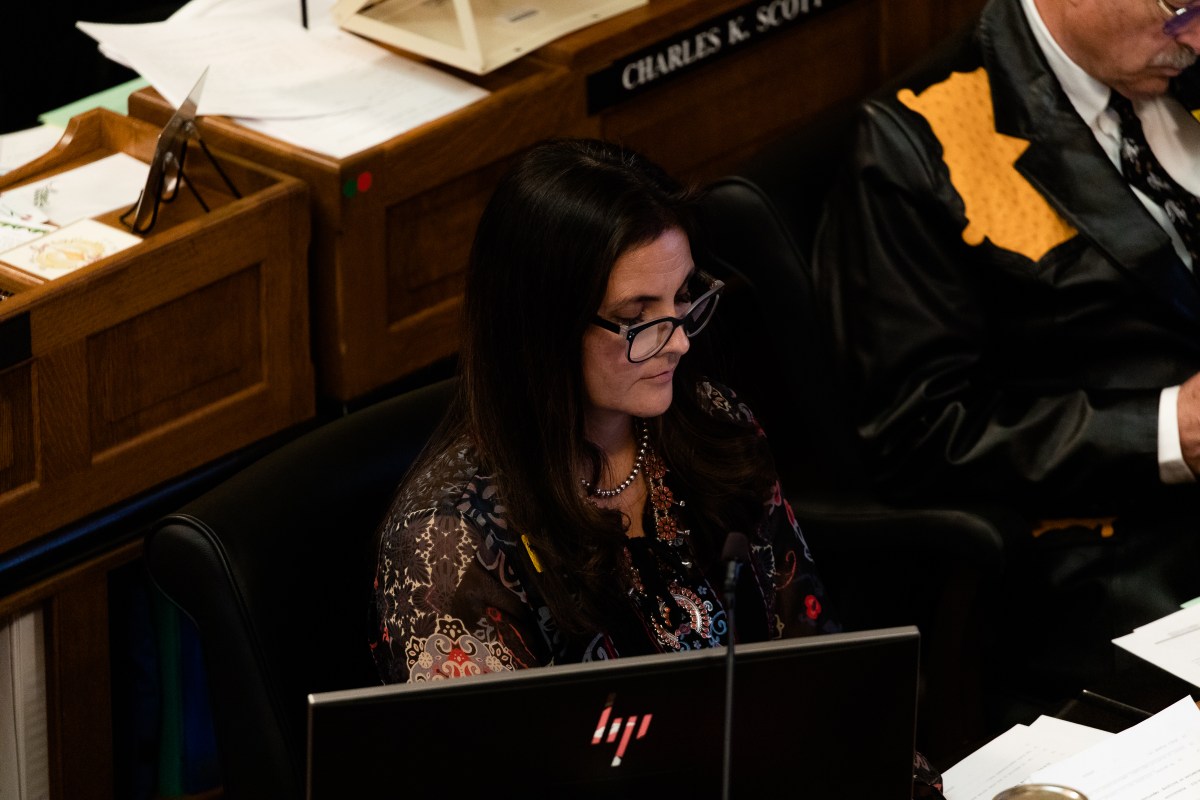
“If the court had come out the other way, it would have been a complete erosion of tribal sovereignty,” said Sen. Affie Ellis (R-Cheyenne). “This case could have been devastating and fortunately it wasn’t.”
After enacting a mirror version of ICWA on the state level this spring, Wyoming lawmakers are now considering how to proceed in light of the ruling.
“The state can’t weaken its obligation but it can certainly provide more protection,” Ellis said.
Ellis, a member of the Navajo Nation, was lead sponsor of Senate File 94 – Federal Indian Child Welfare Act codification, which codified the federal law in state statute. Gov. Mark Gordon signed the bill into law in March. The Northern Arapaho and Eastern Shoshone tribes championed the state law in anticipation that the legal challenge could dissolve 45 years worth of protections.
“Today’s decision by the U.S. Supreme Court to uphold the Indian Child Welfare Act (ICWA) is a landmark victory for child welfare, Tribal culture and our very way of life,” the Northern Arapaho Business Council said in a statement. “This ruling marks a rejection of shameful pre-ICWA practices that saw Native children systematically removed from their homes and communities in order to erase our language, culture and practices.”
The Eastern Shoshone Business Council did not respond to WyoFile’s request for comment by press time.
History and legislation
Several studies conducted ahead of the passage of ICWA found that more than one-third of all Indigenous children had been removed from their homes. And of those, 85% were placed with non-Indigenous families and institutions with no tribal ties — even when fit and willing relatives were available.
To remedy this, ICWA created three priorities for placing Indigenous children when they are adopted or enter into foster care. First preference is a member of the child’s extended family, followed by a member of the child’s tribe. If neither is possible, the next preference is a member of another tribe. Those priorities were at the heart of the legal challenge and mirror what is now codified in Wyoming law.
The Wyoming Legislature also created a task force to consider the protections afforded by the federal law after the high court took up the matter.
“There was a clear understanding from those of us on the task force that we couldn’t be burning much daylight,” Rep. Lloyd Larsen (R-Lander) said. “We had to make hay while we could because if it was overturned, we wanted to be prepared to come back [in the next session] with something that would continue to protect tribal interests.”
The court’s decision to uphold the federal law “relieves a lot of the pressure,” Larsen said, but questions remain about whether the state will craft additional legislation — the ICWA bill signed into Wyoming law sunsets in 2027.
“The federal law is the baseline, but are there areas within that federal law that we should address and try to add clarity for the judicial system or not?” Larsen asked. “I think that will probably be the essence of our next meeting.”
Ellis, who chairs the task force with Larsen, said: “We owe it to ourselves as a state and we owe it to our tribal partners to ask, ‘How can we do this better?’”
Ellis, an attorney, previously taught federal Indian law at the University of Wyoming and served on the U.S. Tribal Law and Order Commission. She said she was a little surprised to see the opinion come out as it did, but called it a “really sound decision.
“I want to be sensitive to the fact that these are family law matters, and they’re really, really hard,” Ellis added, before pointing to Justice Neal Gorsuch’s concurring opinion as “language that I think our country needs to hear.”
“Often,” Gorsuch wrote, “Native American Tribes have come to this Court seeking justice only to leave with bowed heads and empty hands. But that is not because this Court has no justice to offer them. Our Constitution reserves for the Tribes a place — an enduring place — in the structure of American life. It promises them sovereignty for as long as they wish to keep it. And it secures that promise by divesting States of authority over Indian affairs and by giving the federal government certain significant (but limited and enumerated) powers aimed at building a lasting peace.”

What comes next
The task force does have another meeting scheduled, in conjunction with the Joint Tribal Relations committee, said task force member Sen. Cale Case (R-Lander). Though “it doesn’t seem like it’d be harmful to explore whatever needs to be done,” Case said, “ I sort of feel the reason for the task force is now over.”
The Management Council appropriated $40,000 for the task force to work and meet before the 2024 legislative session. In May, the task force held a private work session. It would “save very little money,” according to Case, to cancel the upcoming meeting since task force members and staff will already be traveling for the coinciding meeting. Case is unsure but open to the idea that there’s still work to be done, he said. “There’s always issues like access to the courts.”
Stephanie Amiotte, the legal director for the American Civil Liberties of Wyoming, prefers a proactive approach.
“As much as we love to say that we can rely upon these decisions, it’s not a permanent thing,” Amiotte said. “We know that decisions are overturned or different challenges can be made.”
The organization and several other ACLU affiliates co-authored an amicus brief in the ICWA case. Amiotte, an enrolled member of the Oglala Lakota (Sioux) Tribe, said the ACLU would like to see the task force consider several improvements, such as “strengthening protections for Native American families at the initial investigation process.”
ICWA provides protections once a child enters the foster or adoption system following an investigation, but “child welfare agencies really need to be educated on both internal biases that may exist and basic lack of understanding about Indigenous cultures and Indigenous practices,” Amiotte said.
The ICWA task force is scheduled to meet in Riverton on July 12.

“Mulling” is just another word for doing nothing substantial.
Thoughts and prayers, but never any action.