


More and more Wyoming students aren’t getting vaccines.
These aren’t the much-maligned and distrusted COVID-19 vaccines, though. They’re long-utilized inoculations against diseases like polio, diphtheria and measles, Wyoming Department of Health data shows.
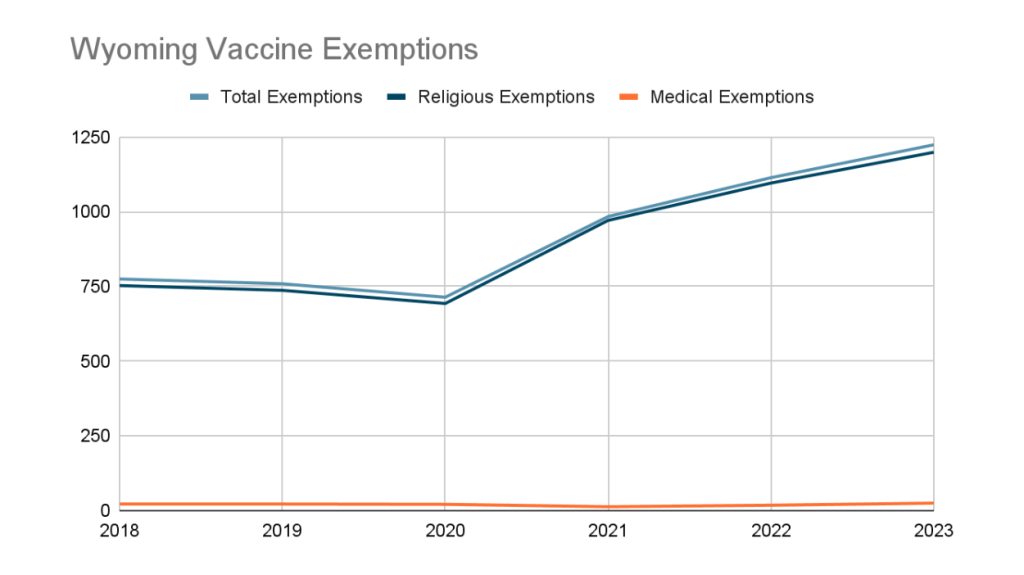
Wyoming requires a range of vaccines, but since 2020, the number of K-12 students securing exemptions has grown from 714 to 1,224 — an increase of 71%. There were 130 more in just the last year.
The vast majority of students still get vaccines — more than 90% of Wyoming kindergarteners get all the shots — but this growing minority puts kids with cancer, immune disorders and the unvaccinated at risk.
With a less robust herd immunity resulting from fewer vaccinated people, diseases like measles have reared their ugly head, leading to outcomes like pneumonia, diarrhea, ear infections and — in rare cases — death. The World Health Organization recommends a 95% inoculation rate against measles to keep the highly contagious virus from spreading — others argue even that wouldn’t be enough in some cases.
Only about 91% of Wyoming kindergarteners had the MMR shot — vaccinating against measles, mumps and rubella — last school year, according to the Centers for Disease Control and Prevention.
Who’s exempt?
While medical exemptions are a contributing factor, they’re a small minority, making up only about 2% in 2023, according to Wyoming Department of Health data. That leaves religious exemptions.
“I certify that I have a religious objection to the immunization(s) indicated on this form and therefore am requesting a waiver to the mandatory immunizations for myself or my child to attend a Wyoming preschool, child caring facility or school (K-12),” the waiver required for an exemption states.
The waiver goes on to have guardians state that they understand their child won’t be allowed to go to school during a “vaccine-preventable disease outbreak,” and, “I understand the risks and possible outcomes of my decision to exempt my child from the mandatory immunizations, which may include serious illness, disability or death.”
Purely ideological exemptions, or those stemming from a busy schedule, are theoretically not allowed in Wyoming.
“The law does not allow parents/guardians to request a waiver simply because of inconvenience,” the health department states. As presented on the health department’s website, the exemption policy emphasizes that “Wyoming statute does NOT allow for the authorization of waiver requests based on philosophical beliefs.”
Seeking a religious exemption does not require any proof, though.
University of Wyoming community and public health professor Christine Porter said that the increased exemptions are likely not the result of growing devotion to religious doctrine.
“So it’s not really, in most cases, about religion,” she said. “It’s about, you know, fear and beliefs … And again, I know that the parents who apply for these are trying to protect our children with the knowledge and understanding that they have.”
“I understand the risks and possible outcomes of my decision to exempt my child from the mandatory immunizations, which may include serious illness, disability or death.”
Wyoming religious exemption form
While this trend of more exemptions started years before COVID-19, the pandemic certainly didn’t help. Porter said for the MMR shot, many nefarious rumors started in the late 1990s after a paper erroneously claimed that it could cause autism.
“That paper was horrific science,” she said. “It had 12 participants, and it was ultimately retracted because they thought the data was fraudulent and badly analyzed, even among just those 12. But the damage had been done.”
The studies tying the vaccine to autism have since been ridiculed for their lack of scientific rigor. Meantime, other studies — including one with hundreds of thousands of participants — found no such connection.
Vaccines do have side effects, including those shots required in Wyoming schools. However, the benefits of these required shots outweigh the risks, Porter said.
Still, a Kaiser Family Foundation survey found that there’s a growing number of people who believe exemptions should be granted. It showed that from 2019 to 2022, the number of people who think MMR vaccines should be required of healthy school children dropped from 82% — as reported by the Pew Research Center — to 71%.
Over the same time frame, there was an increase in those who believed parents should be able to decide whether to vaccinate their school-age children, swelling from 16% to 28%.
“Among Republicans and Republican-leaning independents, there has been a 24 percentage-point increase in the share who hold this view (from 20% to 44%),” Kaiser found.
That means the majority of people still support these vaccinations on both sides of the political aisle, but with growing anti-vaccine sentiment, public health experts are concerned that vaccination rates won’t be enough to prevent future outbreaks of highly contagious diseases.


Perhaps what the Legislature needs to do is apply the standards they use for abortions to vaccinations. Before a family can refuse the vaccinations, they all should have to watch educational videos on what life was like before the vaccines. It should include the mortality rates for every age group and compare them to the rates after vaccination was required. Then they should have to have a face to face meeting with their personal physician and public health officials to review the risks of not being vaccinated. Finally they should have to sign a waiver and release declaring that they will personally bear the full cost of any healthcare required as a result of their failure to vaccinate. I would say unvaccinated children should separated and sent to different schools then vaccinated children, but I don’t want to appear extreme.
Parents should be required to read articles from Wyoming’s old newspapers where stories of whole families of children died over night from smallpox, measles, whooping cough and other diseases now preventable by vaccines. In some cases people were padlocked into their cabins to keep them from spreading disease.
Yup. Diphtheria in Alaska,red measles the most contagious virus of them all, rubella that causes spontaneous abortions, and young women never exposed or vaccinated against chicken pox…you all can look up being pregnant with no chicken pox antibodies.