


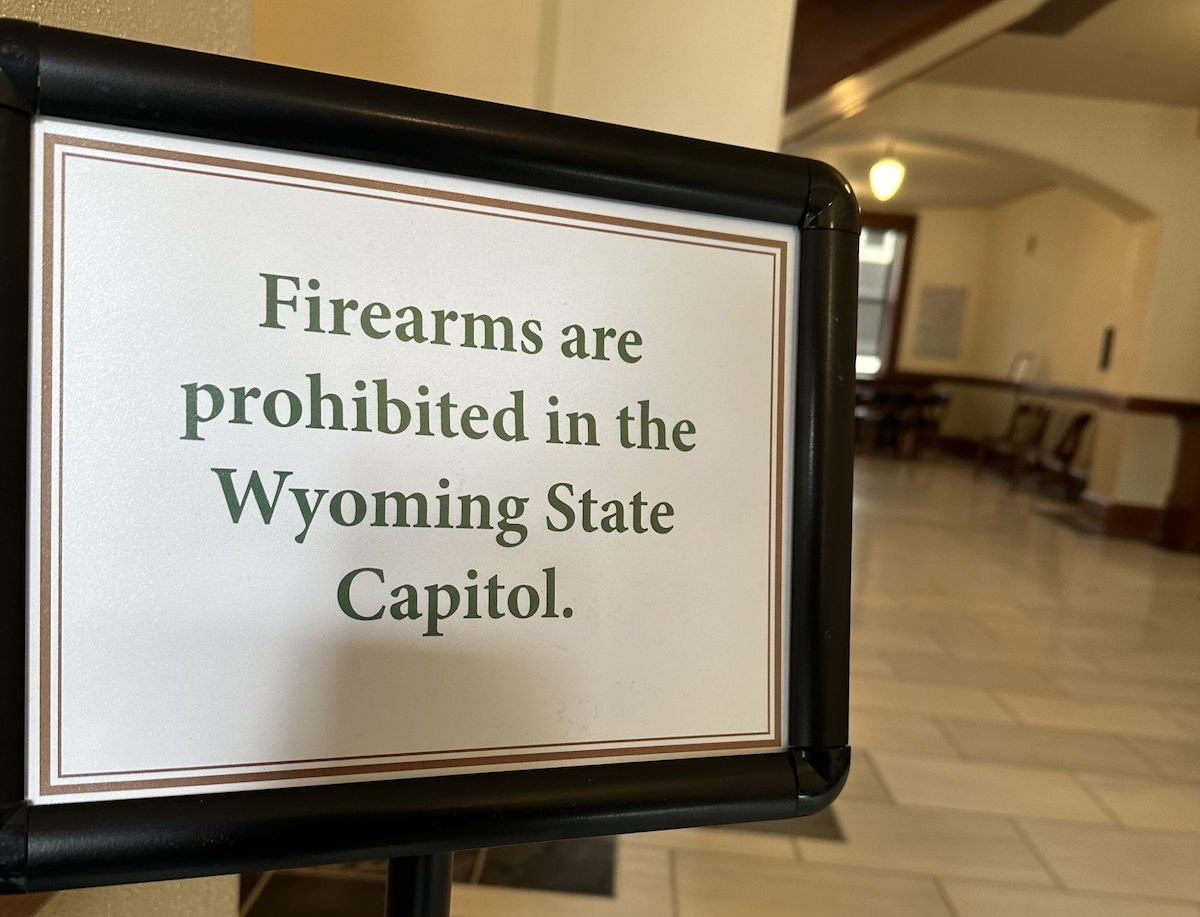
Following his contentious veto of a sweeping ban on gun-free zones in Wyoming, Gov. Mark Gordon is leading efforts to allow concealed carry in a more targeted selection of state properties — like the Capitol.
“I think it’s probably on everybody’s mind here that we should be able to reform and revise these rules to make them much more attuned to Wyoming’s desire to make sure that we have concealed carry,” he said Wednesday during a State Building Commission meeting in Cheyenne.
That said, he added that with complications like insurance costs and security needs, the process needs to be done in a “deliberate way.”
The State Building Commission includes Wyoming’s top five elected officials: the governor, secretary of state, state auditor, state treasurer and superintendent of public instruction.
The commission’s meeting minutes from this week state it “received direction to start the process to reconsider our rules to allow concealed carry permit holders to exercise their rights within the Capitol and other appropriate state facilities.”
That’s where things get complicated.
The commission still has to suss out what facilities this could apply to, according to governor spokesperson Michael Pearlman, and what facilities concealed carry will be “appropriate” for.

Some facilities under the commission’s purview include the State Hospital, Life Resources Center, Girls’ School and Boys’ School, according to commission spokesperson Travis Hoff. Still, he noted, the group doesn’t oversee day-to-day operations at those facilities.
As for the Capitol, most of the building — including the top two floors — falls under the jurisdiction of the legislative branch during the session. That means the commission and executive branch wouldn’t be able to set rules there during that time.
Secretary of State Chuck Gray asked during the meeting whether the commission even had oversight of the corridors during or after the session.
“Because if the answer to that is no, it’s going to be difficult for this to be carried out in the way I think I certainly want it to,” he said.
Gov. Gordon responded that it was still a bit “ambiguous.”
Meanwhile, commission members noted possible changes in insurance costs, increased security needs and possible human resources issues with more concealed carry. State Auditor Kristi Racines also mentioned the need to work closely with departments and staff in state buildings to avoid unintended consequences.
State Treasurer Curt Meier wasn’t sure he’d want people armed in his office without some level of training. He underwent training from law enforcement on how to handle certain scenarios but, “I did not fare well,” he said.
“Everybody thinks that they can handle a circumstance until they get into one,” he said. “And once you get into one, it’s a lot different and you act a lot different than you think. Or circumstances occur that you had never contemplated.”
Meanwhile, Gray said his staff wanted the option to safeguard their own security.
“My staff want to carry,” he said, adding: “I think it’s important for the general public, the citizens that are in our beautiful capitol complex that they’re able to carry. And that’s ultimately going to make everybody safer and be consistent with our Second Amendment rights and advancing those rights.”
Context
Gordon said he’d push to eliminate more gun-free zones even while shooting down House Bill 125 – Repeal gun-free zones and preemption amendments, citing concerns that it violated separations of power.
“[House Bill 125] erodes historic local control norms by giving sole authority to the Legislature to micromanage a constitutionally protected right,” he wrote in his veto letter to the secretary of state’s office. “If enacted, [HB 125] would require every one of our unique state facilities, such as the University of Wyoming, Wyoming State Hospital, or the Wyoming Boys School, to receive legislative approval to restrict carrying firearms, or even to set policies as practical as proper weapon storage.”
That legislation would have ended state, county and town governments’ authority to regulate concealed firearms. Beyond that, it would’ve allowed concealed carry in public spaces like schools, local government meetings and the Capitol.
Legislation supporters said they wanted to allow law-abiding citizens with guns to stand up to bad actors in places where firearms wouldn’t otherwise be permitted.
Detractors — like the Wyoming Education Association and Wyoming Association of Municipalities — argued for a balance in Second Amendment rights with safety and security, noting a long history of gun-free areas in the state.
“Everybody thinks that they can handle a circumstance until they get into one.”
State Treasurer Curt Meier
Rep. Jeremy Haroldson (R-Wheatland), who sponsored HB 125, said in response to Gordon’s latest actions: “Any time rights are restored I am excited!”
Still, he added, “It is sad though that the Govornor [Sic] feels his office has a better grasp on the heart of the people than the legislature does. We gave him the vehicle to fix this problem and he decided to not use that vehicle. Now he feels that directives by his office are going to help with that decision. Only time will tell.”
Back at the SBC meeting, Superintendent of Public Instruction Megan Degenfelder said the commission’s work to remove certain gun-free zones could improve future bills.
“I think this process, this work is going to allow for better legislation to occur because we’re then not dealing with sweeping legislation that impacts the executive branch,” she said.
What’s next?
Next steps involve writing and compiling necessary documents, getting Gordon’s sign-off to those documents and uploading the rules to the Wyoming Secretary of State’s rules system to open a 45-day public comment period.
Beyond that, Gordon talked about scheduling more public meetings focused on the effort to eliminate certain gun-free zones in state facilities. (Usually, the commission only meets quarterly.)
While there wasn’t a timeline ready for the meeting Wednesday, SBC Secretary Suzanne Norton said it was in the works.
Meeting schedules can be found here.

No to guns in the Capitol. Please.
Treasurer Meier touches on a very important point, training. None of the bills to expand concealed carry have mentioned training. The proponents rattle on about the importance of “trained good guys” being able to thwart evil doers but never specify that training is required. A “well regulated militia” is a militia that is well trained. How about requiring certification in the P.O.S.T. short range training standard and weapon retention as a bare minimum to carry in current gun free zones? As Curt points out, “Everybody thinks that they can handle a circumstance until they get into one,” he said. “And once you get into one, it’s a lot different and you act a lot different than you think. Or circumstances occur that you had never contemplated.”
Looks like the Governors weak spine came back.
Why stop at carrying firearms everywhere we go. I believe that we would all be a whole lot safer if each and every one of us were also required to carry on our person: an automated external defibrillator, 10 quarts of distilled drinking water, a Class ABC fire extinguisher (10 pound or larger) and a 150 foot roll of tin foil for making emergency protective headgear. Just my personal opinion mind you…… I don’t intend to guilt the governor into forcing my will on the good people of Wyoming……