


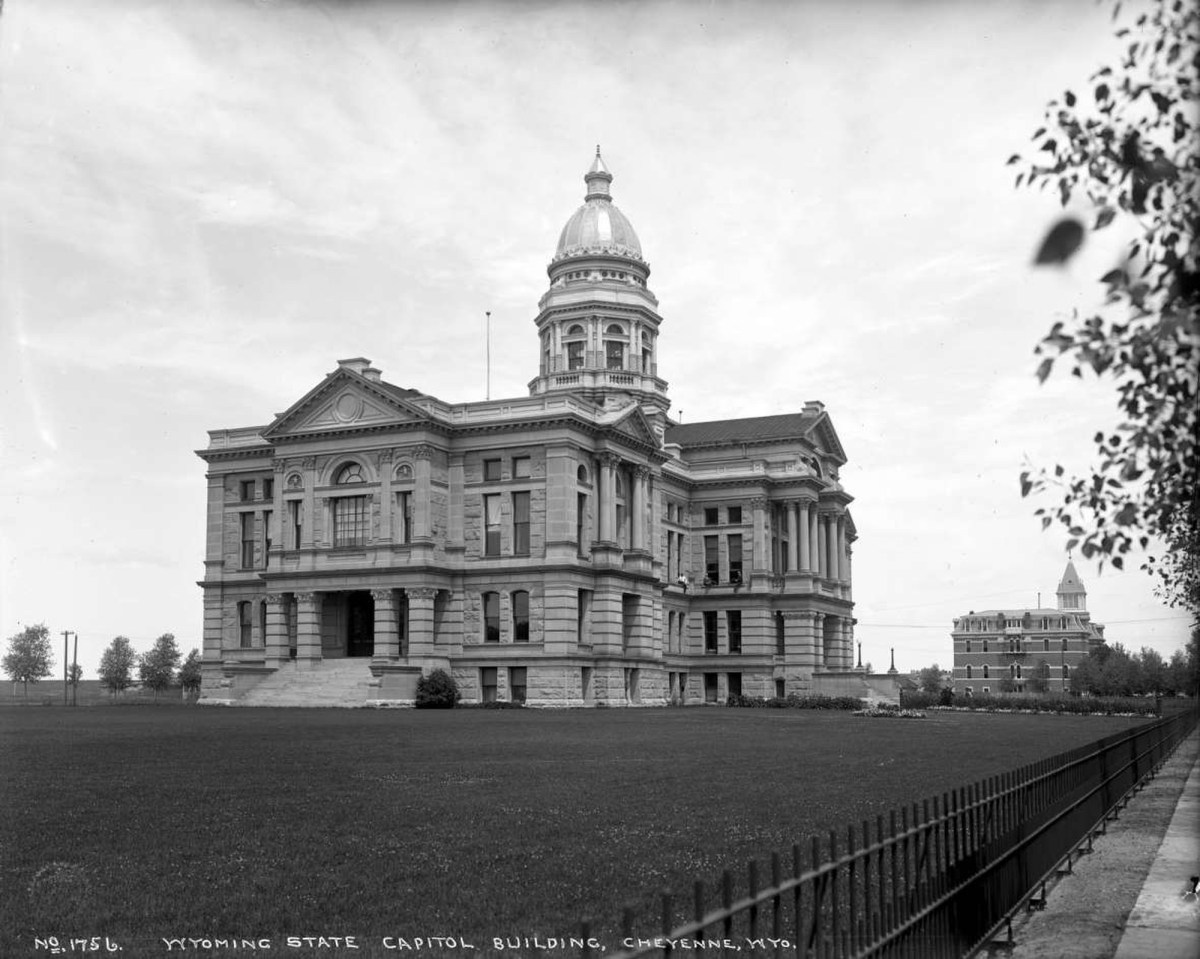
On the morning of Dec. 2, 1892, a notary public swore in Democrat John E. Osborne as governor of Wyoming in the Capitol library. Osborne then entered the governor’s suite. How he got there depended on whom you asked. The Cheyenne Daily Leader, which backed Osborne, said he “took peaceable possession.”
Amos Barber, a Republican who also claimed the governor’s office, issued a proclamation that day charging that Osborne had entered the Capitol “by stealth and force.” The Republican-leaning Cheyenne Daily Sun supplied alleged details to back him up: A carpenter had forced open a window, and Osborne had edged along an outside ledge to climb in.
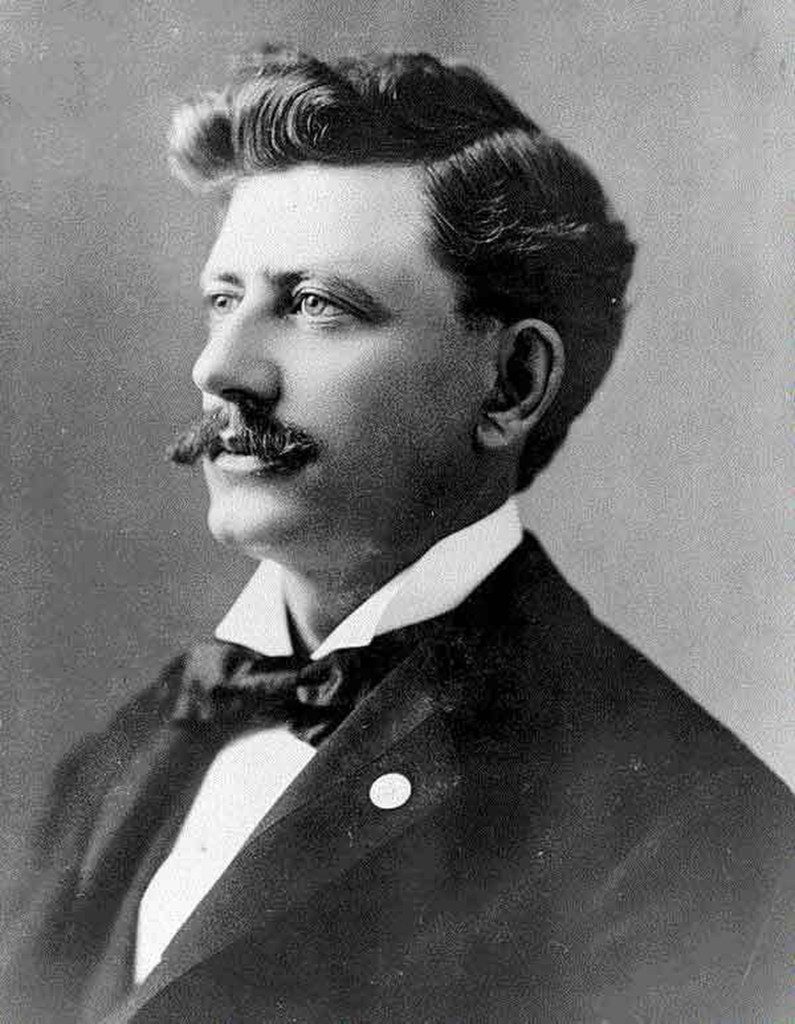
Soon after Osborne settled in, Richard Repath, Barber’s private secretary, came rushing up, “breathless with haste,” as the Leader put it. Repath locked the doors and put the keys in his pocket. Osborne was free to leave, the Sun noted, but then he would have to force his way back in. So, he stayed. For a while, Osborne and Repath “conversed at intervals,” the Sun reported, “and neither appeared to particularly object to the company of the other.”
At dusk, two men brought candles to a window. Osborne pushed up on the window. Repath shoved down. After a short struggle, Osborne won. The window went up and the candles came in, the Leader reported. Supper came in the same way, and so did bedding for what the paper called Osborne’s “first sleep as governor of Wyoming.”
Things got worse that night, according to the Sun. When Repath refused to let two of Osborne’s allies in, Osborne threatened to throw him “through the glass.” Repath “only laughed.” Democrats slipped notes under the door all night, while Osborne tried to fit a key to the lock with the file blade of his pocketknife. Repath eventually withdrew to the governor’s inner office, keeping the keys and leaving Osborne alone in the anteroom.
The next day, Osborne’s allies opened a side door with skeleton keys. For the rest of December, Osborne held the reception room of the governor’s suite, while Repath held the governor’s private office and its keys.
Two governors, one Senate seat
For a month, Wyoming had two rival governors. What was at stake reached well beyond the governor’s office.
Barber, the secretary of state, had been acting governor since Republican Francis E. Warren resigned in 1890 to go to the U.S. Senate. Barber had never been elected governor. Barber and Warren’s apparent support and protection of the invaders during the Johnson County War in April 1892 turned Wyoming voters against the Republican Party the following fall. While Republicans held onto a majority in the Wyoming Senate, initial vote counts showed they lost the House and governor’s office to the Democrats in a landslide. Osborne, a Rawlins physician, won the governor’s race on Nov. 8, 1892, 9,290 votes to 7,509.
The law said the winner would take office “within thirty days after” the state canvassing board counted the vote and declared him elected. Osborne’s side found a loophole: The law directing what the board could count named races for Congress and the Legislature, not governor. So, Osborne argued, the county returns were enough, and they showed he had been “unquestionably elected.”
Who held the governor’s office mattered because of the U.S. Senate. Until the 17th Amendment in 1913, state legislatures, not voters, chose U.S. senators, and Warren’s Senate term was ending. Several races for the Legislature were in dispute, and the governor signed the certificates of election for the winners. Those seats could decide which party controlled the Legislature, and with it, who went to the Senate. Democrats feared Republicans would use the count to send Warren back to Washington.
Armed men in the hallway
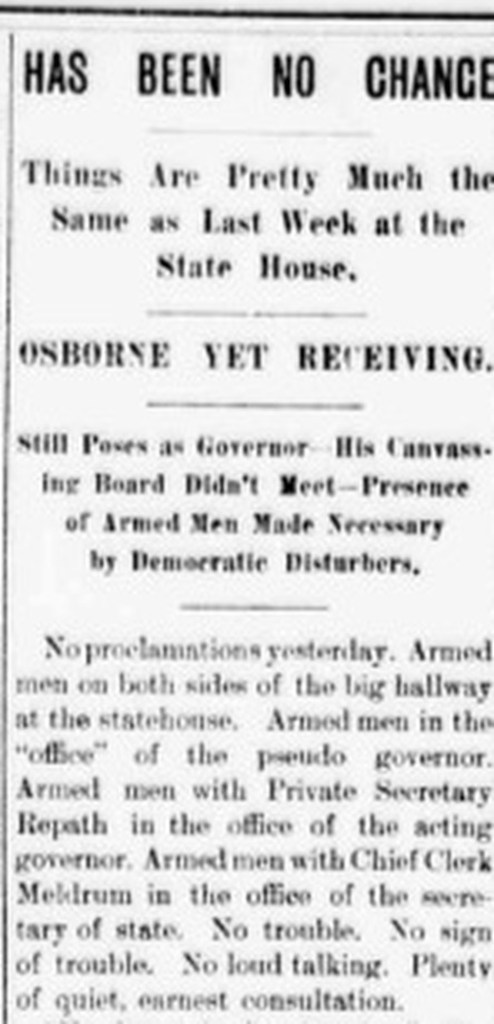
The fight dragged on. Claiming the governor’s authority, Osborne had called the canvassing board to meet on Dec. 5 and count the November returns. “The members did not heed his call,” the Sun reported. When Osborne went to the secretary of state’s office, where the board met, the chief clerk refused to let him in, citing “a plot to take the office by force.” Two of the board members, the auditor and the treasurer, said they “knew but one governor and his name was Barber.”
The next day, the Sun reported “armed men on both sides of the big hallway at the statehouse.” The paper blamed “Democratic disturbers” for the guns, then assured readers: “No trouble. No sign of trouble.”
Barber’s all-Republican board met on Dec. 8. It refused to count one Carbon County precinct, Hanna, because of flaws in its paperwork. Those votes would decide two seats in the state House. The Democrats went to the Wyoming Supreme Court, which ordered the Hanna votes counted on Dec. 31. Both seats went to Democrats.
A second oath
The standoff ended on Jan. 2, 1893. By then, the state board had finished its count and declared Osborne the winner. In his proclamation, Barber had promised to “cheerfully” step aside for “whoever may have been legally declared the choice of the people.” He kept his word.
Osborne took the oath a second time, reportedly wearing shoes he had made from the skin of outlaw “Big Nose” George Parrott. This time it was administered not by a notary but by Wyoming Supreme Court Chief Justice Herman V.S. Groesbeck. Osborne attached a note to the new oath. He was taking it, he wrote, only so that Barber “may no longer have such pretense for usurping the powers and duties of governor.” His first oath, he insisted, remained “of full force and validity.” That afternoon, Barber and Repath visited Osborne to formally hand over the governor’s office, and Osborne got the keys.
Two weeks later, the Supreme Court ruled that the December oath was not valid. Osborne had taken that oath before the state board counted the vote and declared a winner, the court said, which made it “premature and invalid.” A candidate could not simply declare himself elected. “If one person may do this, another may.” The ruling did not touch the January oath. Groesbeck, who had administered it, joined the decision.
A senator short
As for the Senate seat behind it all, nobody got it. When the Legislature finally settled who belonged in it, there were 22 Republicans, 21 Democrats and five Populists. Lawmakers voted 31 times without agreeing on anyone.
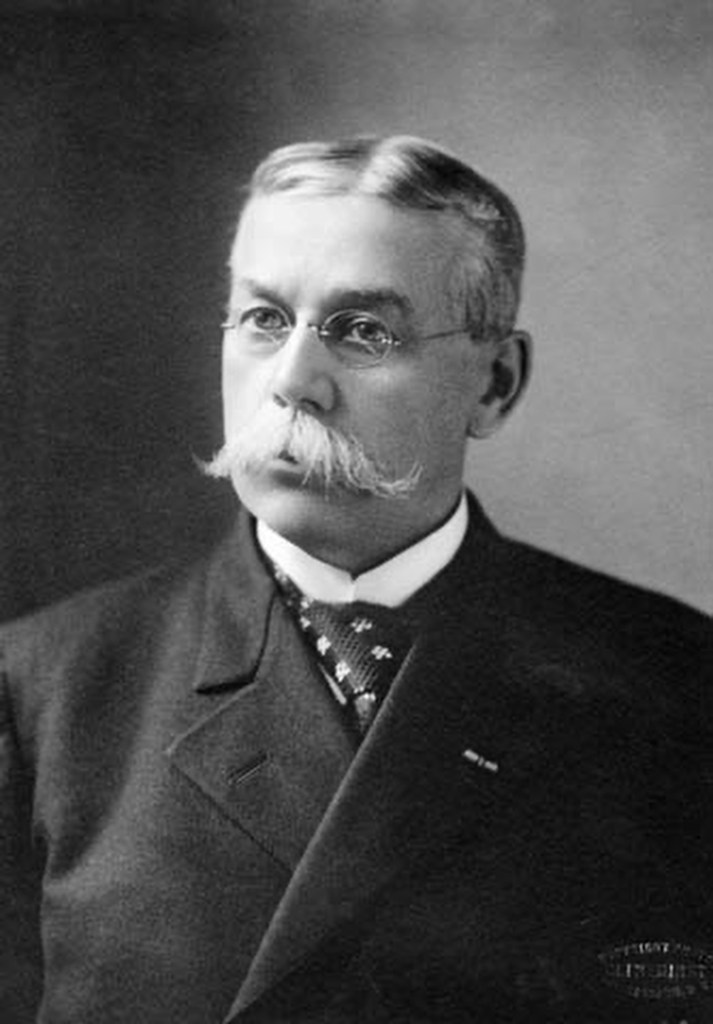
For two years, Wyoming had only one senator, Joseph M. Carey. Once again, the governor had a say. Osborne appointed a Democrat, A.C. Beckwith, to the empty seat, but the U.S. Senate questioned whether a governor could fill a seat the Legislature had failed to fill, and Beckwith withdrew in July.
It was a bad time to be short a senator. That year, the U.S. Senate’s session ran through the summer as members debated a national depression and whether silver should remain a basis of the nation’s money. In 1895, Wyoming lawmakers finally filled the seat — with Francis E. Warren. He held it until his death in 1929.
Osborne went on to serve in Congress and in Woodrow Wilson’s State Department. In 1918, he ran for the Senate himself, against Warren, then 75. Warren won by more than 6,400 votes.
Read more on WyoHistory.org:
John E. Osborne and the Logjammed Politics of 1893
Francis E. Warren: Massachusetts Farm Boy Who Changed Wyoming
Amos Barber
A Contested Transition
The Johnson County War: 1892 Invasion of Northern Wyoming
Big Nose George: A Grisly Frontier Tale
Additional Sources
Cheyenne Daily Leader, December 3, 1892, and January 3, 1893
Cheyenne Daily Sun, December 3, 4 and 6, 1892, and January 3, 1893
In re Moore, 4 Wyo. 98 (1893)
State ex rel. Bennett v. Barber, 4 Wyo. 56 (1892)
U.S. Senate Historical Office. “Wyoming Senate Timeline.” senate.gov