

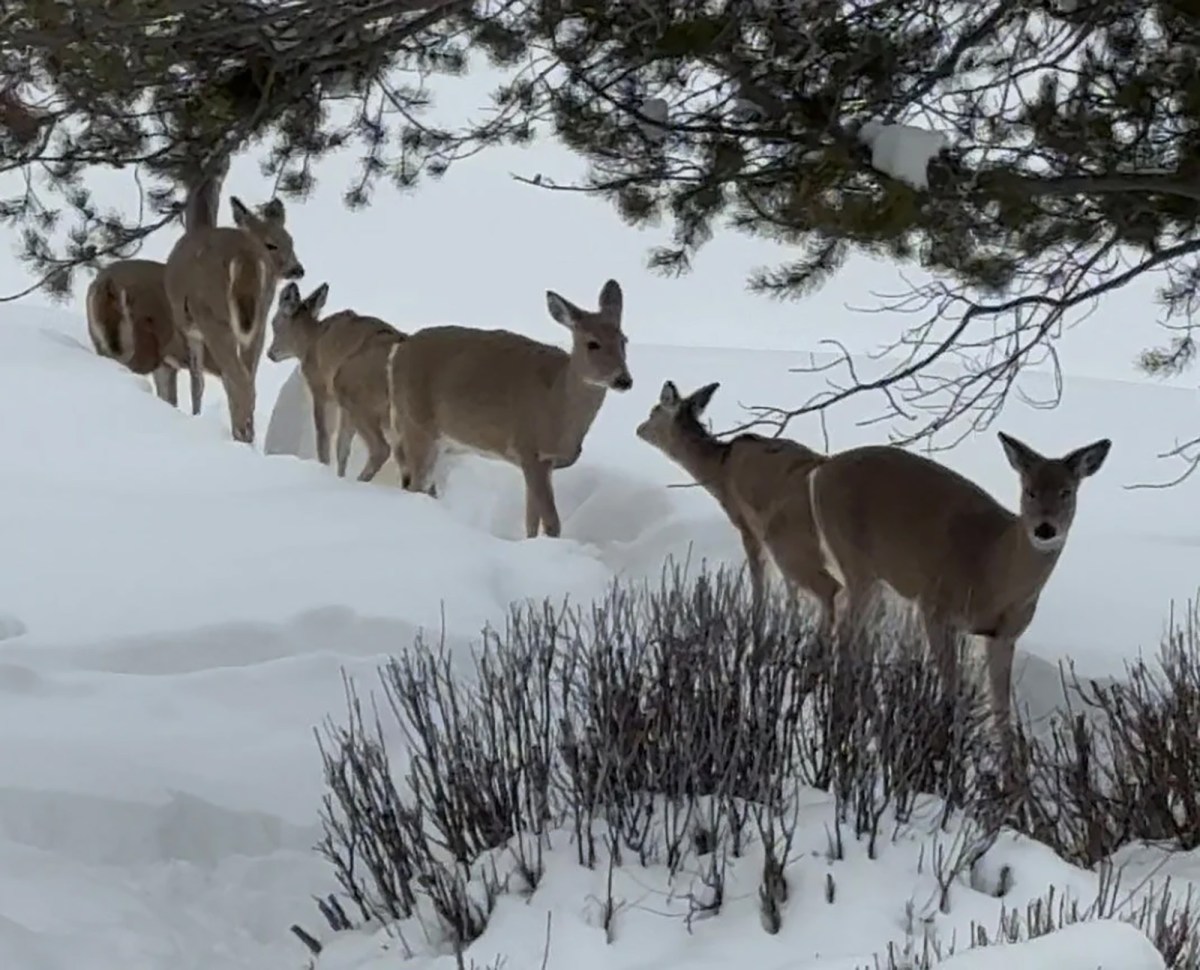
JACKSON—The Wyoming Game and Fish Department is in the process of shrinking the population of white-tailed deer in the Jackson region to “little to no” animals due to concern about a growing population and the spread of chronic wasting disease in northwest Wyoming.
That’s according to a departmental update on CWD delivered to the Wyoming Game and Fish Commission earlier this month.
The strategy came out of a 2020 plan from the department to manage CWD, an always-fatal, highly transmissible neurological disease in ungulates, said Sam Stephens, the department’s wildlife biologist for the South Jackson region. That plan called for trying to reduce concentrations of deer irrespective of species, but decreasing white-tailed deer populations in particular is “low-hanging fruit,” Stephens said.
“In large parts of the state, we surveyed the public about what they will tolerate in terms of CWD management actions, which are not often popular,” he said. “Aggressive white-tail harvest is one of the most supported management actions.”
In the Jackson region, wildlife managers are concerned about white-tailed deer on elk winter range, as CWD can be spread through environmental contamination from urine, feces, blood and saliva of infected animals. Wildlife managers first detected CWD in the Jackson Elk Herd in a hunter-harvested cow in 2020. The National Elk Refuge detected its first two cases last winter.
White-tailed deer abundance in northwest Wyoming has increased in recent years, Stephens said. That could be due to winters becoming more mild.
“A lot of their historic population swings have largely been governed by winter severity,” Stephens said. “Big winters knock them back.”
Game and Fish does not monitor white-tailed deer populations outside of “incidental observations” documented during other field work. Department staff collected 44 observations in the Jackson region between 2000 and 2010, which leapt to 300 between 2010 and 2020, Stephens said. Department staff have documented another 200 in the six years since.
The highest concentrations are along river bottoms, such as the Snake River between Wilson and South Park, the lower Gros Ventre River and parts of Star Valley along the Salt River, Stephens said.
“We’ve really seen that shift in population and abundance really post 2010,” he said.
Only two white-tailed deer in the Jackson region have tested positive in the past few years, Stephens said. Real prevalence could be higher as the department can only sample dead animals.
But statewide last year, white-tailed deer had the highest CWD prevalence of any big game species, with 25% testing positive, according to data presented to the commission. Twenty one percent of tested mule deer were positive and 4% of tested elk were infected.
That’s because white-tailed deer are non-migratory, occupying a 10-square-mile home range, Stephens said. Migrating buffers mule deer from disease transmission, as they use a larger landscape rather than staying concentrated in one area. Resident mule deer populations are as likely to have CWD as white-tailed deer, Stephens said.
Winning strategy?
The department has liberalized white-tailed deer in the Bighorn Basin, doubling or tripling quotas in some hunt areas and allowing the season to run all fall through December, Stephens said. It’s difficult to track the effect of those actions on CWD, as wildlife managers have to measure prevalence over a long period of time.
It’s not a bad idea to keep white-tailed populations low, said Kyle Richardson, an assistant professor of wildlife ecology at University of Montana Western. Richardson studies CWD in southwest Montana. It’s “simple disease ecology,” he said, that as populations decline, disease declines.
“Nobody wants to see white-tailed deer eradicated from an area, or elk, or anything else,” he said. “But at the moment we’re so in the dark about methods of control for this. There aren’t a whole lot of options.”
The approach is scientifically sound, but using it only on one species limits the efficacy, Richardson said. That’s particularly the case given that Game and Fish and the U.S. Fish and Wildlife Service, which manages the National Elk Refuge, continue to feed elk during the winter in northwest Wyoming. Continued feeding is strongly supported by outfitters and ranchers, though conservationists oppose the practice.
“I use your elk population in my disease ecology class to teach students what not to do,” Richardson said. “You’re inviting disease if you’re feeding wildlife.”
Changing seasons
The department started selling white-tailed deer-specific licenses, as opposed to those that can also be used for mule deer, south of Jackson in 2015 and north of Hoback in 2018.
Stephens does not anticipate a dramatic increase in licenses in the region in the immediate future. That’s because many white-tailed deer reside on private land along river bottoms, making access difficult. The department currently acts as a middleman between hunters and landowners, Stephens said. If there were more of both who were interested in decreasing white-tailed numbers, maybe the department would increase licenses.
“It wouldn’t make sense to really liberalize our harvest strategy if those licenses aren’t currently being used,” Stephens said.
