


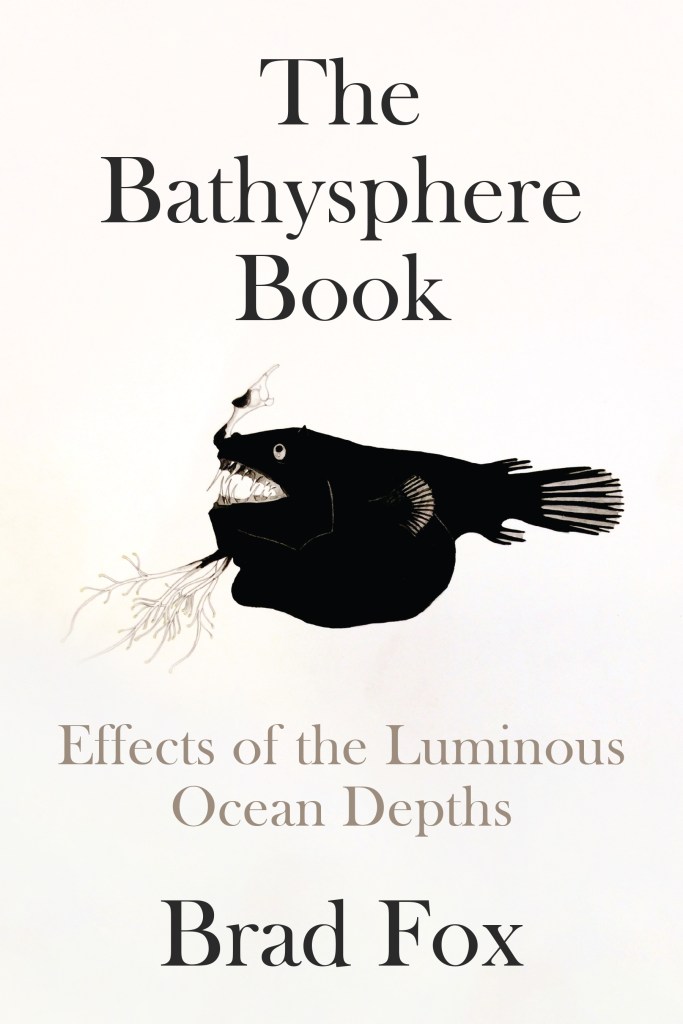
“The Bathysphere Book” opens on the deck of a barge floating near Bermuda in 1930. Two men crawl inside a cramped steel orb before it’s sealed shut, tethered with a cable, wheeled to the edge and dropped into the ocean.
What its inhabitants see through its thick quartz windows as their vessel drops into the depths is otherworldly and beautiful, defying the limits of language and human comprehension. One of the men, William Beebe, will wrestle with the realm of darkness and bizarre creatures as he scribbles down and mulls over these early deep-sea dives, leaving behind a curious record of detailed scientific logs and scraps of poetry constructed with words like “siphonophore,” “peduncle” and “vomerine.”
Nearly a century after that 1930 dive, while stuck in Peru during pandemic lockdown, author Brad Fox sifted through Beebe’s archives to create his own exploration — of the confines of science, the early 20th century transformation of America, a secret love affair and the sublime world that exists out of sight and imagination of most people.
Inside the short chapters of Fox’s “The Bathysphere Book” are descriptions of fish built of burning filaments, the origins of big ideas and colorful tales of true-life Depression-era figures. The New York Times called the book “beautifully written and beautifully made.”
The author will be in Wyoming this week as part of the The National Book Foundation’s 2024 Science + Literature program, which picked “The Bathysphere Book” as one of three annual selections used to deepen understanding of science and technology. The program partnered with the Bookmarked Literary Arts Festival to give away free copies of the book and bring Fox to Lander, where he will speak at a public event Wednesday.
Fox sat down with WyoFile before the event to talk about the book’s origins, its striking artwork and the process of following his curiosity. The conversation has been edited for length and clarity.
WyoFile: What are the origins of the book?
Brad Fox: “It started a long time ago, before 9-11. I was unemployed and was sitting in an internet cafe looking for job leads. I just started mindlessly surfing around the internet. And I came across a couple of paragraphs from Beebe’s book, “Half Mile Down.” It describes him coming up from one of the first deeper dives and kind of emerging back into the Bermuda afternoon and saying this line, which I remembered as “I saw a blue so blue, the yellow of the sun will never be the same,” which is actually not what he said but it lodged in my memory somehow like that. It stuck with me.
Now and then I thought about the bathysphere and the idea of the deep ocean as a transformative crucible somehow. And then when I was in grad school, I had a classmate who was a science historian, Katherine McLeod, who was working on Beebe. She was very surprised that I had heard about him. She ended up curating an exhibit at The Drawing Center in New York of illustrations [from the dive expeditions]. So that was how she introduced me to those images, and then she introduced me to the archivist who handles the stuff that’s held at the Bronx Zoo and the Wildlife Conservation Society.
So I started going up to that archive and just looking around and I just saw how rich and amazing the material was. I started from there.
WF: Tell me about researching. I was struck by the inclusion of details that made the people and the scenes so vivid. Did you take any liberties or were they all based on records?
BF: I hope that there’s nothing in there that is not at least implicit in the archives. I really tried to use the idea of nonfiction as a creative constraint. To stick to the evidence.
Beebe was a huge diarist. All the official kind of expedition paperwork and a lot of correspondence and also some personal stuff was at the Bronx Zoo. Beebe’s personal papers are at Princeton. There’s 60 years of his diaries, daily diaries, so it’s an exhausting process to go through. Then there is all of his correspondence, like crazy letters from [Arthur] Conan Doyle. Gloria Hollister [the scientist with whom Beebe had a close relationship] also had a diary that is in the Library of Congress that was quite personal and made her a much more vivid figure.
There’s a lot of incredible material. All of these amazing little tidbits just kept surfacing.
I had scanned everything. And then when I got stuck [in Peru], I managed to find a secondhand laptop. Then I just sat in this little lodge and wrote.
WF: There are a couple things that make reading this book a different experience: The glossy pages as well the prints of the artwork and the other archival material throughout. Can you talk about the decisions that went into how it looks and feels?
BF: I was very obsessed with that. So when my agent connected me to Astra, basically my terms were: Don’t normalize the form and make a beautiful object.
With the images, I spent a long time playing around placing them and thinking about pace and size and elliptical combinations and when something would be comprehensible, like you might see something and then only a couple of pages later would understand what it was.
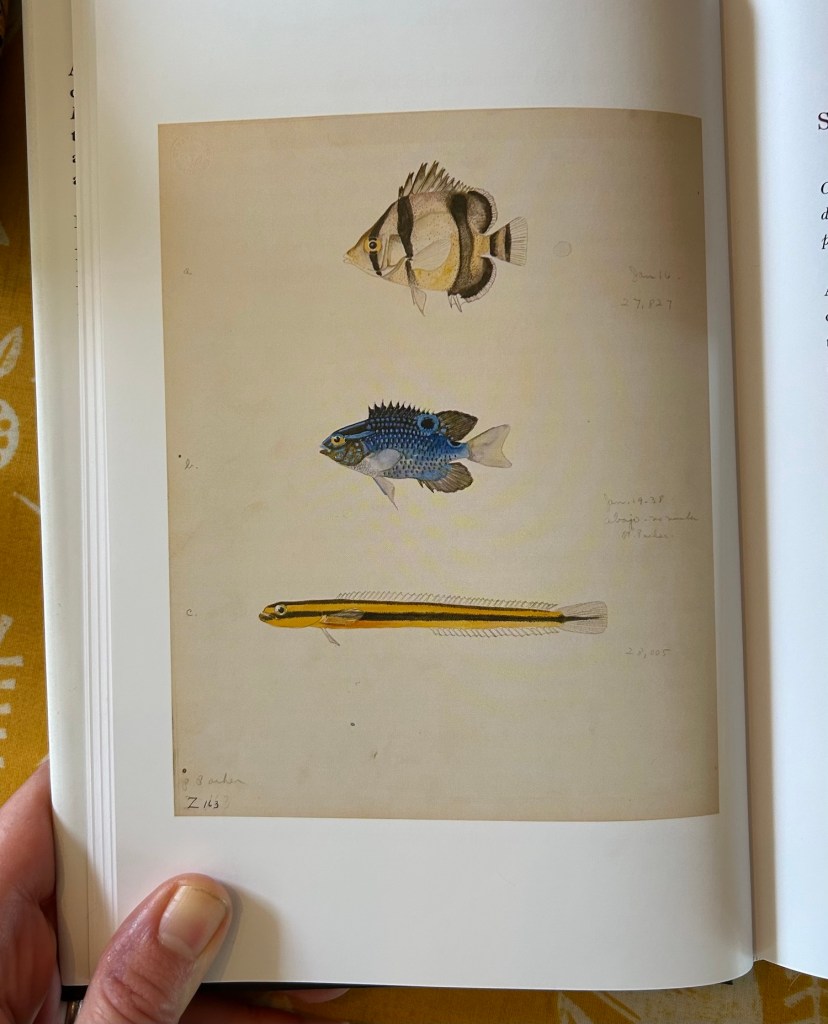
Astra went the extra mile to do this beautiful production. I mean, it’s such a nice book. It’s so dense and heavy and it’s so satisfying.
WF: Speaking of making readers work a little bit. I often found myself in the dark while reading the scientific descriptions. Why did you decide to keep those scientific names that maybe laymen would not be familiar with?
BF: I just found them really wonderful. I found the language fascinating and delightful. Like those new marine species where I’m just using the text found from the scientific articles and just arranging it into these little language objects. I just thought it was wonderful to spend time with that language and kind of leave its opaque quality for people who are not, you know, well versed in those species like I’m not.
What I was first drawn to in the logbooks was this matter of the failure of language. I was very interested in the fact that Beebe was obsessed with the fact that he couldn’t communicate [what he was witnessing]. I thought a lot of the difficulty of that vocabulary kind of helps bring across that sensation.
WF: Beebe’s life and work and the ocean itself form the foundation of the book. But there were these other pieces of history tied into it, almost these vignettes like the scandal around Joan Lowell’s memoir and the Mona Williams description. They felt carefully selected. What made you include these details?
BF: I was just following my curiosity basically. I was like, “who are Beebe’s books dedicated to?” [Eugenicist] Madison Grant was one. So obviously that was gonna be addressed. That’s a part of American history. Then I was like, “who’s Mona Williams?” I started to look around and I was like, “oh my god, this character is amazing.” They mention what they’re reading and so I’d be like, “what are these books?” I looked up Joan Lowell and I got a copy of [her fraudulent memoir]. Dr. Barry [a transgender physician who passed as a man in the early 1800s] was just this note scratched on a piece of paper that I found among Beebe’s papers. It was this story that mentioned a doctor who turned out to be a woman. Eventually I found three books written about the incredible story of Dr. Barry.
It was like an embarrassment of riches. Those stories were just amazing. There was no way I was gonna leave them out.
WF: What would you hope readers take away from the book and Beebe’s work and his ideas?
BF: There’s no particular thing. I come from literary writing, I come from novel writing. And so it’s not like I’m trying to deliver a message. I’m trying to allow complex realities to come across in their complexity. I’m just presenting what I found.
I have my own thoughts and beliefs about history and politics and, you know, planetary realities. But I wasn’t writing anything driven by an agenda.

Thank you, Katie! I’m just a short way into this wonderful book. The dialog the author shared with you has been most helpful in interpreting the content. I look forward to reading the rest of this poetic narrative.