

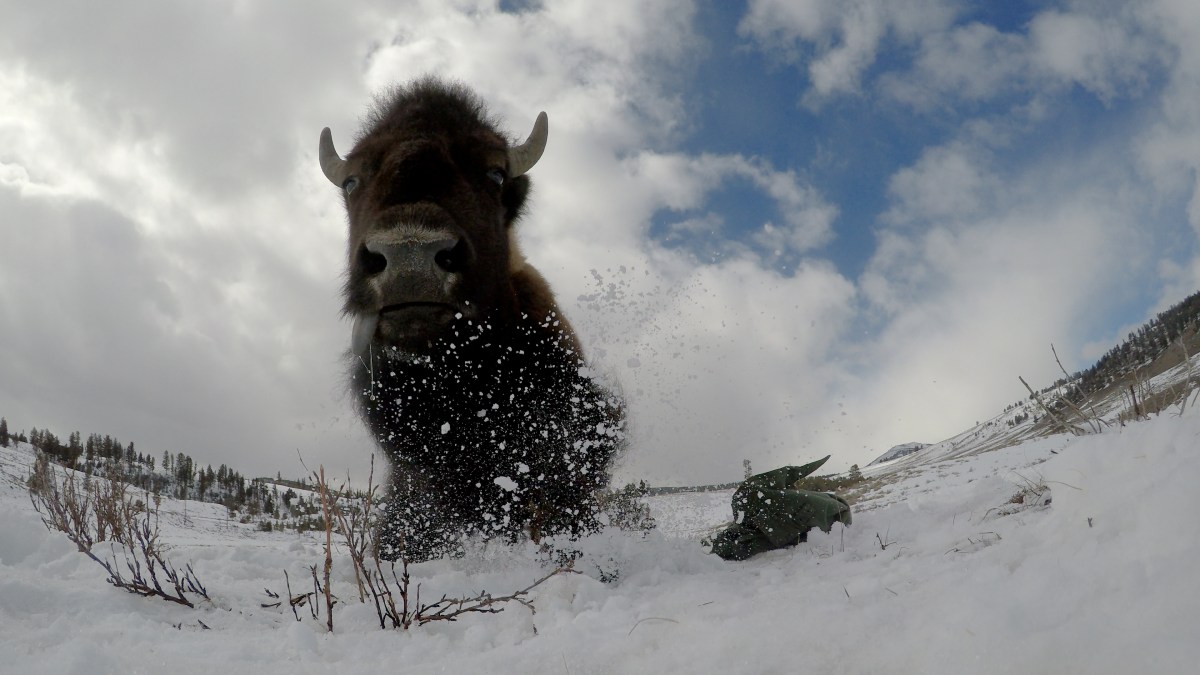
A bison’s shaggy beard hangs in the top of the frame as a calf sleeps in the sun. The camera lilts slightly from one side to another as the scraggly fur moves up and down, up and down, attached to a mouth that’s chewing lunch perhaps, or dinner, or a snack. Another shot shows bison standing belly deep in a river. In another they’re racing through a snow-covered field.
The vantage point for all of these isn’t some far away hillside, it’s right there, among the largest land mammals in North America.
A new film from the Wyoming Migration Initiative feels intimate and rare because the footage is closer to than any human dare to be from a 2,000-pound animal. The cinematographers? A handful of bison who wore cameras around their necks for nearly a year, offering science and the public a first-of-its-kind look into their lives.
“We got to see something no one has ever seen. You can get pretty close to bison when you film them by your vehicle, but it’s not like you can go up and follow a bison all day and live in their world,” said Pat Rodgers, the film’s producer and co-director. “It was cool to get into their world in an intimate way. To get to see what bison see.”
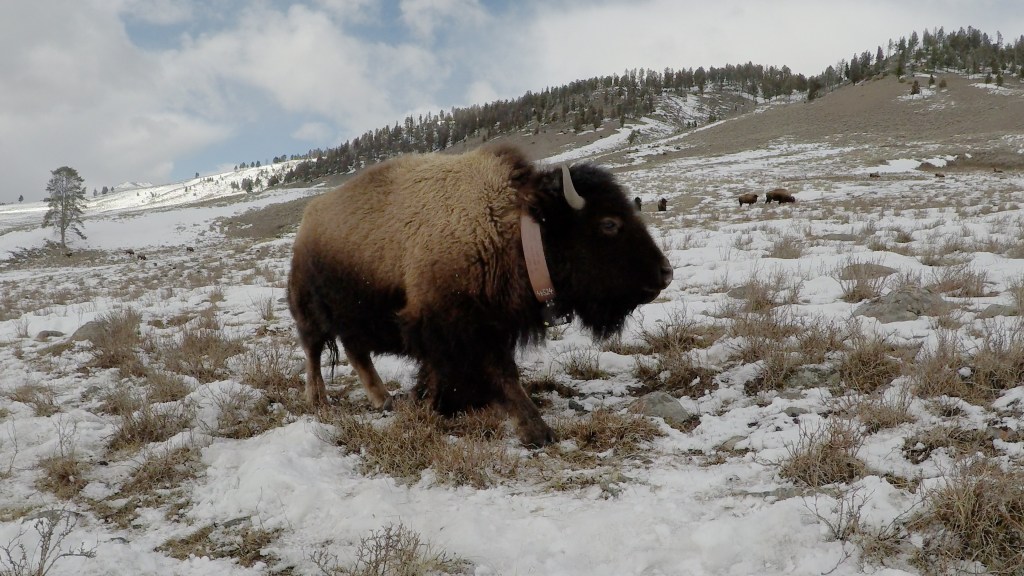
And soon anyone visiting Washington D.C. will be able to watch “What Bison See: Restoring Yellowstone’s Lost Migrations” in the Smithsonian’s Museum of Natural History, the country’s premier nature and science museum. The film shows how bison learned to migrate after near extermination and how the landscape depends on these movements. It will play in the museum for three years as part of its Bison: Standing Strong exhibit as well as in two Yellowstone National Park visitors centers.
A 2,000-pound comeback
By now, almost everyone knows the story of the buffalo, how 200 years ago 30 million to 60 million of them roamed great swaths of North America; how European settlers killed them by the thousands and then millions; and how only a few hundred remained in isolated pockets.
What fewer people know is how they returned in places like Yellowstone National Park, where at one point only 23 buffalo clung to life. Year by year, those buffalo reproduced, then their offspring reproduced, and then their offspring reproduced. They largely stuck to the Lamar Valley portion of Yellowstone until the brutal winter of 1942, when about 130 of them mobilized and headed northwest to less snowy pastures. Each decade after, Yellowstone buffalo continued to expand their movements, walking through valleys, trudging through snow and fording rivers following the green wave of nutrition.
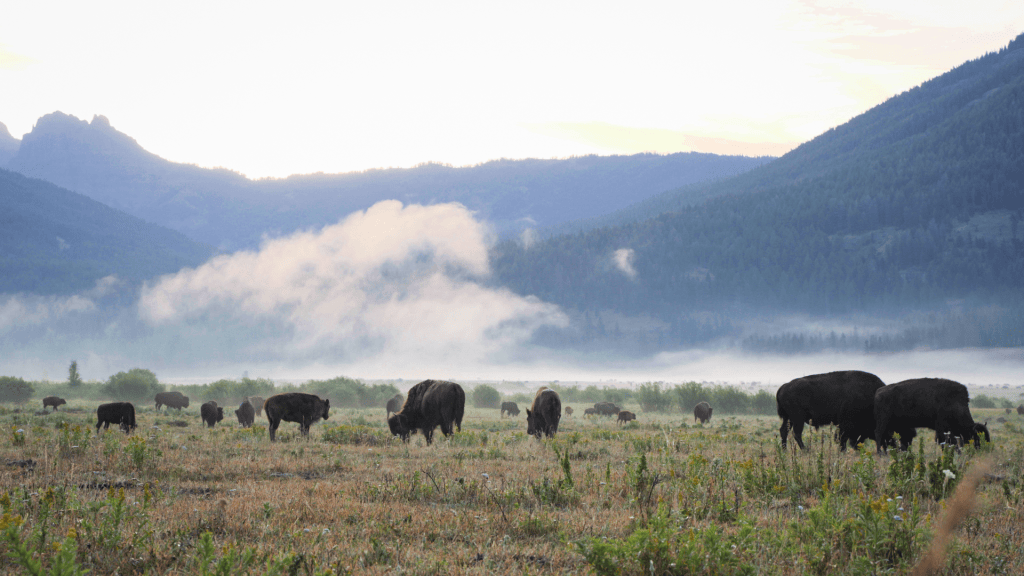
Fast forward to today, and Yellowstone’s more than 5,000 bison make a dizzying array of migrations through the park, some up to 70 miles long. Yet researchers still didn’t know how bison knew to make the various migrations, to find better food or escape deep snow.
So University of Wyoming researcher and the film’s co-director Janey Fugate combed through historical records looking for any mention of bison that would indicate a possible migration. Her work built on decades of data compiled by the park’s first female biologist, Mary Meagher. Fugate realized that bison repeated, over and over, the same approach they took in the 1942 winter. They tended to stay in an area until their numbers were large enough and the snow piled deep enough that it pushed them to search for food elsewhere.
Then they established that path as an annual migration option for when conditions merited movement, passing that knowledge to the next generation.
“Bison are very dynamic in their groups and spend lots of time with each other in the park as their individual knowledge gets passed rapidly back and forth,” said Chris Geremia, a biologist and Yellowstone National Park’s bison manager.
In their wake, they left “interstates,” he added, pathways sometimes 20-animals-wide and visible from space.

But their impact on the landscape wasn’t just in highways. Years ago, Geremia noticed a kind of perpetual spring in areas where bison grazed. The grass kept growing back over and over late into the season. So he and University of Wyoming researcher Jerod Merkle, along with Washington and Lee University researcher Bill Hamilton, studied the soil and grass in areas heavily grazed by bison, and discovered that bison feces acted as a natural fertilizer, stabilizing the soil’s carbon and speeding up its nitrogen cycling.
The buffalo, Geremia realized, were farming portions of Yellowstone, creating more nutritious grass, not just for themselves, but all the other herbivores in the system. And because buffalo moved around so frequently, those farming techniques spread far and wide.
Neither the film nor the bison story stops there, though.
Room to roam
Plenty of habitat still exists in Yellowstone for more migrations, Geremia said. But states like Montana, where bison migrate out of the park, have minimal tolerance for the large-bodied species with little respect for fences. Bison can also carry brucellosis, a disease that causes cattle to abort their fetuses. Brucellosis rates in wild Yellowstone-region bison run around 60%, but there’s never been a confirmed case of wild bison transmitting the disease to cattle.
“Bison tend to travel together in large groups,” Geremia said. “If you map the best bison habitat out there it will overlap exactly with private lands outside our protected areas.”
And Montana doesn’t want them. The state went so far as to sue Yellowstone, demanding the Park Service cut bison numbers and prevent the creatures from leaving the park.
Meanwhile, many tribes do want Yellowstone’s bison. The Wind River Reservation, for example, has welcomed quarantined Yellowstone buffalo with open arms.

There, the buffalo are still raised more like livestock than wildlife, said Jason Baldes, Wind River Tribal Buffalo coordinator. But he has hope that one day the creatures will be allowed larger spaces to migrate.
“In order to meaningfully restore this keystone species we have to think bigger,” Baldes said. “And that means that they need to be able to move. They need to be able to cover ground.”
It will require compromise and understanding from both sides, he said, those who want to see buffalo fully restored and those who fear the consequences of an animal that size migrating once again in large numbers.
That’s where the film comes in, Geremia said. The hope is if people can see how bison live, how they raise their calves, the conditions they endure to move to greener pastures and the way they farm their landscape, then maybe minds and hearts can begin to change.
If nothing else, viewed on the big screen, the film gives an intimate look into an animal that is otherwise best viewed from a distance.
Correction: This story has been updated to correct the spelling of Jerod Merkle‘s name. —Ed.

As a seasonal park ranger who has worked in both Yellowstone and Grand Teton National Parks, I continually remain perplexed by the insistence of ranchers and farmers to desire to kill bison that leave Yellowstone in the winter. I do understand why they remain concerned about the brucellosis affecting their cattle, but for a long time now, the information has been out there about there never being a confirmed case of this happening. I would also like to see more emphasis on attempting to give the excess bison to Native American tribes instead of killing them.
Let them run again in as many places as the public will allow and tolerate! Much better for the land than Euro bovines and great eating too when harvested carefully.