


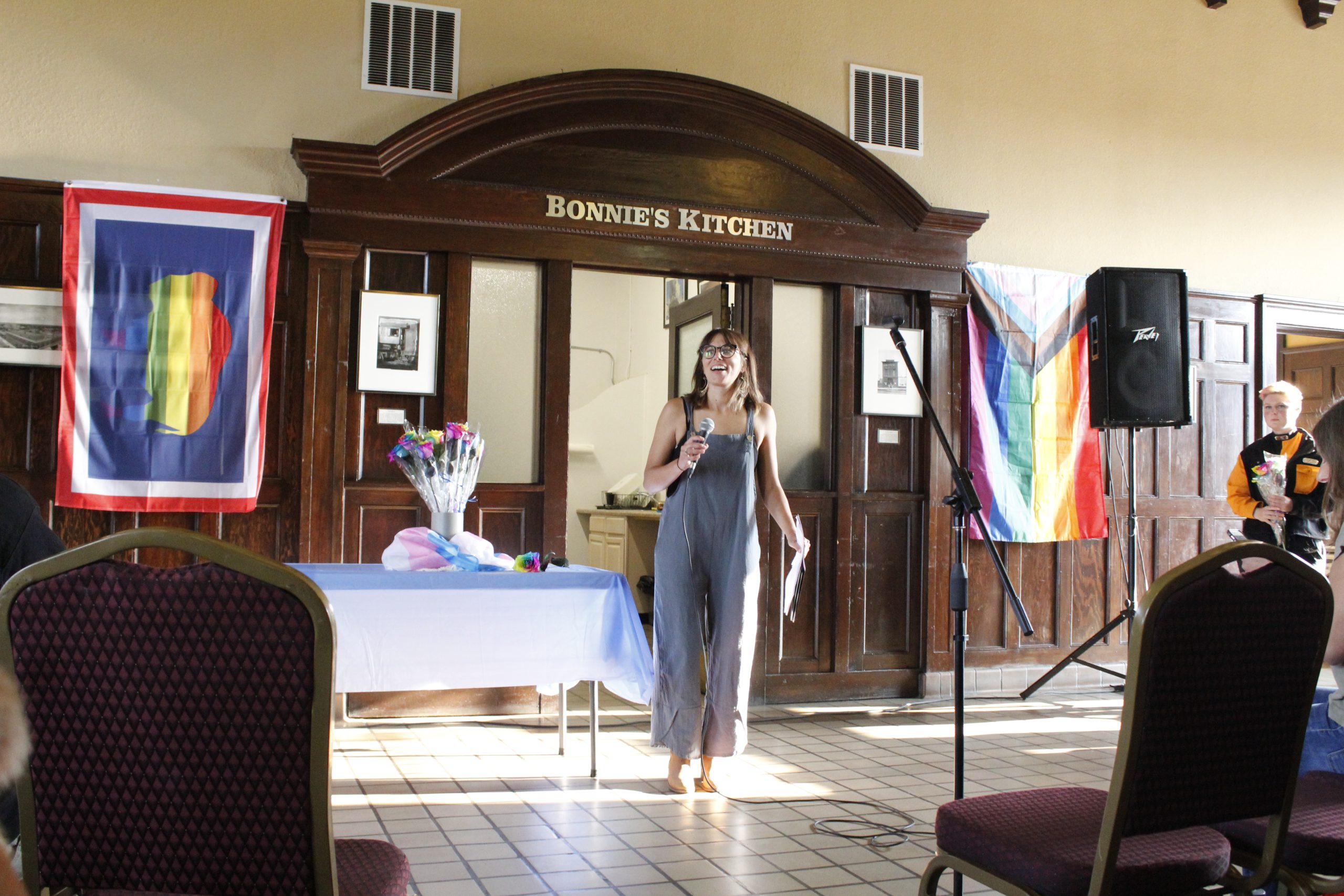
It’s often the most deserving of the spotlight who seek it the least.
Rose Curtis may not want it for herself, but works to make sure it shines on others.
The Laramie resident is behind several projects — from food-centered Community Chow to porch portrait series People of Laramie and live storytelling with Tales at the Taphouse — that pull residents together.
Curtis feels the churn of people moving to and from Laramie, but believes there’s value to bolstering the existing community. She only meant to be here for four months, she said, but stayed 14 years.
“I always make the same joke when people leave Laramie saying that ‘the good ones always go,’” Curtis stated. “But really, good ones stay, too — and sometimes good ones come back.”
From there to here
Curtis is originally from Baker City, Oregon, and lived in Southern California and Colorado before landing in Laramie through a seasonal forestry job in 2009.
A year later, she moved to the area full-time, soon becoming a staple at Coal Creek in downtown Laramie. Curtis worked at the coffee shop and brewery for a decade before starting her current job as a shop manager at Good Vibes Garage, a mechanic shop that aims to promote community and provides sliding fee scales.
Outside of her employment, Curtis has been an inspiration to many with what she does after hours. She taps into some of the oldest communal traditions in human culture: gathering for food and storytelling.
One of her projects was Community Chow, which was a communal food club for people to come together and socialize over home-cooked meals. It encouraged people to give what they could and take what they didn’t have, she said.
“The whole point was to bring people together in a social setting where maybe you couldn’t afford to eat out, but you want that whole vibe of eating out and being around others,” she said.
It was a cheap way for people to gather around a calendar where individuals could sign up to host, bring food or just show up.
“And each host could make it their own,” she said. “Some people wanted potlucks, some people [said] ‘I’m just cooking curry, and there’s no cap, the more the merrier’ … And then COVID happened.”
The COVID-19 pandemic put an end to the gatherings, but Curtis said the group put together an “online cookbook club” for a while, cooking and talking recipes over Zoom. However, with the end of communal eating, Curtis brought a new idea to the table: People of Laramie.
Porch profiles
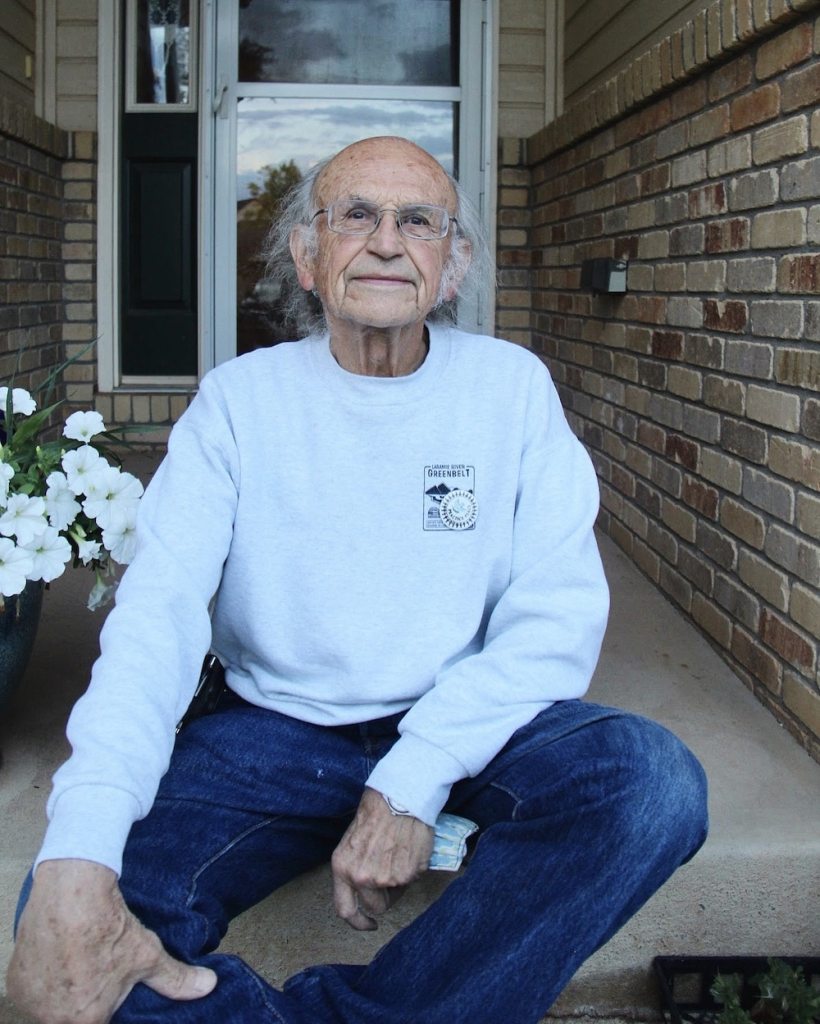
People of Laramie was similar to photography projects like Humans of New York — though Curtis said she wasn’t aware of it at the time. Her own project was focused on photographing and talking with Laramie residents on their porches or front stoops at a time when distancing was the norm.
The stories she captured ranged from isolation and a yearning for togetherness to those who were thankful for what they had.
“I have lived through several years of the Great Depression, World War II, the Korean War, Vietnam conflict, and 911,” Germaine St. John told Curtis. “This pandemic has by far had the greatest impact on my life … However, with this virus coming into being in my lifetime, I am pleased that I am living in Laramie, Wyoming. My support system has been tremendous, including many friends who have been there for me, calling on the phone, zooming frequently and delivering ‘goodies’ to my patio door.”
A chat about People of Laramie was how Celeste Havener first met Curtis. Then there was a second meeting at Good Vibes, she said, “which is also a pretty stellar deal. You know, they work really hard to be very community oriented there.”
As the founder of the Laramie farmer’s market and someone who’s done community assessments — identifying local needs and gaps in service — around Wyoming, Havener said she truly values community building. Soon enough, Curtis and Havener got to talking about Curtis’ largest and longest-lasting community project: Tales at the Taphouse.
Tales at the Taphouse provides a venue for community storytelling, often hosted at a business or Laramie’s Train Depot. Similar to the Moth, it involves 10-minute stories about a particular theme told by women-identifying, LQBTQ and non-gender-conforming locals.
Havener was intrigued by the project, she said, because Curtis is “a pretty awesome person.”
“[Curtis is] not one of those people that immediately jumps out as ‘oh, she’s a shaker and a mover!’ She’s much more subtle. But nonetheless, she’s really effective,” Havener said.
Curtis invited Havener to tell a story based on the theme “belonging.”
“It was really perfect,” Havener said.
Havener had experienced a hard few years, including battling cancer, then facing COVID-19, then having the cancer come back. She questioned whether she still belonged in Wyoming as politics and other topics divided residents.
“The weird part of the cancer coming back was the awareness of community, of what I had,” she said. “And people that maybe [didn’t] sit on the same side of the political spectrum … were coming with just crazy things, like hay for the horses so I could go to treatment in Colorado, and game meat for the winter, and on and on.”
Havener said Curtis’ efforts help make the glue that binds people together.
“It’s a pretty isolated state to begin with, but it can become unhealthy,” she said. “And I think a lot of times we don’t realize how much it takes to keep a community healthy. And someone like [Curtis] is just a godsend.”
Tales at the Taphouse
Tales at the Taphouse started when Curtis worked at Coal Creek Tap. The brewery was hosting “ladies nights,” including discounted drinks on Tuesdays. The idea didn’t sit quite right with Curtis, she said, knowing that the night wasn’t really to benefit women as much as encourage women to come in and buy beers. She wanted to offer something more.
“What could we do that’s more substantial, that really highlights the women of our community to show that we care about them?” she asked.
Resident Emily Reed suggested storytelling, Curtis said, so she gave it a shot. From the first event in October 2018, Curtis was sold.
“I was laughing and crying from the start, from the very first storytellers,” she said. “And it definitely was a need we didn’t know we were filling — from speaker to listener to anyone involved.”
Tales from the Taphouse has continued to grow.
I think a lot of times we don’t realize how much it takes to keep a community healthy. And someone like her is just a godsend.
Celeste Havener
The storytelling can be cathartic and healing, she added, and even those who didn’t sign up have a chance to tell extemporaneous tales at the end of each event.
Even after the first Tales at the Taphouse gathering, it was clear people were no longer just coming for the ladies-night discounted beverages.
“I just knew in my heart of hearts that no one’s here for the beer,” Curtis said. “They’re here for the stories.”
The project has even partnered with nonprofits and organizations in the area, giving them space to talk about the work they’re doing for the community.
People need empathy to connect with others, she said, and projects like Tales at the Taphouse allow them to “stretch and strengthen their empathetic muscles.
“It’s quite possible that this community of Laramie is the only common thread tying someone to something,” she said. “And I care about people having access to welcoming, safe and inclusive spaces. I desperately need these spaces. We all do.”
Tales at the Taphouse inspired a similar project called Fearless Femme Storytelling in Indiana after its own founder happened upon the Laramie storytelling event. The inspiration didn’t stop there.
Bob Vines is a prevention specialist for the Wyoming Coalition Against Domestic Violence and Sexual Assault, engaging men and boys in gender-based violence prevention.
He came across a Tales at the Taphouse flier at Coal Creek Tap one night, he said, “and I always knew that, with my background in gender-based violence prevention … that storytelling plays a huge role in culture change.”

Vines reached out to Curtis, he said, and ended up partnering with her for a storytelling night focused on masculinity and gender norms called Man Up. But before the event could happen, Vines ended up in the hospital with COVID-19.
“Rose and other collaborators just stood up and made sure that that thing went off as smoothly as it did,” he said. “I don’t think it would have happened if it wouldn’t have been for Rose … So many people showed up, and that’s really a testament to her.”
From the bedrock of that first event, Vines built the male storytelling event Men Speak, the next of which will be on June 20 in Cheyenne. Hosted by Safehouse Services and the WCADVSA, the events challenge hyper-masculine gender stereotypes to help change the culture.
Curtis is “amazingly supportive,” Vines said, “and she’s always been there for us.”
“She’ll host these storytelling events, but she doesn’t keep the mic because she provides the space for other people,” he added. “And that’s what is so cool about her.”
Storytelling is vitally important to building healthy communities, Vines said, especially with how easy it is to become isolated in Wyoming. As of the latest federal data in 2021, the state had the nation’s highest suicide rate.
“We think that part of what makes us Wyomingites is our solitude, and we confuse solitude with isolation and loneliness,” he said. “That’s one of the reasons why our suicide rates are so high. And it’s also a reason why our violence rates are so high.”
Following his work with Men Speak, Curtis also encouraged Vines to sign up for a storytelling workshop. After that experience, Vines said he was encouraged to get a certification to provide other storytelling workshops to help bolster these kinds of storytelling events elsewhere.
“What she does, does have a habit of branching out,” he said of Curtis. “I mean, how can you not get excited if it’s coming from Rose? She just has that personality where you just want to be involved with whatever she’s involved with.”
Curtis is galvanized by the volunteers and people who participate in storytelling to continue facilitating these projects.
“They are courageous, brave, intelligent, witty, and creative people who often reveal their humility, weaknesses, truths, failures, and are able to laugh at themselves which gives me something to strive for, connect to, and gives me permission to be human myself,” she said.


I met Rose as a story teller for the second Tales at the Taphouse back in 2018, and ours developed into a friendship that would change my life. Rose creates and supports safe spaces in our community for people to connect as their genuine selves. It’s a gift to participate and we are so grateful for Rose!