

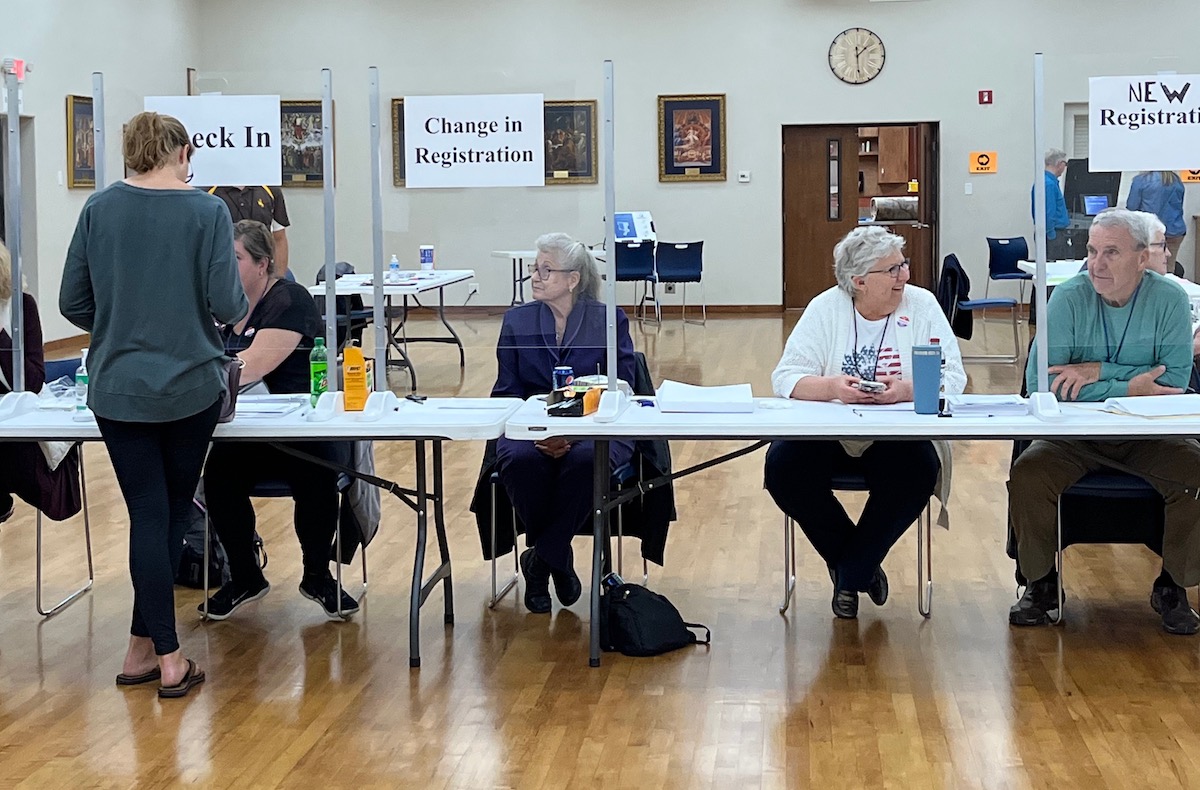
CHEYENNE—Wyoming Supreme Court justices grilled attorneys Wednesday on the constitutionality of the state’s crossover-voting ban, which limits how and when residents may affiliate with a political party.
Since it was filed in August 2024, the lawsuit has taken a few twists and turns. Initially, the legal challenge sought to overturn the state’s “sore loser law,” a prohibition barring failed primary candidates from appearing on the general election ballot as independents. The complaint expanded in 2025 to also challenge the state’s closed primaries and party affiliation restrictions. In November, a Laramie County District Court judge upheld the laws, siding with the state and ruling that the statutes are a “valid exercise of legislative power.”
The plaintiffs, who include voters, former political candidates and a retired state lawmaker, filed an appeal in March to the Wyoming Supreme Court and narrowed their complaint to challenge the lower court’s ruling on the state’s crossover-voting ban.
More specifically, the plaintiffs are now asking the high court to declare the ban unconstitutional and to allow voters to affiliate with political parties under the previous law. They point to two sections of the Wyoming Constitution — one that protects the “untrammeled exercise of the right of suffrage” and another that guarantees “equal political rights.”
Lawyers with the Wyoming Attorney General’s Office pushed back at Wednesday’s hearing, arguing that the case is not about voting rights but the state’s constitutional interest in protecting the purity of elections.

The suit names Secretary of State Chuck Gray in his official capacity as the defendant.
“I have defended and will continue to defend Wyoming’s primary system and our ban on crossover voting amid these radical Left attacks in court,” Gray wrote in a statement to WyoFile.
After plaintiffs filed their appeal in March, Supreme Court Justice Bridget Hill recused herself from the case because she was attorney general when the lawsuit was initially filed in 2024. (It’s the attorney general’s job to represent and defend the state’s interests in civil cases such as this one.)
Wyoming 7th District Court Judge Joshua C. Eames is filling in on the case.
How we got here
For decades, Wyoming had a partially open primary election system. That meant voters were restricted to casting ballots in races that aligned with their political party affiliation, which they were allowed to change on Election Day and during most of the early voting period.
The one time voters couldn’t change affiliation included the two weeks leading up to Election Day. In 2023, Wyoming lawmakers extended that period to the 96 days prior to the primary in order to ban what’s known as crossover voting.
The restriction now lines up with the candidate filing period, requiring voters to affiliate with a party before the slate of candidates has been finalized. Supporters of the law said it was needed to stop registered Democrats, minor party and unaffiliated voters from changing their party affiliation in order to participate as Republicans in the primary election.
The law is what prevented Joshua Malcom, one of the plaintiffs, from casting a vote for his brother, Matthew, in the 2024 primary election for House District 61 in Cheyenne, according to the lawsuit.
As an unaffiliated voter, Joshua could not cast a vote for his preferred candidate, his brother, because he is not a registered Republican. Similarly, plaintiff Christina Kitchen, a Teton County plaintiff, was prevented from voting for her brother-in-law, Jim Rooks, when he ran as a Democrat for the Teton County Commission in 2024. Kitchen was a registered Republican at the time.
Jim Roscoe, another plaintiff in the case, once represented House District 22 as the Legislature’s sole independent lawmaker. That lack of an affiliation has prevented him from participating in Wyoming’s primary elections.
Wednesday’s hearing
The law “advances no public purpose,” William Schwartz, an attorney for the plaintiffs, told the court Wednesday in his opening statement.
“It solves no problem,” he said.
Instead, it “advances only partisan interests of one party,” Schwartz said, and in doing so, infringes on the right to vote explicitly enshrined in the Wyoming Constitution.
If voters have the right to choose their preferred candidate in every election, Justice G. Fenn posited, would that not force an open primary?
Fenn described a hypothetical example of a voter in a primary election wanting to support a Democratic candidate in one race and a Republican candidate in another.
The plaintiffs are not arguing in favor of an open primary, Schwartz responded. Instead, the problem, he said, is the requirement that voters affiliate with a party by a certain deadline.
Judge Eames asked if the Legislature could adopt any sort of statute that would place restrictions on voters or elections. Yes, Schwartz responded, pointing to laws that determine, for example, when and where elections take place. Those laws are applied to voters equally, Schwartz added.
Later, Fenn pointed to Article 6, Section 13 — a part of the constitution the defendants highlighted in their own filings.
“The legislature shall pass laws to secure the purity of elections, and guard against abuses of the elective franchise,” it reads.
That seems to define the role of the Legislature, Fenn said.
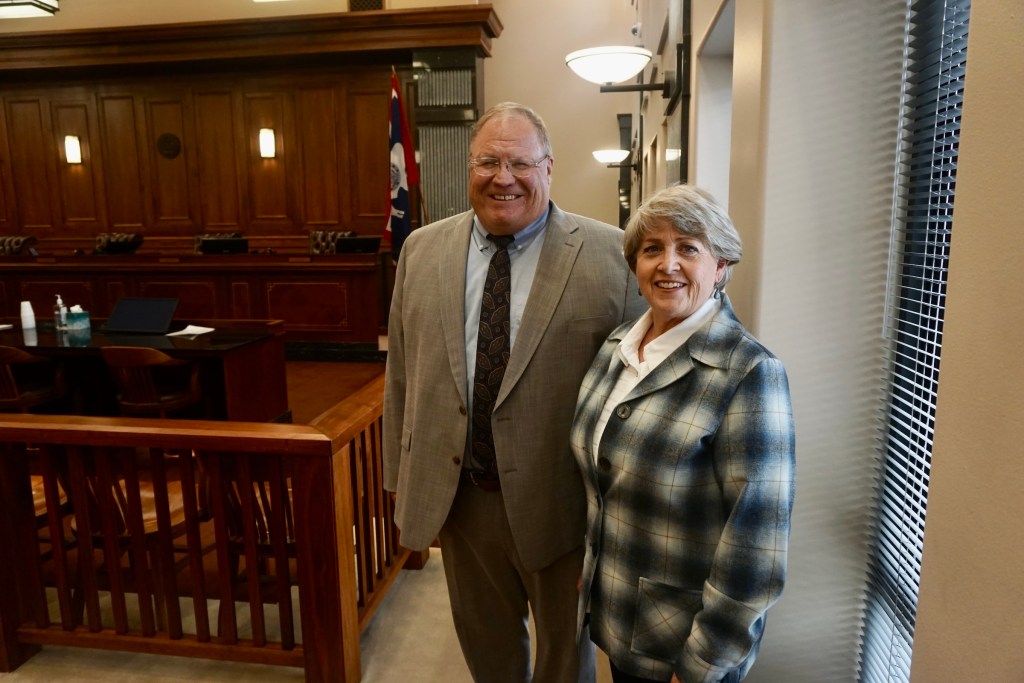
In his opening statements, Deputy Attorney General Mackenzie Williams told the court, “this case is not about voting rights.”
Voters are not entitled to select a nominee for a political party they are not a member of, Williams added.
Chief Justice Lynne J. Boomgaarden asked Williams, when does an infringement, specifically one that restricts party affiliation changes, “go too far?”
There is no case law in Wyoming, Williams said, but when looking at other jurisdictions, there is a point when it can go too far, such as one U.S. Supreme Court ruling that voided a 23-month-long restriction. Otherwise, Williams said, it’s not an easy question to answer where to draw the line.
“Wherever the line is,” Williams said, “we are on the correct side of it. “
Again, Boomgaarden returned to the question of infringement, arguing it’s less arbitrary than drawing a line. In response, Williams told the court every voter has the ability to cast a ballot in the general election.
The court will now take the arguments made during the hearing into consideration before publishing a written decision in the case.

The prohibition against switching parties violates the 1st Amendment right of freedom of association. You have the right to associate with, or disassociate with, any person or group immediately and at any time – not just when it isn’t election season. This is a fundamental Constitutional right that the Court can’t argue with. You must always be able to switch parties.
I agree totally. We as American citizens should be able to vote who we find the most qualified person to represent us. It does not matter what party. And get rid of the Electoral College voting as well!!
Just have open primaries and be done with it. What’s so bad about that? All the current arguments concerning crossover voting are tedious. If I want to vote for the weakest most unqualified Republican I should be able to do that.
I agree totally!
You know this basically is a Republican state. There are few to none that could be defined as radical left. The folks living here are representative of what freedom really is and has been in Wyoming since before it became a state. We have been a live and let live state which I would call a community that became a state. We want equality and justice for all. We want the ability to select our representation not only at state level but Federal and in each county and town. Those elected are to represent all constituents, not just a party platform. The name calling and assertion that their are “Rinos” , “Libtards” , “Communists” , and whatever other fanatical names that are circulating is ridiculous. The majority of Wyoming citizens are very close in their beliefs and may have some differences, but they are not and never have been any of those names brought forward by the Freedumb Caucus and individuals like Gray, Bear, Rodriguez-Williams to name a few. Actually open primaries would benefit this state a great deal because we would all be able to select the actual best candidates to run and be elected that would represent Wyoming and not a party. Especially, a party that has been fractured by out of state interference and carpetbaggers looking to gain access to a political career at the expense of the citizens and the state of Wyoming.
The only radical that I can see out there is Lil’ Chucky – “it takes one to know one” as the saying goes. Who are these “radical Left” folks anyway, Chucky? What a doofus!
Chuck Gray Secretary of State has accomplished nothing in his position. He keeps touting more election laws that are unneeded. It is his job to oversee the elections in the state of Wyoming along with the county clerks. Apparently, he feels insecure about his ability to perform the task of Secretary of State so he sends our voter information to the government of the United States to over see to make sure that Wyoming‘s elections are fair and honest, so he clearly feels he cannot do his job. The elections in this country are ran by the states and there is some president who wants to change that making the federal government run the elections. I can’t even believe Maga would want that.
Radical left… radical left…. radical left. Our diminutive secretary of state is a damned broken record.
You know what’s funny Steve.
Every broken record has the flip side.
MAGA, MAGA, MAGA
MAGA is a name the goofballs chose for themselves.
Not quite, he also whines endlessly about “woke windmills”. I’d love to hear his explanation of how inanimate objects like wind turbines can subscribe to political ideologies like wokeness, although I suppose it of necessity would be so convoluted and insipid it’d make any rational person’s brain bleed.