One of the things I most love about living in Wyoming is how close we are to the animals with whom we share our state. This closeness leads me to thoughts on neighborliness, human-animal relations and the many barriers we face.
Opinion
In 1998, a research team led by biologist Hall Sawyer began its work documenting the 120-mile-long mule deer and pronghorn migrations from the Upper Green River Basin to Grand Teton National Park. Using radio collars and both aerial and ground observation, Hall’s group gave us the first data-driven description of these animals’ migration, which led in 2008 to the first federally recognized migration corridor in the United States.
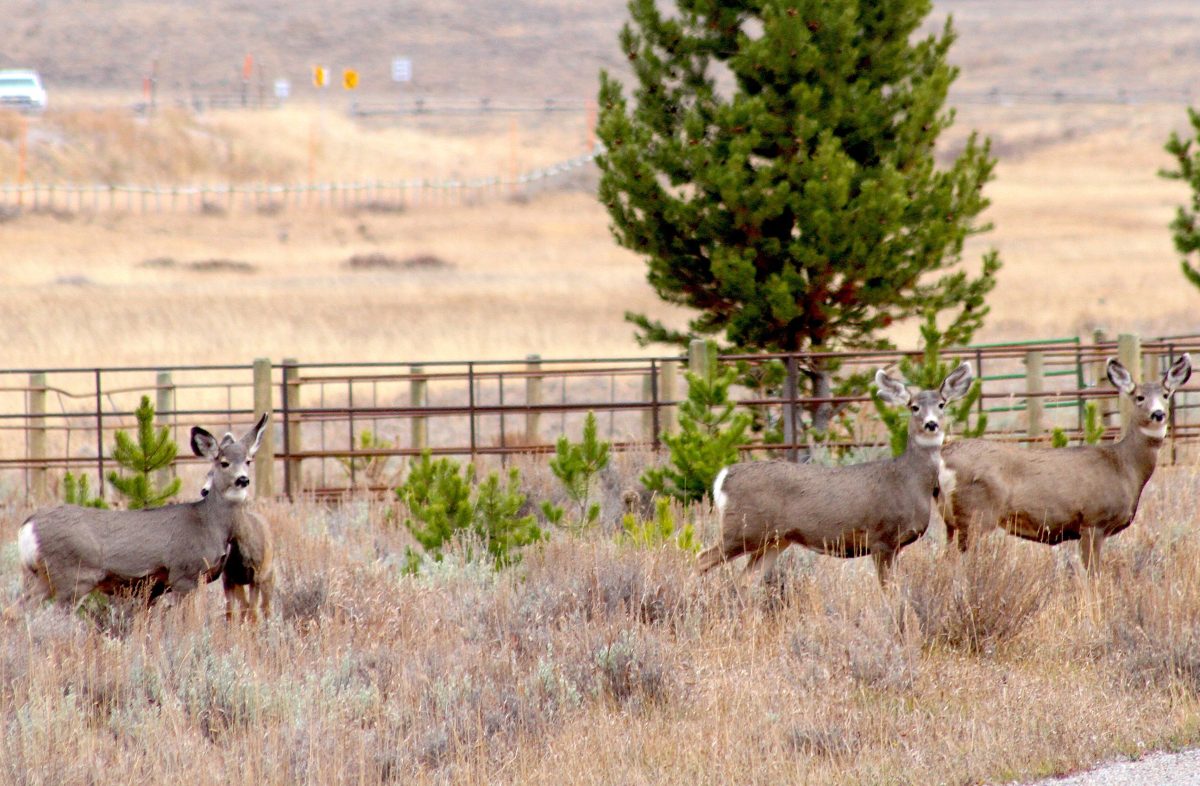
In January 2011, another research team, also led by Sawyer, began the work of tracing the migration of mule deer from their low-elevation winter range in the Red Desert to their summer range in the high mountain slopes around the Hoback Basin. The team equipped 40 mule deer with GPS collars that collected locations every three hours for two years. Ultimately, the data revealed a seasonal migration of 150 miles, the longest mule deer migration recorded in the continental United States. This migration was longer even than the 120-mile-long pronghorn migration documented by Emilene Ostlind and Joe Riis, and previously believed to be the longest ungulate migration in the Lower 48. One mule deer completed the longest individual migration in the world — 242 miles one way.
While both the pronghorn and the mule deer face many natural obstacles in their journeys, including sand dunes and water crossings, perhaps the most daunting obstacles are those presented by human activity. For the mule deer, the route includes crossing Wyoming Highways 28 and 352 as well as swimming across high-use recreational waters in the Finger Lakes area. They must negotiate drilling pads and housing developments and in some places pass through bottlenecks where houses, roads and fences squeeze their route down to a width of fifty meters. And they must cross more than a hundred fences.
These obstacles made me think of borders. The relative absence of a border between the human and non-human worlds is one of Wyoming’s great gifts. Yet while we relish our closeness to our animal neighbors, we sometimes separate ourselves from our human ones. We create borders of many kinds, including those powerful imaginary lines we draw on the earth and which we use to control each other’s movements.
But these human-made borders don’t just shape and limit the lives of human beings. They have an equally strong power to control the non-human species who depend upon habitat and food sources that lie on opposite sides of the borders. The wall being built by the US government along our border with Mexico is a fine example of the problem. In the completed portions of the wall dividing Arizona and Sonora, metal slats placed at four-inch-wide intervals allow passage to animals no larger than rabbits. But the area’s mountains, which know no borders, are stepping stones across harsh desert into the San Rafael Valley, one of the last intact expanses of Sonoran Desert grasslands in Arizona. The valley offers crucial habitat, food sources and water for many large species, including bears, wolves, javelinas, pronghorn and several rare and endangered big cats — ocelots, jaguars and mountain lions. Without the ability to cross what for the animals is a truly imaginary line, these species face lives that are ever more precarious. And these animals have no legal recourse — they can’t apply for either a Mexican or US passport to present at border crossings.
But somehow we find ways to work around the lines that divide us. I was mountain biking one late afternoon in fall, coming down from Mosier Gulch to Buffalo along Clear Creek. At a spot above the Turkey Lane trailhead, a deer ran across the path ten yards in front of me, followed moments later by a mountain lion whose heat I could feel and scent I could smell. It was both frightening and exciting, the two animals intertwined in their separate difficult lives, both lives so close to my own.
It brought to mind the James Dickey poem “The Heaven of Animals,” in which the writer claims that in heaven, the animals who lived in a wood will live forever in a wood and those who lived on open plains will live forever on those plains, the grass rolling away under their feet. The hunters will hunt and the hunted will be caught and fall, but rise to live again.
Not long after that bike ride, a friend saw a mountain lion crossing Highway 196 just south of Buffalo. But the cat wasn’t crossing the road where it might be hit by a car. Rather, it was walking along an irrigation pipeline that crosses above the road, the big cat balancing there like a circus tightrope walker. Maybe that’s all of us, human and animal, walking the tightrope of life, seeking to cross the boundaries that divide us.