



Delta-8 THC and similar hemp-derived substances will remain illegal to sell in Wyoming following a federal district court judge’s decision today not to grant a restraining order or injunction on the ban.
“Public interest is best served by denying Plaintiffs’ Motion for Preliminary Injunction,” U.S. District Court Judge Kelly Rankin wrote Friday. “The Court appreciates the hardships [the ban] places on Plaintiffs. It is unfortunate their businesses face financial strain and they cannot use the substances that help them. But those burdens are part of living in society.”
Plaintiffs in the case — a coalition called the Hemp Community of Wyoming that includes retailers, manufacturers, consumers and a farm — filed suit on June 28 to overturn the ban, which took effect July 1. They also asked the judge to suspend the ban while the challenge played out in court. The state, governor, agriculture department director and attorney general’s office are named as defendants.
While the lawsuit will continue and could overturn a ban the Legislature passed in March, Rankin said the plaintiffs did not meet the standards to secure a temporary restraining order or preliminary injunction. Violations of the new law risk penalties of $750 in fines and up to 6 months in jail.
Mandy Flint, a plaintiff who helped form the Hemp Community of Wyoming, said she’s encouraged by part of the judge’s ruling because she feels he clarified some confusion over the law by specifying that CBD remains legal.
In his ruling, Rankin wrote: “The gravamen of [the plaintiffs’] argument at the hearing was that it appears CBD is now banned. That is not the case and Defendants affirmatively agreed CBD is not banned.”
Flint also noted that the judge specifically said the law is meant to only ban “artificial” or man-made substances, citing it as a synonym of “synthetic.” The plaintiffs’ shops only sell synthesized, naturally-occurring delta-8, she said, nothing man-made.
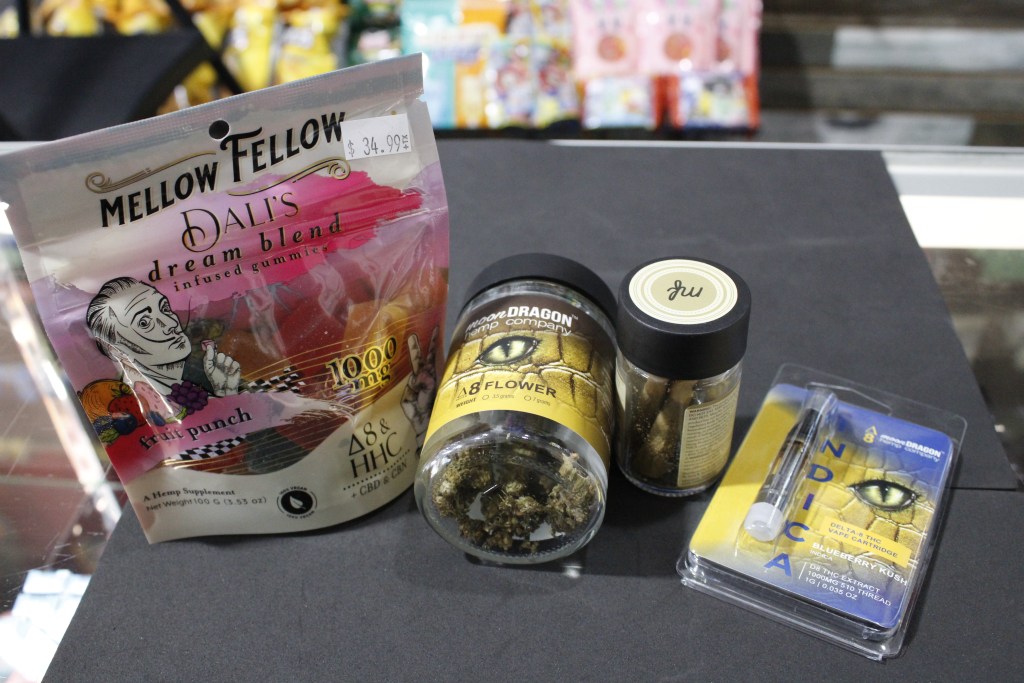
“What the addition of ‘synthetic substances’ does is prohibit the addition of artificial psychoactive substances to hemp products,” Rankin wrote. “Assuming here is ambiguity, [the ban]’s purpose and the legislative intent was to exclude those artificial substances from otherwise legal hemp products.”
For Flint, this is encouraging, but she believes questions still remain over whether their naturally-occurring but lab-synthesized delta-8 would continue to be considered illegal to sell in Wyoming.
From Rankin’s ruling, he likely doesn’t think so.
Flint isn’t sure yet whether the group will appeal the decision to deny their requests to delay the ban’s implementation.
Day in court
Parties to the suit made their cases for and against the injunction July 12 amid a heatwave that luckily didn’t reach the courtroom. A few dozen observers occupied the wooden benches before Judge Rankin.
The court first addressed some housekeeping, with the judge asking whether everyone agreed with dropping the district and county attorneys from the list of defendants. Everyone acquiesced.
Nearly three hours of arguments followed, including seven people — all parties to the suit — testifying in favor of the injunction and a crime lab employee testifying at the behest of the state.
The plaintiffs
Plaintiff attorneys Donna Domonkos and Brittany Thorpe argued that the law should be put on hold. In order to procure that injunction or restraining order, they said they could prove a likelihood of winning the case challenging the ban, irreparable harm to plaintiffs that’s greater than harm to the state and that a pause is in the public interest.
They listed several reasons plaintiffs felt the ban would likely be found unconstitutional. These included a claim that the law unconstitutionally narrowed the federal definition of hemp. This limited what federally legal products could be sold and possessed, they said, which also stepped on the toes of the interstate commerce clause: You can’t stop federally legal products from passing through.
Rankin interrupted the plaintiffs’ opening and closing arguments with questions and comments about the state’s interest in regulating substances for health reasons and states’ abilities to pass laws stricter than federal counterparts, signaling some doubts.
Later, in his denial, Rankin stated that the federal legislation cited “permits States to impose more stringent restrictions,” and that the ban places “an insignificant burden on interstate commerce.”
“Public interest is best served by denying Plaintiffs’ Motion for Preliminary Injunction.”
U.S. District Court Judge Kelly Rankin
Plaintiffs also argued the ban is unconstitutionally vague. Jeremy Banks with Casper hemp product manufacturer and retailer PolyXtracts provided some chemistry-heavy testimony as to why he believed the phrases “psychoactive” and “synthetic” used in the ban were so hard to interpret.
Senate File 32 – Hemp-limitations on psychoactive substances states that no one shall: “Produce, process or sell hemp or hemp products containing more than three‑tenths of one percent (0.3%) THC on a dry weight basis … Add, alter, insert or otherwise include any synthetic substance into hemp or hemp products produced, processed or sold in accordance with this chapter.”
It defines THC to include “psychoactive” analogs or isomers of THC, later defining synthetic substances as “any synthetic THC, synthetic cannabinoid or any other drug or psychoactive substance.”
“Psychoactive” could be interpreted to mean anything from CBD to certain vitamins or even sugar because they bind to receptors in the brain, affecting someone’s mood, Banks argued. And beyond that, he added, many CBD products could also be considered “synthetic” because of what they’re mixed with and how they’re processed.
Rankin’s ruling shows that while he believes the “degree of the psychoactive effect could cause uncertainty,” he pointed to a Wyoming statute — 14-3-301(a)(xi) —- that more narrowly defines “psychoactive” to mean a substance with a stimulant, depressant or hallucinogenic effect that’s “substantially similar to or greater than” the effects from controlled substances.
Addressing irreparable harm, plaintiffs who took the stand talked about how substances like delta-8 affect their health and their bottom lines. Plaintiff Mandy Flint testified that she was able to stop using pharmaceuticals to treat temporal lobe epilepsy and ADHD, instead relying on delta-8, which she said had less negative side effects. She also said it was unclear whether she could legally have the product at home.
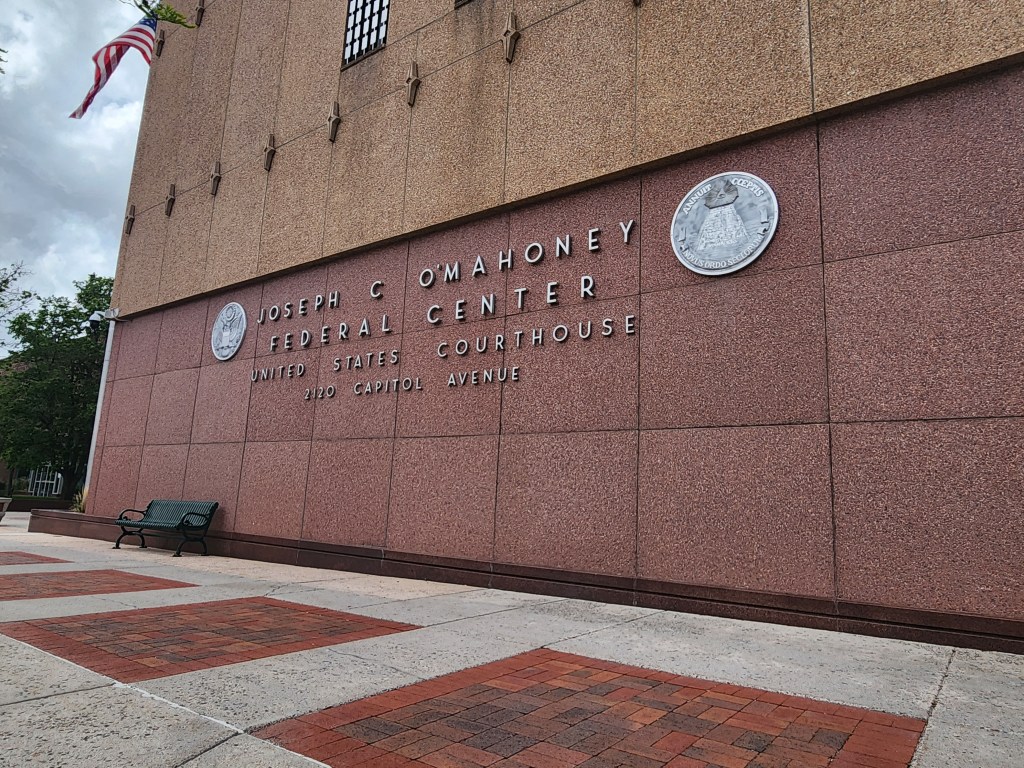
Meanwhile, Sam Watt, who co-owns Platte Hemp Company, said he uses delta-8 for PTSD from his military service. Not only does the substance help him, but his five shops around Wyoming are losing a cumulative $10,000 a day since the ban went into effect July 1, he said, mainly from now-banned products. Meantime, he said his workforce shrunk from 37 employees to 19 after many quit.
“They just feel like [Wyoming] is a lost cause,” he said.
In his order, Rankin disagreed that these concerns qualified as irreparable harms that couldn’t be remedied via “a full adjudication on the merits, nor does it outweigh Wyoming’s interest in enforcing its laws.”
“There is not a potential loss of a constitutional right, imminent physical harm, nor other category of harm that fits within ‘irreparable,’” he wrote. “Irreparable harms require more than economic loss and the use of a drug of choice.”
The state’s case
The state’s attorney, Kellsie Singleton with the Attorney General’s office, argued the federal definition of hemp as outlined in the 2018 Farm Bill didn’t grant a right to own or sell substances like delta-8.
“My research on the Farm Bill couldn’t find such a right,” she said in court Friday.
Technically, most delta-8 products were also already considered illicit synthetic substances under Wyoming law before the ban, she said.
The trouble is that state crime lab employees couldn’t tell the difference between legal naturally occurring delta-8 and illegal synthetic delta-8. While products with a lot of delta-8 were assumed to be illegal because the compound only naturally occurs in miniscule amounts in the plant, it’d be hard to prove.
The 2018 Farm Bill definition — and the same definition adopted by Wyoming — states that legal hemp doesn’t contain more than 0.3% delta-9 THC on a dry weight basis. Delta-9 THC is the main intoxicant in marijuana.
Other states have banned delta-8 and similar substances, too, including pot-friendly Colorado. Testimony from Jeff Craven, owner of Laramie-based Up N Smoke II, said people from that southern neighbor even travel to Laramie to get delta-8.
Singleton also argued that the ban wouldn’t violate the interstate commerce clause, because it would allow for federally legal hemp to pass through, and that lawmakers are within their right to pass laws to safeguard public health.
The Food and Drug Administration has warned that delta-8 can be created using harmful chemicals and isn’t federally regulated. Several Cody teens were hospitalized after taking what they said was delta-8. Plaintiffs argue that they are already prohibited from selling to minors.
According to the 9th Circuit Court of Appeals, delta-8 is considered a federally legal substance because of the Farm Bill definition.
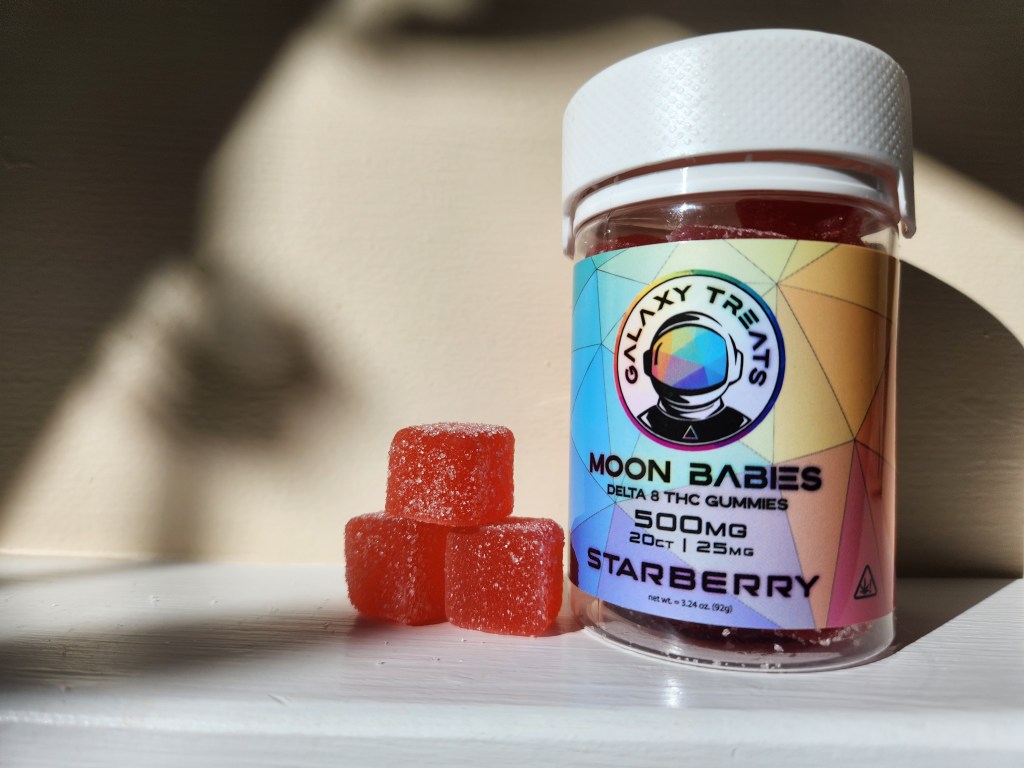
While there may be disagreements as to exactly how the law should be understood, Singleton also argued it shouldn’t be considered unconstitutionally vague, pointing to other complicated sections of criminal code.
“Difference of interpretation is not enough” to meet the legal standard of vagueness, she said.
When asked what synthetic means, Sarah Barrett with the state crime lab gave some examples. For one, she pointed to naturally-occuring testosterone versus synthetic testosterone supplements that can be bought at a store.
Singleton said that CBD wasn’t psychoactive and that CBD products didn’t involve synthetic substances, so therefore it wasn’t illegal in Wyoming. Lawmakers reiterated before and during the session that they didn’t intend to outlaw CBD products.
Judge Rankin hinted at doubts in Singleton’s opening argument, telling her that the definition for psychoactive seemed “muddy” to him. However, in his final order, he conceded her point, writing: “Its terms, while not perfect, also do not amount to unconstitutional vagueness and give sufficient notice of the prohibited conduct.”
Closing loopholes
The booming market for delta-8 — and its similarly structured siblings and cousins like delta-10 — grew out of a perceived loophole in the federal definition of hemp that was later adopted by Wyoming.
The definition defined federally legal hemp as having only a tiny amount of delta-9 THC.
Delta-8 THC, which occurs naturally in tiny amounts in CBD, was then synthesized into gummies, vapes and many other products similar to marijuana shop offerings in states where medical and recreational cannabis are legal. Delta-8 anecdotally provides a similar, albeit reportedly milder high as marijuana. Businesses blossomed across the state offering the substance, including many represented by plaintiffs in this lawsuit.
This entire state-level fight to keep delta-8 legal could be rendered moot by yet another Farm Bill, though. Most U.S. representatives in the House Agriculture Committee have voted to alter language from that previous legislation, clearly denoting that delta-8 and other, similar substances are not considered legal hemp.

So the federal government passed the 2018 farm bill witch states all delta 8 and cod products are legal under federal law so how can a state ban it like I don’t want to pay Medicare tax but it’s federal so we have to.
Wearing a mask? Vaccination to protect individuals and the community? Women making their own healthcare decisions? CBD? Our individual-rights freedom-loving representatives have a very odd list of things where they in their superior but uninformed wisdom feel they have to make the decisions for us. The hypocrisy is staggering.
Thc is much safer than alchol.It has killed many people and ruined people, families and relationships. Corporate America has made countless money off it ALCHOL NOR DO PEOPLE GET TOTTALY STUPID FROM IT.SOCIETY NEEDS AWAY TO RELAX TO MUCH GOING ON IN THE WORLD.BORN CASPER.IT ALSO HAS MEDISANAL PROPERTIES.
Where is my freedom of choice if you’re gonna regulate the health of a product
Take metformin off of the market. It has more ill causing effects to diabetics. Does any c. B? D?
Synthetic or not.
What happened to my right to pursue my happiness? You guys feel at liberty to strip my freedom Take metformin off of the market. It has more ill causing effects to diabetics. Does any c. B? D?
Synthetic or not.
What happened to my right to pursue my happiness? You guys feel at liberty to strip my freedom with form me Who paid off the legislators?
To outlaw this product.
You did not outlaw alcohol.
Why is Wyoming targeting c? B? D? Because no doubt they’re being paid. Big bucks by BlackRock, who owned all the pharmaceutical companies.
It’s a pay to play.
Impeach all of the legislatures. They have a producerity duty 2. The people not to big corporation.
Check the loyalty. The only way this could have happened is they took a pay off from the pharmaceutical companies that is the truth.
No need to prove it either. Everybody knows that’s how this country is played pay Amor. Sue the legislative branch a Wyoming.
They are the ones that took the payoff and then claim public safety.
As their war cry.
It’s an herbal remedy that should be taken seriously in the medicinal sense it helps so many people who have to take real drugs like opioids and the meth pills they give to patients for issues that’s going to cause them to be addicted and cause harm rather than oooh I’m hungry I want a cheeseburger the confusion starts with the fact that everyone gets better and now its illegal when there are far more dangerous substances in your state than cbd y’all need money for your government and your using people to do that Texas did the same
Still Wont stop people that use, Meanwhile the state of Colorado is rejoicing up and down and clapping their hands because they will CONTINUE to provide and profit from Wyoming Resident’s money and boosting their economy at a Billion maybe even Trillion dollar empire now, that’s the good ol boy state for you, good job Wyoming.