

Less than four months after Evanston Regional Hospital discontinued its labor and delivery services, a Utah medical network has stepped in to patch the maternity care gap in southwestern Wyoming.
Intermountain Health is now offering pre-pregnancy, prenatal and postpartum maternal health services in Evanston through a program called Maternal Health Connections.
The program offers a combination of in-person, virtual and home visits, as well as remote patient monitoring, for pregnant people and new mothers. The program can help Evanston-area patients get prenatal and postpartum care without having to risk traveling long distances on Wyoming highways, particularly in dangerous weather conditions.
“Pregnancy can be a difficult time in a woman’s life, and current economic and geographic challenges do not make it simpler,” Ibrahim Hammad, MD, a maternal fetal medicine physician at Intermountain Health, said in a press release. Hammad oversees the new program. “It’s part of our responsibility as healthcare professionals, to not only provide care and treatment in clinics and hospitals, but also to reach out to our patients in an effort to ease their burden. This program is designed to bring maternal care to the patient.”

The news is a bright spot in a health landscape that has seen services erode in recent history. Along with facility closures, hospitals have struggled to attract and retain sufficient staff and diminishing care puts pregnant people and their babies at risk as they travel longer distances to find services. The trend also poses existential threats to communities, as adequate health care is crucial to attracting young families to rural towns, state leaders say.
When Evanston’s maternity ward closed in late 2024, it marked the fourth Wyoming facility since 2014 to shutter its labor and delivery unit and expanded a service gap in the southwestern corner of the state. The hospital cited declining demand.
How it works
Maternal Health Connections provides access to virtual visits from Intermountain OB-GYN physicians and other providers based in Utah, according to Intermountain Health. For in-person care and assistance, an Intermountain Health registered nurse will staff a Maternal Health Connections clinic in the Uinta Medical Building in Evanston. Clinic appointments are available two days per week.
Video conference equipment in the clinic will allow an OB-GYN physician or midwife based in Utah to consult with a Wyoming patient through telehealth, assisted by the on-site nurse. The program also offers remote patient monitoring devices for participating pregnant moms to take home beginning at 28 weeks.
“Our mission is to improve maternal and neonatal outcomes in Uinta County and surrounding communities.” Krystal Richards, the grants project director for Maternal Health Connections at Intermountain Health, said in release. “We’re excited to bring a local maternity care option to these Wyoming families.”
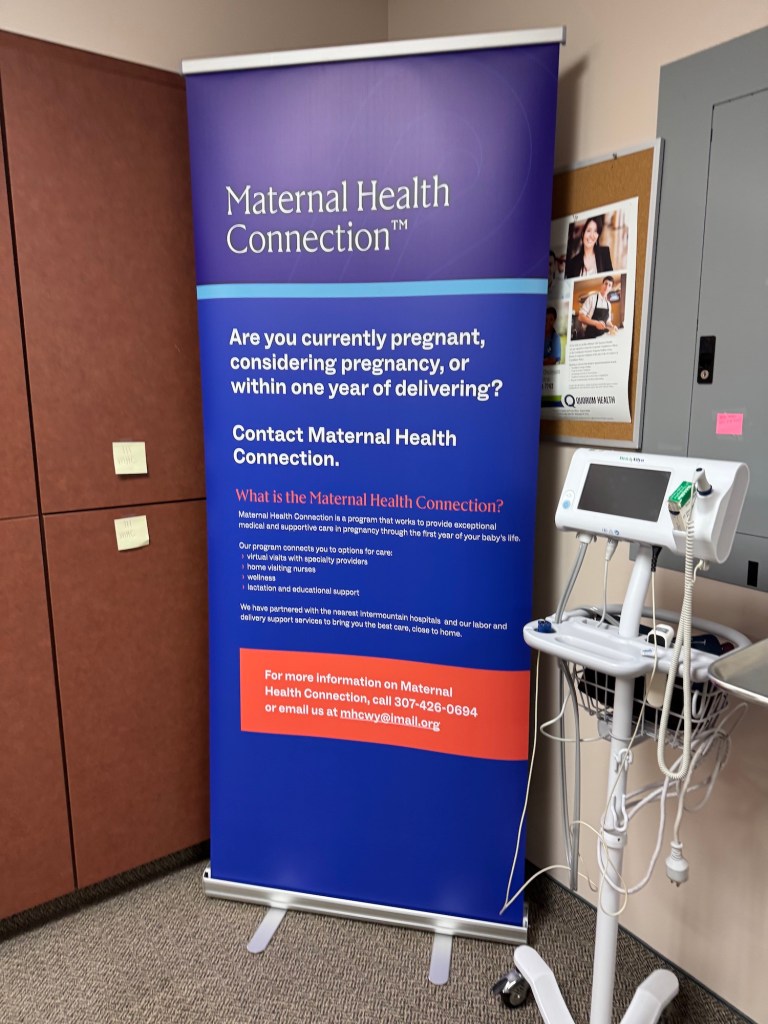
Program patients can deliver babies at Intermountain Health hospitals in Park City or Ogden, Utah, and receive postpartum care through the Evanston-based nurse, including home visits.
A federal Health Resources and Services Administration grant of $3.9 million helped launch the program, according to Intermountain Health.
Interim work
Wyoming’s maternal care gaps have grown drastic enough to capture the attention of lawmakers, the governor and healthcare representatives.
Solutions have been elusive. Complicating the issue are provider challenges like low birth volume in rural areas, high costs of medical malpractice insurance, financial viability struggles for hospitals, the impact of new abortion laws on doctors, liability concerns and regulatory barriers to midwives delivering in hospitals.
Health care advocates have called on the state to expand Medicaid, promote midwifery and build partnerships that could expand care.
The Legislature’s Joint Labor Committee made Wyoming’s maternity care and child care shortages its No. 1 priority between the 2024 and 2025 legislative session. No bill explicitly aimed at alleviating the care gaps emerged from the committee, however. Attempts to increase funding for maternity care programs failed in budget talks, meanwhile.

The OB Subcommittee of Gov. Mark Gordon’s Health Task Force also worked to explore solutions. That group narrowed its focus last summer to three areas: how to better use midwives, doulas and family physicians alongside obstetricians in delivery care; exploring creating OB medical fellowships to bolster care in Wyoming and regionalizing the state’s maternity care.
The Legislature’s Management Council voted last week to give committee chairs the discretion to choose off-season priority topics for their panels. The Joint Labor Committee had again proposed maternity care as a No. 1 topic for 2025.

Women go back to having more kids will bring doctors to where the action is. Of course part of that equation is good paying jobs equals families having more kids as well
Glad that a non-profit health system has stepped up when the “for-profit” company running the local hospital failed the community. And ERH never fails to mention they are “for-profit” when you call the question any bill you receive, which is why so many people don’t go there (self fulfilling prophecy resulting in closing L&D). IHC used to run the hospital and really wish they would take it back over!
Wyoming politicians must be proud.
A simple solution to this could easily be found had the state legislature accepted the Medicaid expansion. Hospitals in Wyoming are no longer competitive with those states next to Wyoming. When people cannot afford healthcare, they have to wait until they have to go to the emergency room. Hospitals have to accept emergency room services knowing they will never get paid. Other services have to pick up those costs.