

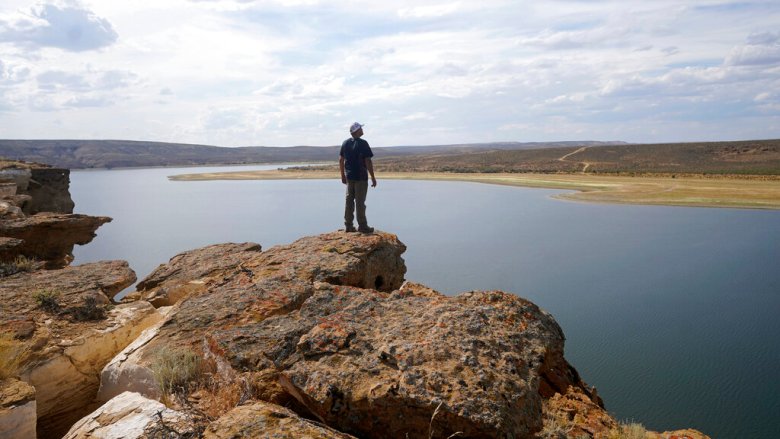
Federal officials formally announced Friday they will draw an extra 660,000 to 1 million acre-feet of water from Flaming Gorge Reservoir on the Wyoming-Utah border over the next 12 months to prevent downstream Lake Powell from dropping below “minimum power pool” the point at which it could no longer produce power.
The desperate move is in response to projections that show Lake Powell, “without major intervention,” could drop below 3,490 feet in elevation by August, which would kill hydroelectric generation at Glen Canyon Dam. If it drops even further, the dam is in danger of structural failure.
With extra releases from Flaming Gorge and by reducing flows from Lake Powell by about 1.5 million acre-feet of water through September, the Bureau of Reclamation hopes to prevent such a catastrophe.
“Together, these actions are expected to increase Lake Powell’s elevation by approximately 54 feet to at least [an] elevation [of] 3,500 feet by April 2027,” the agency said in a press release Friday afternoon.
“Given the severity of the risks facing the Colorado River system, it is imperative that we take action quickly to protect a resource that supplies water to 40 million people and supports vital agricultural, hydropower production, tribal, wildlife and recreational uses across the region,” the Bureau of Reclamation’s Assistant Secretary of Water and Science Andrea Travnicek said in a prepared statement.
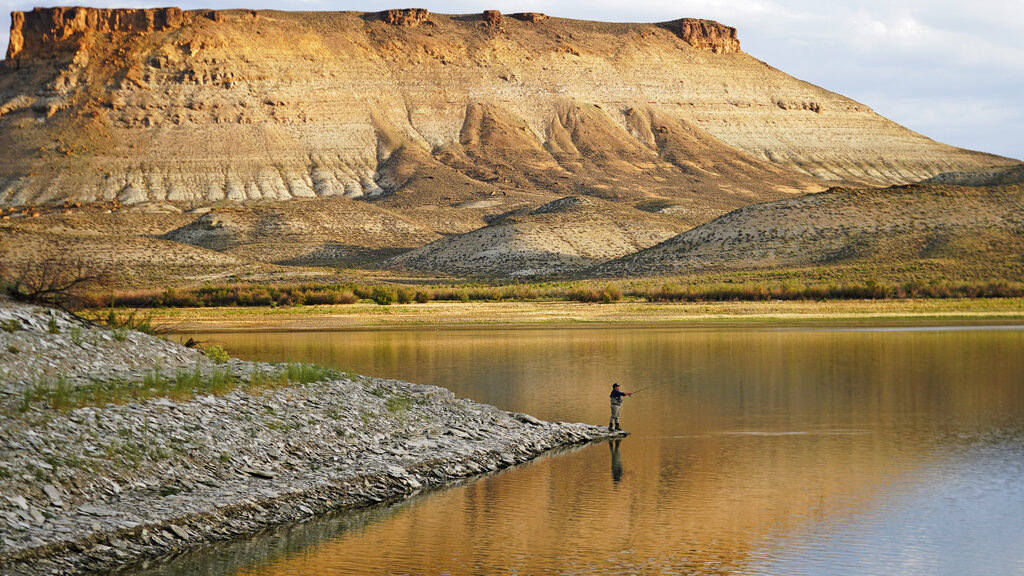
The extra releases at Flaming Gorge, which has a maximum capacity of 3.8 million acre-feet, are in line with recent warnings from Wyoming water officials. Earlier this month, Wyoming Senior Assistant Attorney General Chris Brown braced stakeholders for a release of potentially 1 million acre-feet of water, maybe more.
Still, the draw on the southwest Wyoming reservoir — a popular destination for fishing and other recreation — is sure to cause some pain. Now at about 83% capacity, according to federal estimates, the extra release will drop Flaming Gorge by about 35 feet over the next year.
“Boating access may be reduced earlier in the season than normal,” the bureau said. “In the Grand Canyon, lower flow rates will affect rafting conditions and fishing may be more challenging.”
The bureau noted that it’s not planning to tap other “backup” reservoirs above Lake Powell. It will not draw extra releases from Blue Mesa in Colorado and the Navajo Reservoir in New Mexico due to their already low water levels and forecasted inflows.
But drought response plans are still in flux, the agency warned, and it will exercise “as much operational flexibility as possible.”
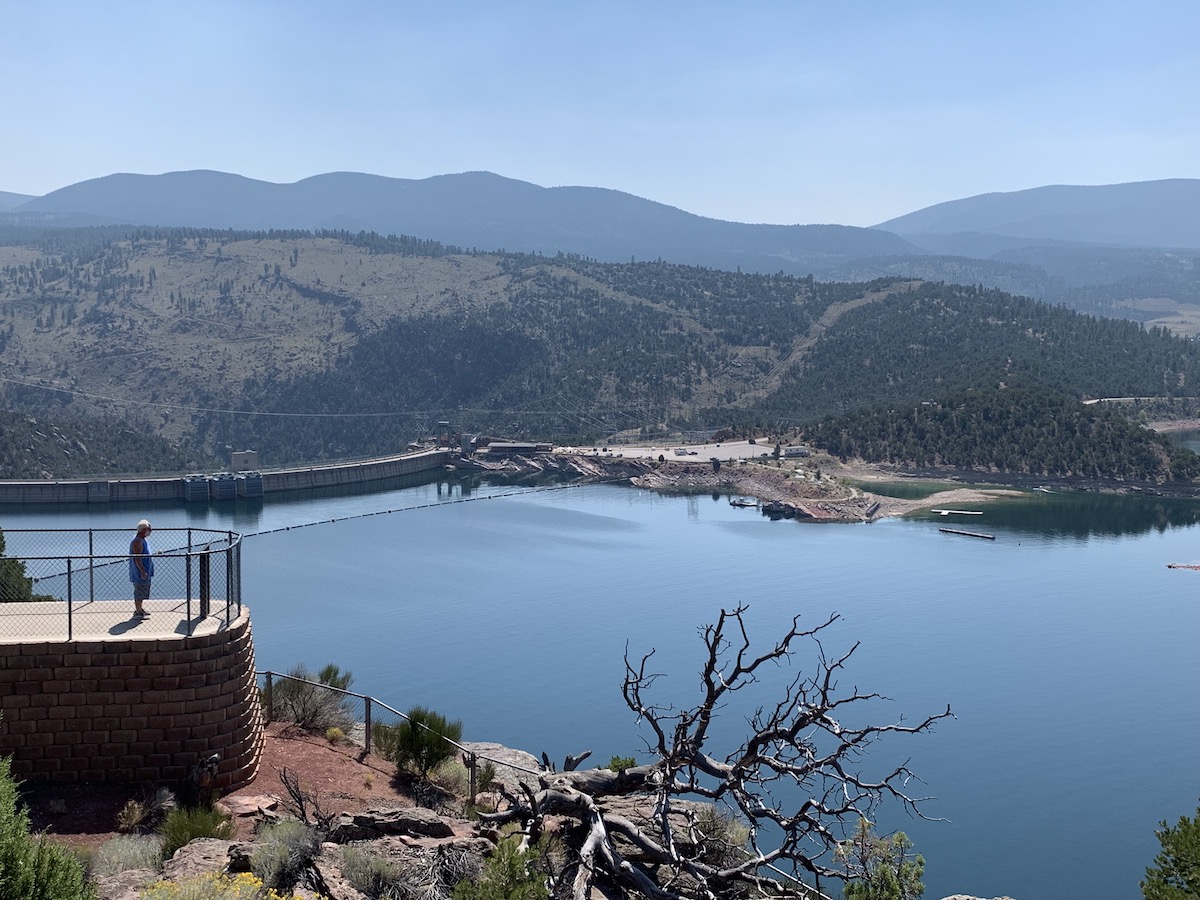
Flaming Gorge also played a vital backup role for Lake Powell in 2023 when Colorado River authorities released an extra 465,000 acre-feet of water.
Wyoming, like other Colorado River headwater states, suffered an historically warm winter along with alarmingly low snowpack in the mountains that feed the Colorado River.
All the while, Wyoming and the other Colorado River Basin states have missed multiple deadlines to agree on a new drought response plan for the system — a situation that portends a tangle of lawsuits and more federal actions that are unlikely to please any of the stakeholders.
“With time running out, there is a need for extraordinary collaboration for 2027 and beyond,” the bureau said.

Great article, I’ve been following the Colorado river and all affected entities since the early 1970,s
Water is more precious than gold!!
I was dubious of this reporting, so I sent this to my best friend who is a mechanical engineer for the dams for the entire state of Colorado, none the least is the dam at Royal Gorge. He literally laughed about the Lake Powell dam “potential structural failure”. In his words, “I don’t see how that makes sense. When it was built, there wasn’t any water on the upstream side, and it didn’t collapse. And that would be a really dumb design to always assume there would be water on it.” He clarify by saying, “The hydro power units are designed to operate with a certain amount of head pressure [or water elevation]. If you try to run them with lower levels, it may cause cavitation. That may be the ‘scary structural damage’”. Again, emphasis on damage, not failure, and it’s only if the generators are running. They wouldn’t be. He finished by saying, “It’s all about catchy headlines.”
Do better WyoFile.
The headline should read “Growth and over population of the south western US High plains and desert threaten the ability of the northern water sheds ability to supply Phoenix and LA water.”
So the chickens are finally coming home to roost. The overpopulation and endless expansion of the Colorado River and its tributaries have been sucking water supplies and this warning has been issued many times and ignored. You built massive water sucking cities in the DESERT!
The dam is in no risk of structural failure…lol, wow hyperbole much?
Like other readers who commented, I, too, wondered: How could Glen Canyon Dam suffer “‘structural failure” if the water levels drop too low? I did some online research using keywords, and there are a number of stories that specifically address this question, and it doesn’t have to do with the concrete dam itself failing. It has to do with design failures stemming from penstocks installed too high, which in turn can cause significant damage to the lower bypass tubes called “river outlet works” when water levels drop below the penstocks. To learn more, do a keyword search and you’ll see stories that detail the issues, including in High Country News, Salt Lake Magazine, and others. The engineers who designed Glen Canyon Dam in the 1950s would have gone back to the drawing board if one of them would have waved a hand over a futuristic crystal ball showing extreme drought in the West and that infamous Glen Canyon “bathtub ring,” which has been growing in height almost every year since Lake Powell was last full in 1999.
Time to recognize reality and take down the Glen Canyon dam. Ed Abbey indeed is laughing.
The plan for dealing with this existential emergency seems to mainly be: Well, this winter and spring of no moisture was just a fluke. We’ll get back to years of normal moisture again soon!
I think that sound I hear is Ed Abbey laughing.
“If it drops even further, the dam is in danger of structural failure”
Short answer: False.
Low water levels at Glen Canyon Dam are a serious operational problem—but there is no credible evidence it is in danger of structural failure due to low reservoir levels.
Would it be possible to go into a little greater detail about why the dam would be at risk of structural failure if water levels drop below deadpool? Seems a bit counterintuitive.
And, in the meantime, Wyoming is considering ridiculous Colo. River water projects like the little Snake river project.
The main problem is that no one is willing to do anything about the out of control and unsustainable growth that has been going on in the SW, in places like St, George where I live.
Everything is about pushing more growth to build our economy, at any cost. I was a delegate for the past 4-5 years and I attended the County Commissioners Meetings, and Washington County Water Conservancy District meetings to better inform my precinct constituents that elected me to represent them.
I tried to give them as much information as I could, sharing links and reports with them to back up what I was telling them. But all it got me was being called names like fear monger, fascist, and communist.
The mayors, city council members, commissioners and even the General Manager of the water district are lying to the people they are suppose to be representing about our water issues, and just how bad things are about to get. And if I were to guess why I would say it’s probably because they are getting some kind of quid pro quo from the developers and builders that are getting rich off of the growth here.
I’m sure it’s the same problem up north and all across the SW. BUT NO ONE IS GOING TO PUT OUT THE NO VACANCY SIGN NO MATTER HOW LOW THE WATER GOES!!
It’s President trump’s fault.