


Federal land managers are not identifying a “preferred” path forward as they assess whether to renew permits for two elk-feeding sites on the Bridger-Teton National Forest, one in Bondurant and another along the Greys River.
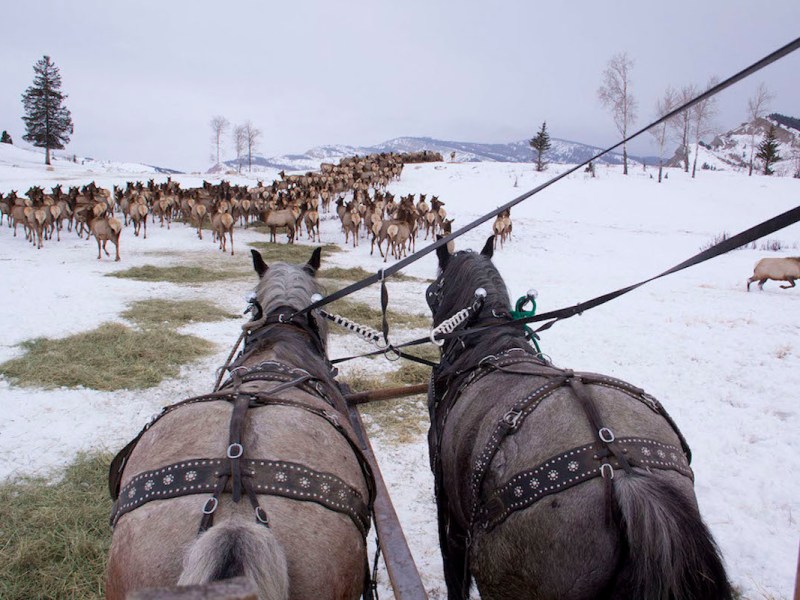
Up for review are the 35-acre Dell Creek and 100-acre Forest Park feedgrounds, sites where the Wyoming Game and Fish Department has congregated elk and fed them hay during the winter since the 1970s.
Forest officials have prepared a draft environmental impact statement that includes four scenarios: continuing to feed elk status quo, denying the permit immediately, allowing a three-year phase-out, and allowing feeding only on an emergency basis in severe winters.
Although land management agencies typically identify their preference in an environmental impact statement, that’s not happening in the ongoing planning process.
“The biggest factor is there are two other efforts going on right now, one with the [National] Elk Refuge and their EIS process and then with the state’s elk feedground management plan process,” said Randy Griebel, ecosystem staff officer on the Bridger-Teton. “We don’t want to influence anything on their side, and vice versa.”

To provide data for the Bridger-Teton’s EIS, the U.S. Geological Survey recently completed research projecting what might happen if chronic wasting disease propagates through the feedground region if feeding continues, is phased out over three years or shut off abruptly.
The short of it: continuing feeding both spikes prevalence rates of the deadly ungulate sickness and causes herd sizes to plummet. There were also benefits with continued elk feeding predicted, like reducing disease-related costs for stockgrowers. Contagious fetus-killing brucellosis can be passed from elk to cattle.
Game and Fish seeks a long-term permit from the Bridger-Teton after its old permit for the Dell Creek Feedground was revoked. In 2021, U.S. District Court Judge Nancy Freudenthal invalidated the feedground’s permit after finding that the state never formally applied to continue using the land. Temporary permits have been issued for the winters since.

Wyoming officials listed four purposes for the feedground renewal in their application to the forest: reducing conflict with nearby livestock; reducing the risk of brucellosis transmission to livestock; maintaining elk population objectives without excessive winterkill; and preventing vehicle collisions with elk on U.S. Highway 191.
The Wyoming Game and Fish Department is in the process of preparing a formal response that will be submitted to the Bridger-Teton Forest, Deputy Chief of Wildlife Doug Brimeyer said.
The public can also weigh in. Comments can be submitted online or mailed to: Forest Supervisor Hudson, P.O. Box 1888, Jackson, WY, 83001. The deadline is Jan. 16.


Aren’t we, as public lands users, always admonished never to feed wildlife to avoid unpleasant results? And then we see a government agency feeding wildlife with disastrous results. Hypocrisy this lethal should be criminalized. When do state wildlife managers ever really learn?
Thanks Mike! I always appreciate your diligent reporting while giving us the facts and avoiding taking sides. And while so many news outlets have closed their comments sections, it is much appreciated that WyoFile has provided this space for the free exchange of criticisms and suggestions.
I state all this because, I wanted to respond to a couple of things in the article. The first is in response to the following under the “short of it”:
“There were also benefits with continued elk feeding predicted, like reducing disease-related costs for stockgrowers. Contagious fetus-killing brucellosis can be passed from elk to cattle.”
Here’s my short of it. Elk are a native species, cattle are an introduced and non-native species; the latter having evolved in the warm and wet climates of Southeast Asia, hence the reason they huddle around sensitive riparian areas when it is hot, unlike “native” bison who do not. They should not be allowed on public lands in the arid West, where they wreak all kinds of ecological and biodiversity havoc. The ranchers are heavily subsided by taxpayers and given loads of monetary and non-monetary welfare (see the destructive work of Wildlife “Services”). Okay, maybe that wasn’t so short.
The next thing that I want to respond to is the WGFD and their ridiculous justifications for continuing the feeding of the cattle.
“Wyoming officials listed four purposes for the feedground renewal in their application to the forest: reducing conflict with nearby livestock; reducing the risk of brucellosis transmission to livestock; maintaining elk population objectives without excessive winterkill; and preventing vehicle collisions with elk on U.S. Highway 191.”
WGFD: reducing conflict with nearby livestock
Me: Remove cattle ranching from public lands
WGFD: reducing the risk of brucellosis transmission to livestock
Me: See my answer above.
WGFD: maintaining elk population objectives without excessive winterkill
Me: Ween them off feeding and reduce the amount each year for 3 years as they (Elk) figure it out. They’ve lived in this environment for thousands of years and have had to contend with harsh winters before that reduce their populations. Maintaining “elk population objectives” is just a fancy way of saying that the WGFD is addicted to the money from hunting licenses. Their budget shouldn’t be dependent on hunting, or, at the very least, the state should have an emergency budget set aside to subsidize the department during lean hunting years.
WGFD: preventing vehicle collisions with elk on U.S. Highway 191
Me: WYDOT has been doing a great job of reducing this factor by installing a large number wildlife over and under passes along 191. Just do more.