
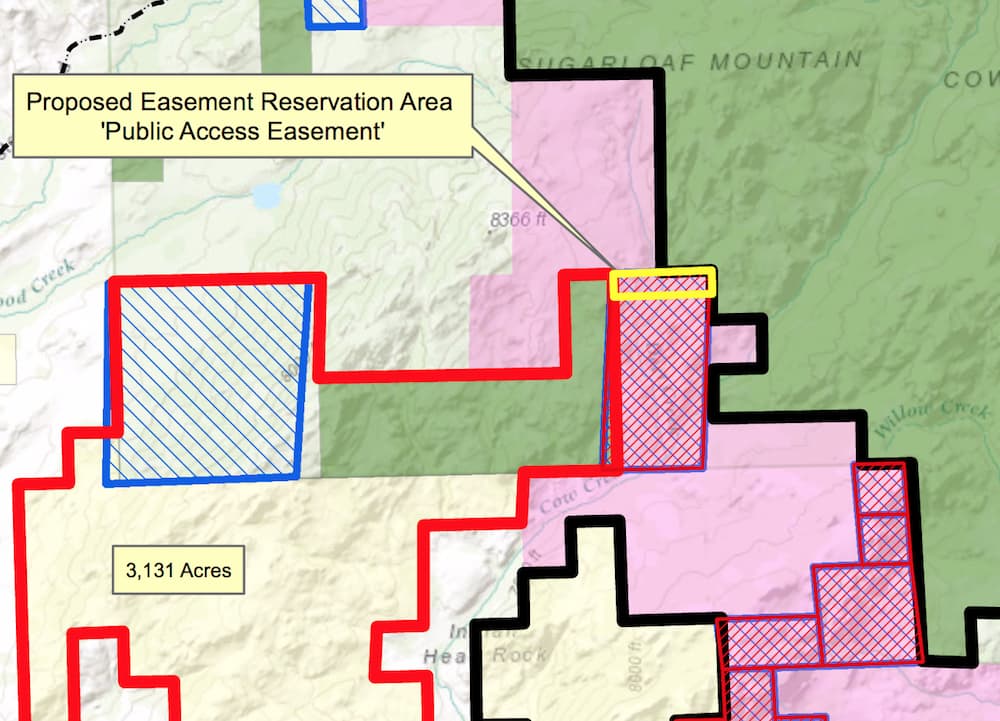
A top state official is recommending that the controversial Bonander land swap contain an easement to preserve access to public land, including parts of the Medicine Bow National Forest. (Office of State Lands and Investments)

A top state official is recommending a controversial land swap near Douglas include a public easement to alleviate criticism the exchange would cut off access to public land.

Bridget Hill, director of the Wyoming Office of State Lands and Investments, is recommending the State Board of Land Commissioners approve the Bonander exchange at its meeting Dec. 1 in Cheyenne. By including a public easement as part of the deal, worries about access for hunters and others would be largely alleviated, Hill wrote in a report to the board.

“A perpetual year-round access easement will provide access to the 3,131 acres of state and federal land that would otherwise be lost,” her recommendation states. “Although not alleviating every concern raised, such an easement appears to address the majority of the concerns related to public access.”

Hill’s office released the recommendation earlier this week along with the agenda for the Dec. 1 meeting. She recommends approving the exchange, along with the easement. Her agency also posted an update on the exchange proposal that outlines some of the controversial issues and the reasoning behind her recommendation. The post includes maps showing the proposed easement.

Worries about access for hunters have dogged the proposal, according to reports in the Douglas Budget and other newspapers.

Don’t miss a story — subscribe to WyoFile’s free weekly newsletter

Jeff Muratore, Casper board member of the Wyoming Chapter of Backcountry Hunters & Anglers, worried that the exchange would cut off access to more than 4,000 acres of public land in Albany County, the Budget reported. Among the areas that would be more difficult to reach would be parts of the Medicine Bow National Forest and Elk Hunt Area 7.

Rick Bonander seeks to exchange 295 acres he owns in the Black Hills in Crook County for 1,040 acres in the Laramie Peak area. The exchange parcels are of near equal value and a slight difference would be made up with a cash payment by Bonander.

Angus M. Thuermer Jr. is the natural resources reporter for WyoFile. He is a veteran Wyoming reporter and editor with more than 35 years experience in Wyoming. Contact him at angus@wyofile.com or (307)...

Join the Conversation

1 Comment

WyoFile's goal is to provide readers with information and ideas that foster constructive conversations about the issues and opportunities our communities face. One small piece of how we do that is by offering a space below each story for readers to share perspectives, experiences and insights. For this to work, we need your help.

What we're looking for: 

  • Your real name — first and last. 
  • Direct responses to the article. Tell us how your experience relates to the story.
  • The truth. Share factual information that adds context to the reporting.
  • Thoughtful answers to questions raised by the reporting or other commenters.
  • Tips that could advance our reporting on the topic.
  • No more than three comments per story, including replies. 

What we block from our comments section, when we see it:

  • Pseudonyms. WyoFile stands behind everything we publish, and we expect commenters to do the same by using their real name.
  • Comments that are not directly relevant to the article. 
  • Demonstrably false claims, what-about-isms, references to debunked lines of rhetoric, professional political talking points or links to sites trafficking in misinformation.
  • Personal attacks, profanity, discriminatory language or threats.
  • Arguments with other commenters.

Other important things to know: 

  • Appearing in WyoFile’s comments section is a privilege, not a right or entitlement. 
  • We’re a small team and our first priority is reporting. Depending on what’s going on, comments may be moderated 24 to 48 hours from when they’re submitted — or even later. If you comment in the evening or on the weekend, please be patient. We’ll get to it when we’re back in the office.
  • We’re not interested in managing squeaky wheels, and even if we wanted to, we don't have time to address every single commenter’s grievance. 
  • Try as we might, we will make mistakes. We’ll fail to catch aliases, mistakenly allow folks to exceed the comment limit and occasionally miss false statements. If that’s going to upset you, it’s probably best to just stick with our journalism and avoid the comments section.
  • We don’t mediate disputes between commenters. If you have concerns about another commenter, please don’t bring them to us.

The bottom line:

If you repeatedly push the boundaries, make unreasonable demands, get caught lying or generally cause trouble, we will stop approving your comments — maybe forever. Such moderation decisions are not negotiable or subject to explanation. If civil and constructive conversation is not your goal, then our comments section is not for you. 

Your email address will not be published. Required fields are marked *

  1. The easement only alleviates “some” concerns for sure. What about the 1,040 acres lost forever to hunters and recreationists? Access from the south is also gone in this proposal, making it much more difficult to reach the public ground. What the state land office doesn’t want to talk about, because it goes against their objectives, is the annual loss of income that would come about with this trade. Loss of revenue on grazing and the loss to local economies that would eventually occur when the impact of public land access loss is felt. This is still a bad deal for the public good!