


Supreme Court Justice Neil Gorsuch on Tuesday gave Elk Mountain Ranch owner Fred Eshelman until July 16 to petition the court to review a corner crossing case that has implications for public lands access and private property rights across millions of acres in the West.
Meanwhile, a hunters group that’s been advocating for public access in the case says it’s ready should the legal fight reach the nation’s highest court.
Gorsuch was responding to a request by Eshelman’s counsel, Robert Reeves Anderson, that the Supreme Court extend a deadline for the petition. The 10th Circuit Court of Appeals affirmed a federal Wyoming judge’s decision that Eshelman cannot block people from corner crossing to reach public property.
If the Supreme Court takes this case, we’ll be ready because access for all is worth fighting for, all the way to the highest court in the land.”
Patrick Berry
Without an extension, Eshelman had until June 16 to file a petition.
Corner crossing is the act of stepping from one piece of public land to another in the Western checkerboard landscape of public/private ownership. Corner crossers do not set foot on the kitty-corner pieces of private land, but they necessarily pass through the airspace above it.
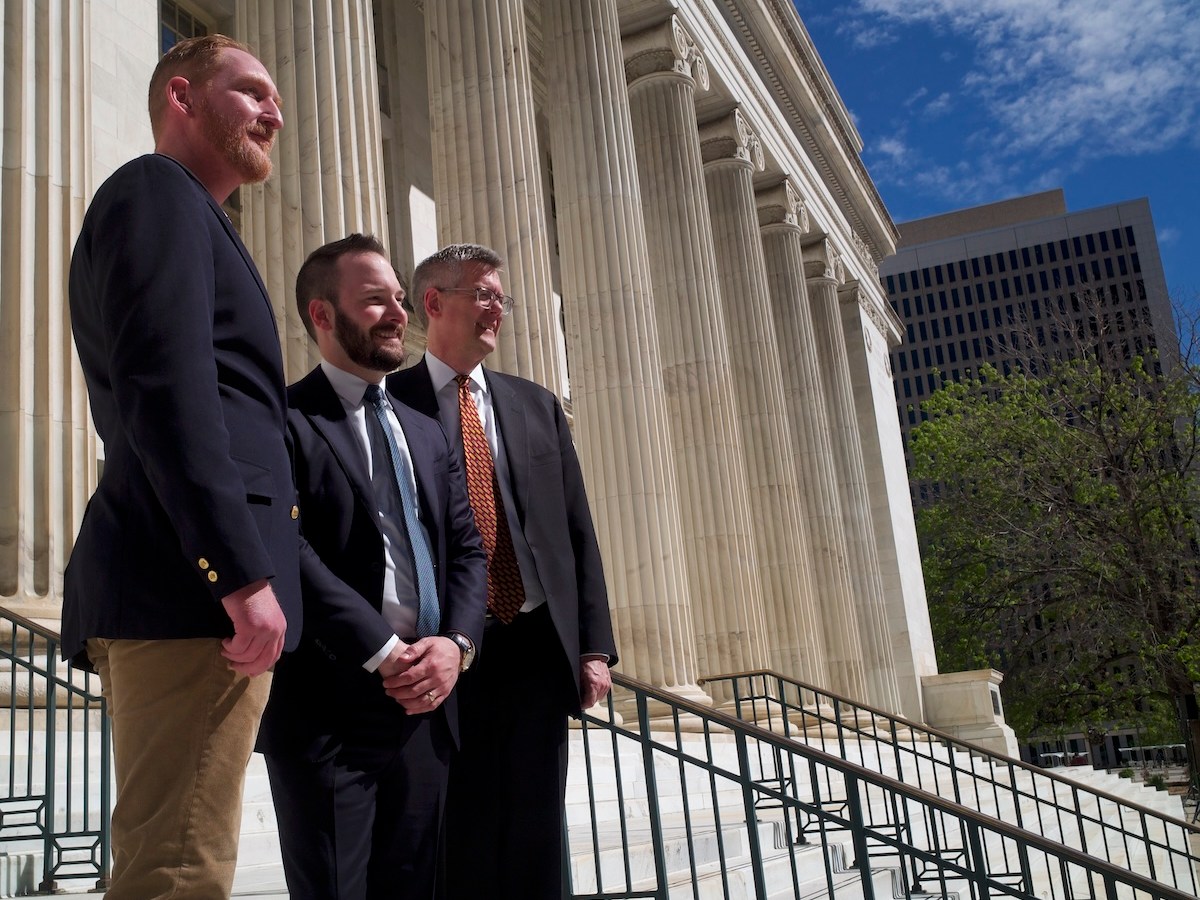
Eshelman sued Missouri hunters Brad Cape, Zach Smith, John Slowensky and Phillip Yoemans, who corner crossed in 2021 (and without Smith in 2020), asking courts to declare that the men trespassed. They never set foot on Eshelman’s ranch.
Backcountry Hunters and Anglers, an advocacy group that has supported the hunters, is prepared. “If the Supreme Court takes this case,” Patrick Berry, president and CEO of BHA, said in a statement, “we’ll be ready because access for all is worth fighting for, all the way to the highest court in the land.”
Eshelman is likewise committed. “This case raises exceptionally important issues at the intersection of private property rights and public access,” his attorney wrote in the request for the deadline extension.
“The Tenth Circuit’s decision has vast reach, covering a huge portion of the roughly 300 million acres of checkerboard land and affecting landowners throughout the American West,” Anderson wrote. “This case seeks review of one of the broadest abrogations of private property rights in American history.”
Backcountry Hunters involved
Eshelman seeks to appeal a ruling by the 10th Circuit that affirmed Wyoming’s Chief U.S. Justice Scott Skavdahl’s conclusion that Eshelman could not block people from corner crossing. Skavdahl’s decision applied to the checkerboard area in Wyoming as long as corner crossers do not step on or damage private property.
By blocking corner crossing — either by erecting barriers or using threats, intimidation or lawsuits — a landowner can control public land enmeshed in private property.
Eshelman — a wealthy North Carolina pharmaceutical entrepreneur — is a hunter who enjoys elk and other hunting excursions on his wildlife-rich ranch. The Elk Mountain Ranch encompasses about 11,000 acres of public property only accessible by corner crossing, trespassing or with his permission.

The 1885 Unlawful Inclosures Act and subsequent case law prevent a landowner’s use of physical barriers, threats and even state trespass laws, to block access in the checkerboard, the 10th Circuit affirmed. The law, the ruling said, guarantees public access to public lands in the checkerboard — an ownership pattern that’s a relic of the 1800s railroad grant era, the appeals court said.
Congress passed the act to prevent settlers from erecting fences to incidentally appropriate public grazing land and water sources as their own. Subsequent court cases supported that broad notion.
The hunters “are ready to keep fighting for and defending public access to public lands,” their principal attorney, Ryan Semerad, said in a statement last week.
Anderson did not immediately respond to a request for comment on the extension. Meanwhile, BHA has underlined its longstanding commitment to the hunters’ and the public’s cause.
“Corner crossing has always been about the right of the public to access the lands they own,” Berry said in a statement. “The 10th Circuit made it clear: stepping from one corner of public land to another is not a crime.”
“BHA has stood with the hunters from the outset,” the group said. With the help of the Wyoming BHA chapter, it raised more than $220,000 to fund the legal defense, the group stated. BHA also filed legal papers supporting the hunters.
The advocacy group seeks “a commonsense solution that recognizes private property rights and ensures access to millions of acres of public lands across the West,” its statement reads.
Here come Leo’s sheep again
In its decision, the 10th Circuit rejected Anderson and Eshelman’s arguments that a case known as Leo Sheep should prevail. In that 1979 ruling, the Supreme Court decided that the federal government did not have an implied easement to build a road across a checkerboard corner to provide easier access to the Seminoe Reservoir, also in Carbon County.
The family owned Leo Sheep Company derived its name from the community of Leo near the reservoir. It won the case against the federal road construction.
But the corner crossing case does not involve an implied easement, a permanent occupation of or a taking of private land, as was the case in Leo Sheep, the 10th Circuit said. Instead, the UIA allows a nuisance — the blocking of public access — to be abated or removed.
The 10th Circuit stated the case thusly.
“If a checkerboard landowner cannot impede access to public lands, then there is impliedly an access right.” Or, put another way by the court, “Iron Bar’s argument ignores that the reciprocal of preventing the right to exclude is to permit access.”
The 10th Circuit said other UIA cases prevailed instead of Leo Sheep. But 10th Circuit Judge Timothy Tymkovich wrote in the decision that the high court could again look at the woolgrowers’ 1979 case.
On that, Eshelman and Anderson may hang their Stetsons.
“The [10th Circuit] panel relied on Circuit precedent to distinguish this [Supreme] Court’s holding in Leo Sheep … that the United States [and the public] had no implied rights of way across private land in the checkerboard,” Anderson wrote. “In so doing, however, [10th Circuit] Judge Tymkovich invited this Court to ‘reconsider the scope of Leo Sheep as it applies to this case.’”
This article was corrected to remove a reference to Leo Sheep as a consortium — Ed.

This guy is trying to use his money to get what he wants. It’s wrong how he wants to control public property
If you don’t approve my comments I’ll stop giving you a monthly contribution.
You’re out of line.
If you feel that your donations allow you to post comments that wyofile deems inappropriate, then you should rethink your comments. You don’t get a different set of guidelines because you’ve thrown a few bucks towards a donation.
More than a few bucks, honey. But my comment wasn’t inflammatory if I remember correctly . How much do you give Wyofile?
Eshelman is used to getting his way by buying entities. He had a bought and paid moron ranch manager, the Carbon Co. Attorney; Carbon Co. Sheriff and the Wyoming Game and Fish Department. It’s very assumable that he’ll try to buy SCOTUS. Not sure about Justice Gorshuch, Eshelman should of targeted conman Clarence Thomas with a plush luxury RV or a weekend getaway at Elk Mountain. The only thing old Fred couldn’t buy was a Carbon Co. jury. Anyway, still no guarantee that SCOTUS will even hear the case and if Fred’s team of shysters had anything of substance surely they wouldn’t of needed an exemption. It’s probably a play for more time to pay someone off. In this political climate it’s easy to see that the justice system can be purchased
Exactly how is public access to public lands an abrogation of rights of private land owners? That statement is revealing. Some private land owners consider themselves de facto owners of public lands. Evidently, as stated below, large bank accounts create exaggerated self esteem. This legal fisticuffs will be telling.
Yikes. While I’m pulling for hunters and anglers in general to protest and protect the rights of Americans and visitors to access public lands, I’m not holding my breath on this case. With unlimited funds and high powered law firms, those of great wealth are changing the landscape of Wyoming, fencing out common folk and hoarding the most wildlife abundant and pristine areas for their paying “guests.” The fact that this ranch is within a stone’s throw, so to speak, of a luxury guest ranch where the offspring of the current president vacation, is a cause for concern. As everything Americans hold dear is for sale in the current administration, the resolution of this action may rest upon funds flowing through political action committees, not any legal precedents or the public good. (https://laramielive.com/tour-the-wyoming-ranch-where-jared-ivanka-spend-passover)
The federal law from the 1800s that the billionaire that owns elk Mountain Ranch wants to sweep under the rug That states something along the line you can’t keep the public from public lands. I think that means the public has reasonable access and does not have to have a GPS and step exactly from one corner to another because Freddy is really fussy about his airspace what a joke. how many times does this have to go to court? I think the law is very clear.
I agree and hopefully the cross country runner wins his case as well. He simply stepped upon public land
Gorsuch and Anderson welcoming time to grease the wheels. A complete embarrassment and bastardization of common sense. And quite possibly the return to lords and serfs feudalism. Which observing is already very present.
This may be a stretch, but given the assault on public rights from the rich and the Trump administration, I think it is something worth looking into. Justice Neil Gorsuch is known to be a friend of the former owner of the Elk Mountain Ranch, Colorado billionaire Philip Anschutz. Because of this relationship (described in the below link) Gorsuch has had at least once to recuse himself from a case in which Anschutz was financially interested. https://www.westword.com/news/justice-neil-gorsuch-recuses-self-phil-anschutz-ties-22716221. During Aschutz’ ownership of Elk Mountain Ranch, we saw much the same conflicts over public hunting access to the enclosed checkerboard. Gorsuch surely knows of these conflicts and he surely has an opinion about them.
So the question is, does Gorsuch have a similar relationship with current owner of the Elk Mountain Ranch, Fred Eschelman? Does Gorsuch have an ideological bias against public lands and access to public lands? Has Gorsuch hunted on Elk Mountain Ranch as a guest of Anschutz or Eschelman?
I can think of no rational, legal reason for Gorsuch to have approved Eschelman’s request for an extension; the issues of this case are pretty clear and Eschelman’s arguments have been well developed through the Wyoming District and 10th Circuit Court cases–both of which Eschelman lost on solid, well-established legal grounds.
I do worry that the Supreme Court’s recent decisions overturning long accepted precedents forecasts a bad decision for public lands and hunters in the corner crossing case. Speaking for myself, if Eschelman wins his case, I think there will be civil disobedience and possibly violence as hunters continue to pursue their rights of access. I hope we don’t get to that point, but that’s the world in which we now live–a world of a few rich oligarchs owning all the land, with the rest of us landless peasants.
I recommend people look up the history of peasant revolts in Britain. Many of them involve disputes over land, particularly the privatization of common lands (called enclosure of the commons) by aristocrats. Here is a pretty good discussion. https://en.wikipedia.org/wiki/Enclosure.
Good luck to the Missouri hunters.
I assume that when our ultra conservative congress allows the sale of our public lands we won’t have any corners left to cross. People were misinformed about the BLM shutting down access in the Rock Springs management plan. Just wait until billionaires have a chance to buy those lands and see how much access us regular folks get.
From the article
“Eshelman — a wealthy North Carolina pharmaceutical entrepreneur”
He is a Billionaire. I am pretty much convinced that once human beings amass a Billion dollars or more, they suddenly think they are kings or even gods. And the other human beings on this planet are beneath them.
Eshelman is essentially a thief and should be treated thusly. What we need is Congress to step in and put an end to this once and for all. Personally I’d like to be compensated by the thief for the private use of our land for all of these years.
Let the hunters, anglers, hikers, all public land users prevail!
Public Land obviously needs public access!
GOOD LUCK GUYS. Let’s put this to rest for good