

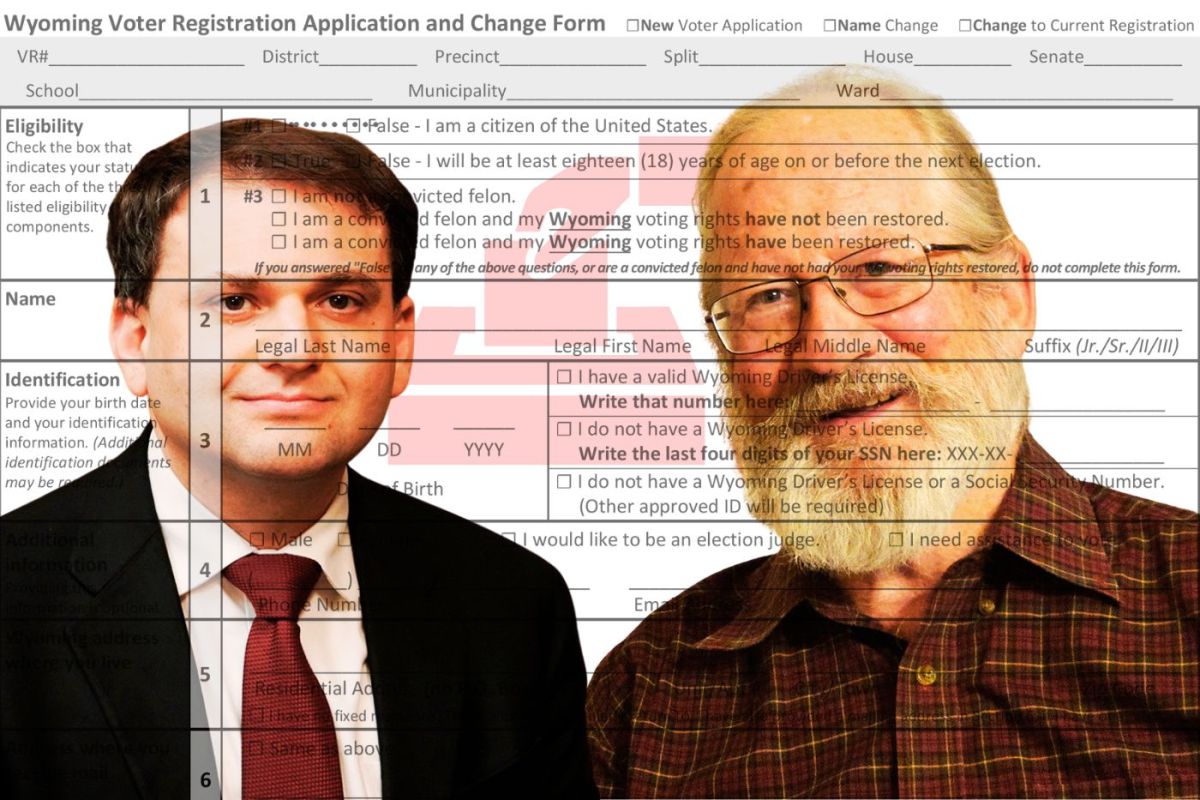
In February, I asked Secretary of State Chuck Gray to explain why he released confidential voter information in response to an unprecedented request from the Department of Justice. The Wyoming Election Code stated unambiguously that this information was confidential. Gray hid behind a wall of epithets and self-serving conclusions. He called me a radical left-wing activist practicing lawfare and claimed that the Wyoming attorney general had approved his actions.
Opinion
So, I made a public record request asking to see the attorney general’s opinion that Gray cited. But Gray asserted this was privileged attorney-client communication. He insisted he could ignore Wyoming elections law in reliance upon an undisclosed opinion of another public servant.
When someone wants to sell me a used car and says that the car has been certified by their mechanic, I want to see that mechanic’s report. Just because Gray said his decision to surrender Wyoming’s confidential voter list was legal does not make it so, particularly after I have read nine separate federal court decisions stating the Justice Department never had a right to request this confidential information in the first place.
So, I did just what the Wyoming Election Code said I should do. I filed a complaint against Gray for releasing confidential voter information. But I had to file that complaint with the attorney general, and that raised yet another problem: If the attorney general represented Gray and had already approved the release of the confidential voter lists, then he had a clear conflict of interest.
No lawyer can investigate a client without violating duties of confidentiality and loyalty. Moreover, no lawyer is going to question their client’s decision to rely on that lawyer’s advice. So, I asked to have a disinterested person appoint an independent prosecutor separate from and independent of the attorney general’s office.
But the attorney general would not publicly acknowledge his conflict of interest, insisting that he had complete discretion and would not conduct his business in the public space. The attorney general’s refusal to provide any transparency regarding how he intended to address his conflict was another wall between me and the truth.
So, I retained counsel, and together we filed my petition for a writ of mandamus with the Wyoming Supreme Court. We argued the attorney general did not have discretion to ignore the conflict of interest. We asked the Supreme Court to order him to recuse himself and permit an independent special prosecutor to assume responsibility for investigating Gray’s actions. The attorney general’s response raised more walls.
First, he said that he had secured “independent evaluations” from two sets of unidentified attorneys and that these “independent” attorneys had declined to pursue any claims against Gray. But who were these attorneys?
One set of attorneys was selected from his own staff. The other set were members of a private law firm assisted by a county attorney retained as special assistant attorneys general. We do not know when these attorneys received their assignments, we do not know what they were asked to do, nor do we know what evidence they reviewed, although I can confirm that no one ever contacted me as part of any investigation.
Even if you put these questions aside, you need to know one more thing. Under Wyoming law, “Each assistant attorney general shall be a member in good standing of the Wyoming bar and shall serve at the pleasure of the attorney general.” No one who serves “at the pleasure” of the attorney general can truly be considered independent.
The attorney general should not only be disqualified from conducting the investigation himself. He should also be barred from controlling the selection of the attorneys who would have the responsibility to clean up this mess. But, who has the authority to hold the attorney general accountable?
We will never know, because the Supreme Court has now denied my petition, holding that I failed to cite “any ‘absolute, clear, and indisputable’ law” requiring the attorney general to recuse himself and allowing the court to appoint an independent prosecutor. Apparently, there is no remedy to address the attorney general’s conflict of interest.
But remember the attorney general said he had reports from these attorneys. Where are these reports? They were not filed with the Supreme Court. If the attorney general wants us to rely on the judgment of his handpicked attorneys, shouldn’t we have a chance to see their work?
I have now submitted another public record request asking for any records to substantiate the attorney general’s statements. Under the Wyoming Public Records Act, a record that is readily accessible must be produced “immediately.” Surely the attorney general should have no problem finding and producing his attorneys’ reports immediately and without further delay. Will he do so, or will I just find myself staring at one more wall?
What have I learned from my efforts to find out why Gray disclosed that confidential voter information? I have learned that some public officials will labor long and hard to prevent public disclosures about the decisions they make. I have learned that we, the people of Wyoming, cannot shirk our responsibility to question authority and hold our public officials accountable. We need to remind our public officials that they work for us. They serve at our pleasure.

George Powers’ column has a strange energy to it.
It reads like a retired attorney discovered attorney-client privilege, mandamus, prosecutorial discretion, and separation of powers all in the same week — then blamed Chuck Gray because none of them came with a customer-service desk.
I’m all for transparency. Public officials should answer hard questions. Voter privacy matters. Federal overreach matters. Wyoming law matters.
But let’s not pretend George stumbled onto some grand constitutional mystery here.
Chuck Gray says he consulted the Wyoming Attorney General’s Office. Powers demanded to see the legal advice. The answer was attorney-client privilege.
A decent attorney should understand that.
Then Powers wanted the Wyoming Supreme Court to force the Attorney General out of the matter and install a prosecutor more to his liking. The Supreme Court said no.
A decent attorney should have seen that coming, too.
Now the column acts like the real scandal is that George Powers did not get every document, every memo, every name, every explanation, and every legal conclusion delivered to him on a silver platter with a little mint on the pillow.
That is not transparency. That is entitlement wearing a lawyer costume.
There are fair questions here. Should sensitive voter information ever be released without a subpoena? Should Wyoming law be tightened? Should the Legislature make the process clearer? Those are serious questions.
But George is not just asking questions. He is trying to turn “I disagree with Chuck Gray’s decision” into “therefore Chuck Gray must be prosecuted.”
That is quite a leap. Even for a retired attorney with time on his hands.
And I know this may sound harsh, but good attorneys rarely truly retire. They consult. They advise. They mediate. They mentor. They charge people $400 an hour to say “it depends.”
When a retired attorney starts trying to turn political irritation into a Supreme Court project, maybe the rest of us are allowed to wonder whether we’re watching legal brilliance — or just a man shaking his fist at attorney-client privilege because it refused to become a public-record vending machine.
Ask questions? Absolutely.
Change the law? Fine.
Protect voter privacy? Good.
But bothering the Supreme Court because Chuck Gray would not hand over privileged legal advice is not a smoking gun.
It is courtroom cosplay with a WyoFile login.
Thanks George Powers! It really cannot be anything but obvious, to any person who is honest with themselves and others, that self serving interests are foremost in the minds and actions of these very crooked people. Sucking up to the MAGA majority of our once fair and equal state in order to enrich themselves is their game. They serve their god person in the White House only. These guys are running a scam and should NEVER hold a position of trust!
Thank you so much for working on this so diligently. I was absolutely furious when I learned that Chuck Gray had been the first to comply with the federal government’s request for our voter roles. Voter fraud is incredibly low in Wyoming and across the entire country. A couple of different sources I found indicate that maybe 3 or 4 cases of people voting who should not have occurred over the last 40 years. Wow, that’s concerning. It is very likely that he did it because he was going to run for a different office and wanted Trump’s recognition and support. Keep at it, Mr. Powers.
Thank you Mr. Powers for all the time and effort you have put into this. The whole episode is shocking. This should not happen in an open, democratic society. Frightening to realize how far we have fallen.
If I was not a legal voter, the last thing I would want to do is to draw attention to myself by trying to vote
Does Chuck Gray have any examples of non-citizens voting in Wyoming or Federal elections. I’m curious. I expect there may be a few, and I mean a few, nationally or even in Wyoming. I surmise that the number is infinitesimally small. When Trump says that he thinks the 2020 election was stolen he means he tried himself but it didn’t work. He and Chuck Gray are going to try again.
Mr. Powers can obviously smell a crooked little varmit from a mile away. Too bad that for some reason the establishment wants to shield that little weasel Chucky
Thank you Mr. Powers for your efforts to get to the bottom of this. I hope you will not stop digging. I will not vote for anyone who hides behind a smokescreen like Mr. Gray. We need transparency in Wyoming.
Is it feasibly possible to create a class action suit against Gray for releasing our private information to an administration that I feel will target us for our party affiliations and past voting records?
They will have our addresses, phone numbers, social security numbers, email addresses, etc.
Kudos to you, George Powers. You fulfill my expectations for an independent WY.
Thank you for your efforts Mr. Powers, please don’t give up now.
It would be interesting to see what exactly Little Chucky Cheese would say if asked whether or not he would have responded the same way to a request for the same information from Biden’s DOJ. I very much would like for him to be asked that question in a very public place, in front of TV cameras.
My question in all this has been – Who’s job is it to presents the best interest of the citizens of Wyoming when it comes to their confidential voting information the State has collected an supposed to safeguard??? Obviously it’s not any of our elected officials. Who was the devils advocate in the room when Gray and Krautz were discussing releasing these records??? If Krautz was “representing” Gray – who was representing the people of Wyoming? Seems like the fox guarding the henhouse!
I’d also like to thank you George for your efforts in trying to keep Gray and Kautz as honest as possible. It’s starting to sound like all that we can do as citizens of Wyoming is to be very conscientious with our votes in August and know who we are voting for. I would have hoped that the Wyoming Supreme Court wouldn’t have come across as looking biased in their decision but that doesn’t appear to be the case here. Thanks again George.
Please continue with your inquiries. It is necessary to let these elected officials know they are not above the law. Keith Kautz was appointed as the acting attorney general for the state last July by Governor Gordon. The attorney general’s position is by appointment of the governor. Since Wyoming will be electing a new governor it is important to remember that this is one of the positions that is important to the welfare of our state, as Mr. Powers has explained.
Lil’ Chucky Gray is a menace to the people of Wyoming. Vote against him please.
It seems that releasing confidential voter information is ok for public officials who, nevertheless do not want their own reasons for sharing this “private”information examined. I find it hard to believe that Wyomingites find this ok.
I grew up in Wyoming, my dad was a well known photographer and outdoorsman there for most of his life. Aunts and uncles were also residents.
China Chuck has some explaining to do now that his crooked ways have come to light. And Krautz? He is a creepy dude.
Thank you, George Powers!
You are correct Mr. Powers. These public servants are accountable to the public. The one thing that we can do is make sure that Mr. Gray is not voted into any of our public offices. Also, I would assume that the Governor could and should have something to say about this, and fully support the public. It may be time to reduce the power of the Republican party.