

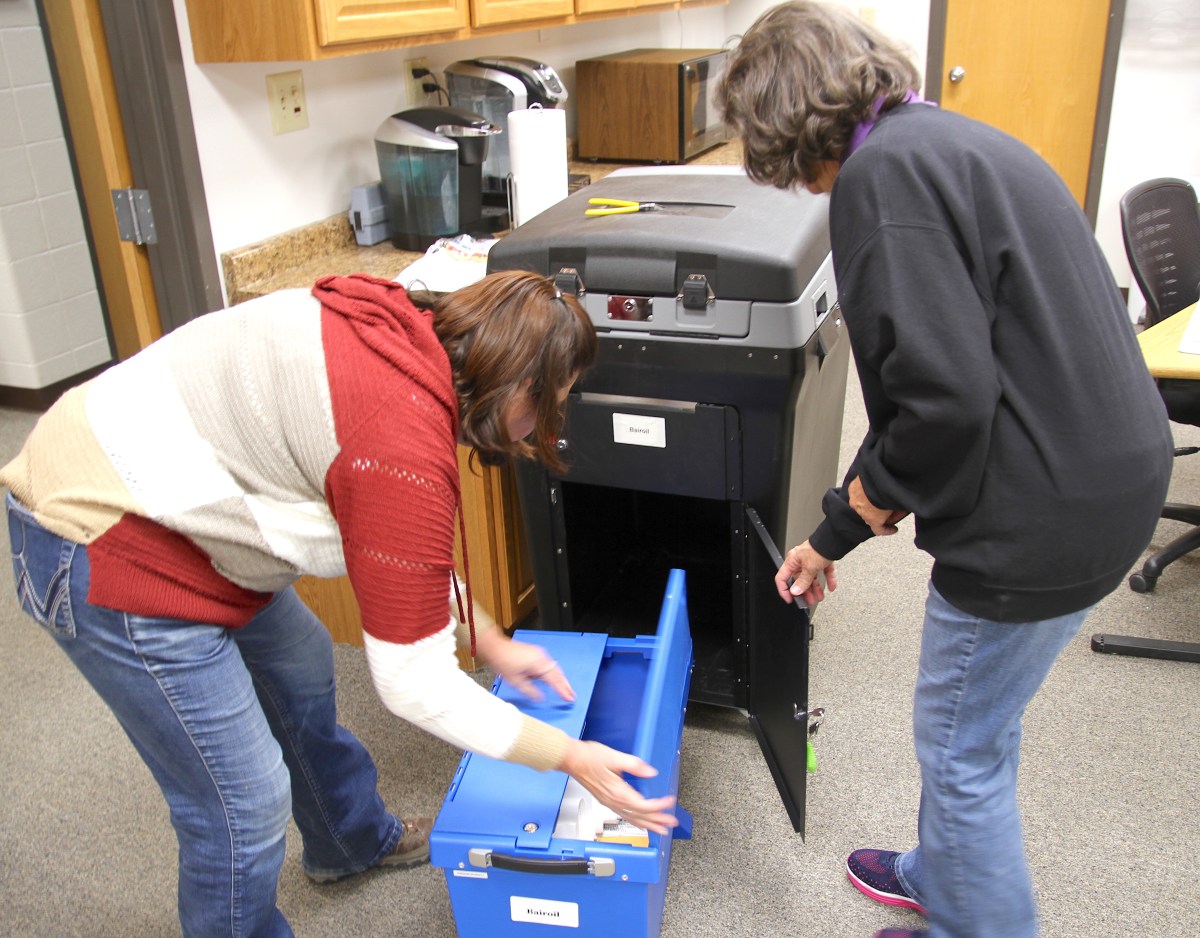
On Tuesday, primary day, I’ll wake up at 4:30 a.m. I’ll be dressed and out the door by 5:30 a.m. I’ll swing through the drive-thru, order coffee: black, straight up, three shots of espresso. I’m gonna need it.
I am an election judge. This is my story.
Opinion
Election Day is like Christmas. The magic, the civic energy, the anticipation; Will there be a strong voter turnout? Who’s going to win? The first time I voted I had just turned 18 and it was a presidential election year. I was still an unformed human, yet they trusted me with a ballot. I couldn’t believe my good fortune. I had a voice. It was thrilling.
Now, the election process, forever a trusted institution, is under attack. In 2016, according to the Pew Research Center, 90% of voters say they were at least somewhat confident their own vote was accurately counted. A decade later, only 55% are confident this November’s midterm elections will be conducted fairly and accurately.
There is no cogent reason to support voter skepticism. In Wyoming, there have been four voter fraud convictions in the past 25 years. Nearly all the lawsuits filed by President Donald Trump and others contesting election processes following the 2020 presidential election have been dismissed or dropped for lack of evidence. Yet, trust in elections continues to slide.
I struggle to connect this weedy, thorny field of suspicion with reality. Frankly, all this unsupported, frothed-up fear regarding elections was killing my joy. So, several years ago, I volunteered to work the polls as an election judge and see for myself. Should I be concerned?
For those who wonder whether an election is safe, this one’s for you.
On Election Day, I arrive at my assigned polling station before 6 a.m. Coffee in hand, I also pack a water bottle, lunch, a book and Ibuprofen. I dress for all seasons, from arctic to stifling air. I bring a seat cushion. Sitting on a metal folding chair for 13 hours is no picnic. The seats are insufferable, an enemy to the coccyx.
County clerk personnel have been at the polling places hours before the volunteers. Who knows when they got there. While the county sleeps, hundreds of staff members are busy lugging, assembling, adjusting, just doing, like nervous bridesmaids minutes before the ceremony. They care.
Once we enter the polling place, we cannot leave. That’s the law. They warn us of that in our training. By resigning ourselves to being trapped in an industrial, acoustically barren building with suspect ventilation, we submit to the jurisdiction of the paranoid and conspiratorial masses, loopy on visions of ballot harvesters ferrying ballots to dark, webby places. Whatever it takes to convince the public and honor voter concerns, baseless or not, we’ll do it.
I find an empty seat before a darkened monitor and wait to be checked in by an IT staff member. Each judge has a password specific to that computer. We sign a chain of custody form, which allows auditors to trace a ballot’s journey from judge to voter to tabulation. If there’s any funny stuff, the ballot can be tracked.
At 7 a.m., the doors unlock, and the manager announces, “The polls are open!” We whoop and holler. We’re trained and ready to serve.
It’s go time.
Bring your tired, your weary, your mailers’ fatigue, your yearnings to the polls. Mostly, bring your ID.
An election judge is a cog in the machination of this Great American Experiment, a witness to the mundane, to the bland ordinariness of an election cycle. Election judges are volunteers. Each year, they take a day off from work, arrange childcare, navigate school pick-up, off-load their obligations to work the polls. They are your neighbors, your friends. We do it because we believe in the system.
Before the election, we attend training. The county clerk walks us through a 100-slide presentation developed by the Wyoming Secretary of State’s Office. We learn to navigate the election software, we do mock registrations. We run through a million different scenarios: a voter at the wrong polling station, name change, party affiliation confusion, felons whose rights have been restored. What to do when we make a mistake, which is inevitable. You name it, there’s a process for that.
We take an oath for election officials not once, but twice — first at our training and again on Election Day. We swear to perform our duties impartially, to root out fraud or abuse.
Through the years, the training has gotten more formal, more intense. It’s been hard to keep up with the rush of new election laws. The secretary of state’s office shows eight new election integrity laws in 2025 alone.
The last election cycle was the first time we discussed security and what-to-do-if scenarios. That rattled me a little.
We verify citizenship. In the 10 years I’ve worked at the polls, I cannot remember an undocumented person attempting to vote. My friends in the faith community who are busy ferrying groceries and school supplies to a rattled, undocumented community too terrified to leave their homes, tell me it’s unlikely an illegal alien would show up at the polls. Think through that my friends.
For those suckling on the teat of a vast conspiracy to steal your vote, take a beat and ask yourself, do you really think an illegal immigrant is stealing our vote? To what end and for whose benefit? Play out your theory for me please.
Instead, focus on the county clerks who work tirelessly every day to make sure elections run smoothly. Have faith in them. They take their work seriously and are proud of the work they do.
You’ve seen museum curators handle the Magna Carta, the Dead Sea Scrolls, the Mona Lisa, Michelangelo’s David. Pick your treasure. That’s how your ballot is tendered.
County clerks are the guardians of our constitutional rights, they understand the right to vote is sacred, a gift given to us by the glorious fiat of our citizenship.
That feeling of walking into the poll booth for the first time has never left me. A poll booth has always felt like a secret garden, those cardboard walls envelop you, a lushy hedge for your thoughts, just you, your opinions and an empty oval waiting for the press of your pen. What a gift.
Your vote is cherished, honored, respected and handled with care. County clerks, their staff, all the poll workers, they don’t care how you vote. They care the system is safe. They care you vote.
See you Tuesday.
Susan Stubson serves on WyoFile’s board of directors. Neither she, nor any other member of the board, has the authority to direct or determine coverage. —Ed.

I, too, worked as an election judge back in the 1970’s. Different times. But your description shows how seriously election are taken and conducted in the U.S. Excellent article.
Thank you for this excellent piece. Sadly, the people who most need to read this never will. They can’t risk venturing out of their silos for fear that they may encounter something [like elements of truth] that might plant a seed of doubt in their feeble minds that the complex web of conspiracies they have convinced themselves are real, are in truth a dark, soul consuming fantasy.
I served as an electrician judge in Alta-more to see my friends and neighbors than out of civic duty as Susan outlines here. I can verify the process she describes. Now I’m living in Mesa Arizona and have gone through an election here as a voter. Same safe process whether small population or large. All this talk of election fraud is just naysayers stirring the pot. Our elections are safe!
Well said, my friend. God bless you for your service.
Self-deputized election enforcer Chuck Gray should’ve dyed his thinning dark brown hair to a virile tangerine orange the day he announced .
Great essay, Susan.
Worked ten elections. I’m closer to 80 than 70 and 14 hour days are no longer my cup of espresso. It’s your turn now. Uncle Sam needs you!
Thanks once again Susan. If more people would listen to folks like you who do the work, and less time listening to the ultra right’s lying about a problem that doesn’t exist when one of them loses an election, this country would be in a lot better place right now.
Thanks again!
Thank you for volunteering and for writing of your experience.
The only one trying to steal your vote is the orange menace in the White House.