


Spanning a wildly diverse range of materials and processes, the Wyoming Arts Council’s 2020-2021 Biennial Fellowship Exhibition at the Nicolaysen Art Museum in Casper, “When Things Dream,” is one of the most consistent in recent memory for excellent technique and articulation of ideas. All six artists create well-made, visually arresting work, and each artist communicates a distinct thesis.
Despite its rich variety, the exhibit delivers a cohesive narrative. It can be experienced as a suite of overlapping and expanding orbits, beginning with the intensely personal, and progressing outward to the globally conscious.
Inner life, woven outward
Laramie artist Diana Baumbach) translates her complicated human experiences (motherhood, relationships, creative evolution) into fabric, fiber, paper and mixed media sculpture. Her repetitive hand-building methods, steered by spontaneous and intuitive variations, are conduits for self-understanding and healing. The artwork successfully articulates contemplation and discovery.
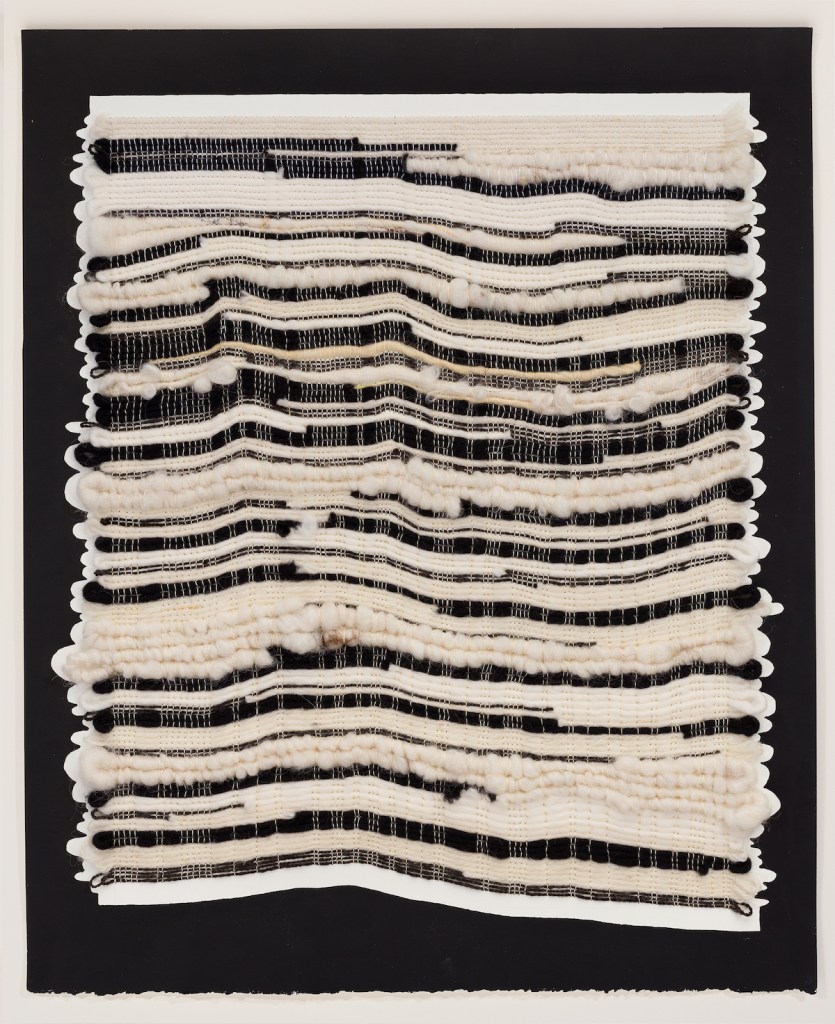
The three works on display summarize Baumbach’s enormous body of work in this area, and her ability to deploy “feminine” materials in a muscular way. Perhaps the most subtle and timely of these is the fiber-and-acrylic triptych, “Metamorphic Pandemic.” A set of irregularly woven mats is held within simple wood frames. We know that pressure and heat result in fundamental change. Here, jagged rows of black, tan or white fiber crawl across each mat, their contrasting textures forming a haphazard stratigraphy. They are geologic maps, medical charts, historical timelines and public health data that we can never interpret by reading — only by feeling.
Adorning the body
Great custom jewelry embraces the body while co-opting it as a platform for sculpture. Rachel Hawkinson of Casper calls attention to our relationship with adornment by creating fine brooches, rings and other accessories, each inspired by a particular bird species. Here, abstracted versions of exotic birds perch safely within a species-specific frame or pedestal that could easily decorate a living room. They appear ready to alight on the hand, head or torso, and are composed of precious and semi-precious metals and gemstones, and sometimes feathers.
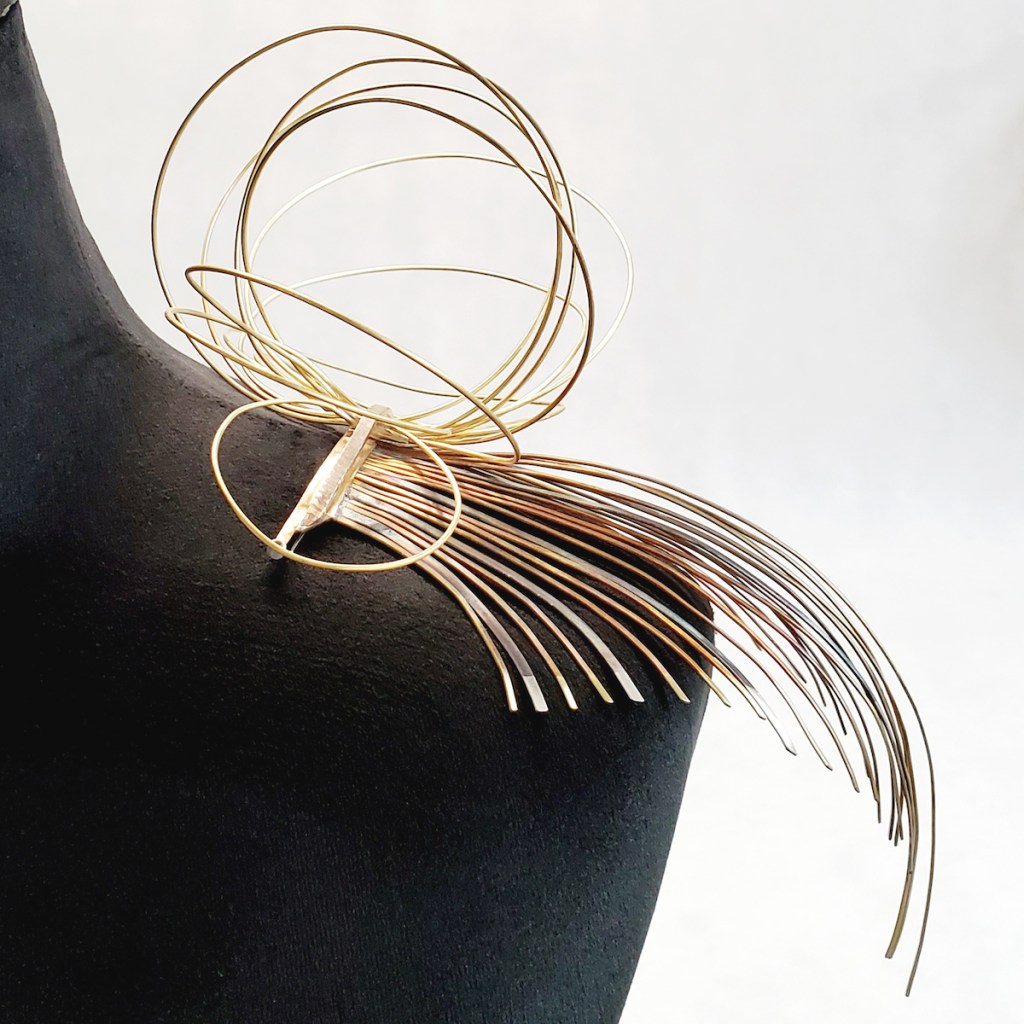
Epaulettes for women are not unknown in the fashion world. Many simulate (or parody) the signifiers of military rank worn by men. Hawkinson’s two versions in this exhibit allow us to imagine an empowered woman with head held high, an elegant bird on her shoulder.
Hawkinson is drawn to birds for their beauty, vulnerability and most of all for their power of flight, she said. For her, learning to fly is a metaphor for artistic freedom, “leaving the nest our minds create.”
The neighbors’ story
Leaving behind the self proper, Laramie artist Wendy Lemen Bredehoft studies a community through the window of history. Her multimedia “Carissa Mine” series excavates the aesthetic and emotional paradoxes of South Pass City, site of Wyoming’s first mining boom and bust.
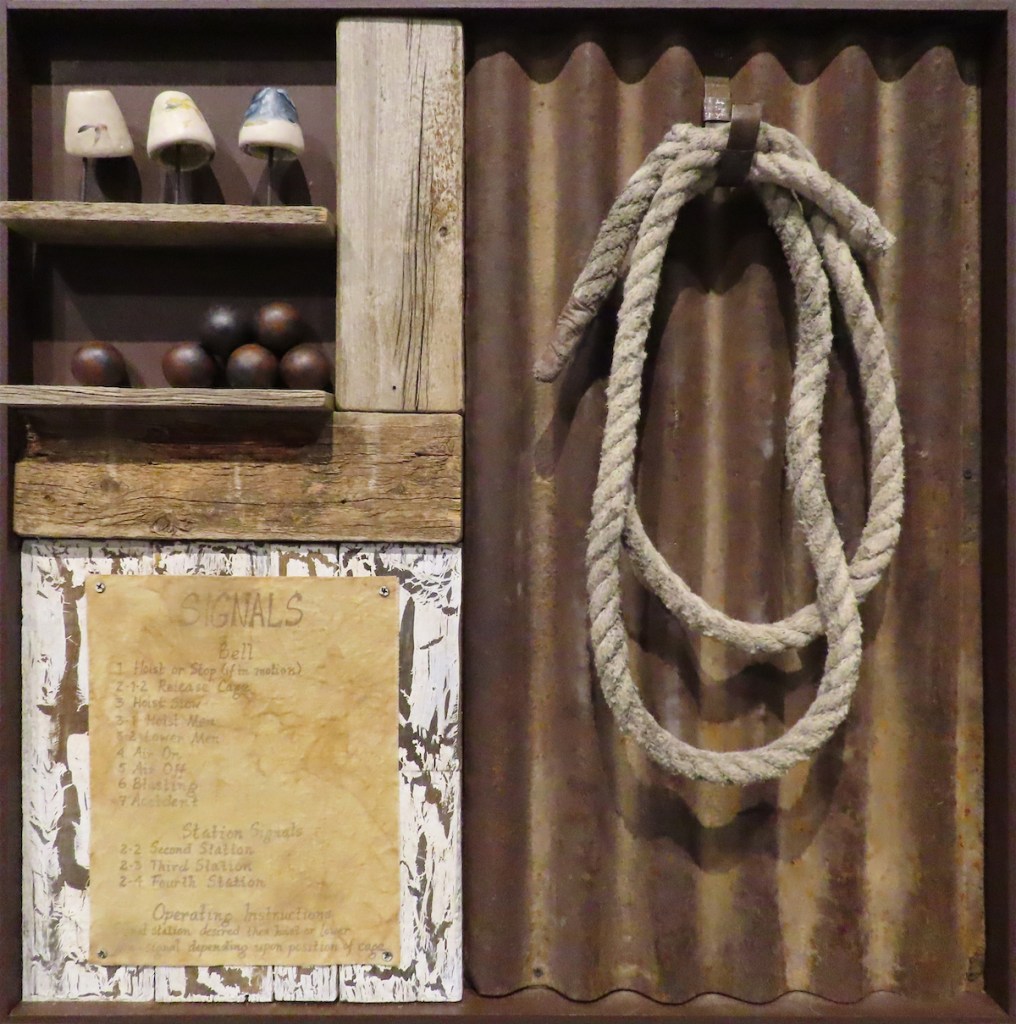
Bredehoft’s large reliefs are compositions of rusted metal, rotting fabric, timeworn wood and curious industrial detritus arranged into rigorous blocks and grids. The contrast of ordered formalism (echoes of Piet Mondrian or Donald Judd) mixed with unstoppable decay elicits a jarringly sweet melancholy, like elegiac poetry or certain southern cemeteries.
Two audio files accessed by QR code magnify and deepen the visual impact of the wall sculptures. The ambient soundscape “Carissa’s Song” places the listener outside the mine, among wind-blasted foothills, then draws her within Carissa’s shadowed metal and earth recesses. In “Carissa’s Dream,” Bredehoft’s poem conjures the men who endured that isolation, claustrophobia and grinding labor by way of “dreams carved out of hope … loss of innocence overlooked in moments of golden expectation.”
Cities of virtual people
Garrett Cruzan of Laramie uses digital technology and devices to take on society’s obsession with — and naïve trust in — digital technology and devices. Cruzan critiques the “too-muchness” of intervening apps, news feeds, online everything and FOMO. Instead of seeing for ourselves, he argues, we watch ourselves watch the technology that is watching us.
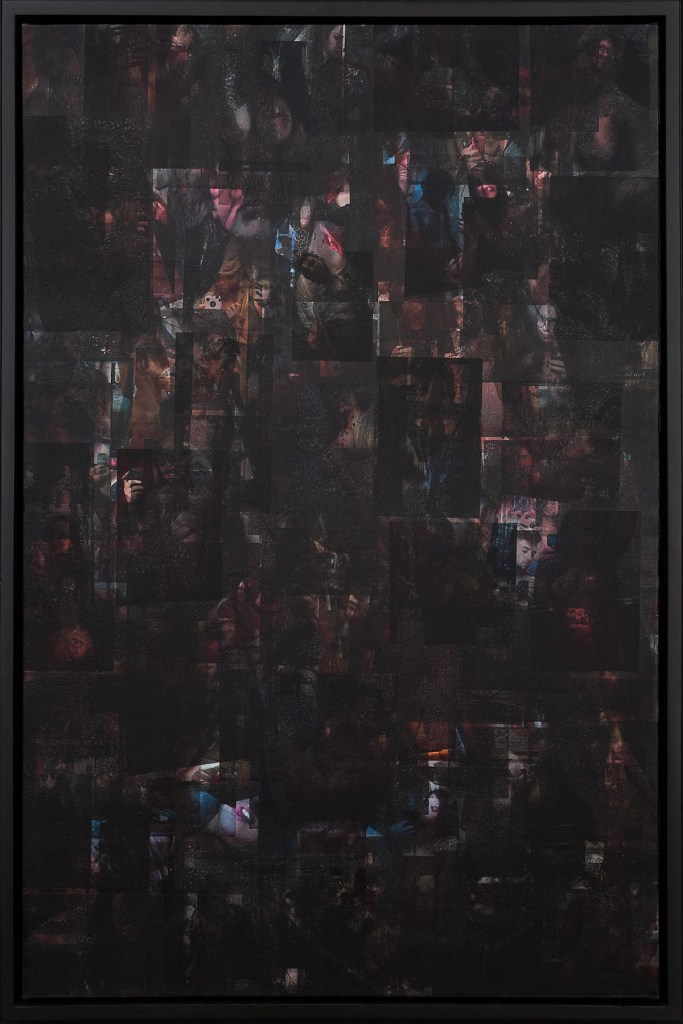
In Cruzan’s “Black Box” series of mixed-media works on canvas, method serves up the message. Through a laborious manual process, the artist transfers individual printed cell phone screenshots, each an anonymous internet selfie, onto translucent “skins” of acrylic medium. These ghostly embedded images are adhered to the canvas in layers, building up and obscuring each other.
The effect is a disturbing simulation of partial blindness and mass obliteration. But the slivers of faces in a multitude of colors, peeking from velvety blackness, pull the viewer in close. You’re compelled to check out the details, like that social media feed you can’t quite abandon.
Escape to the forest
Instead of defying technology, Shawn Bush of Casper bends technology to his artistic will. During the pandemic, he visited the Denver Botanic Gardens as a substitute for a planned trip to Hawaii’s lush paradise. The outcome is Bush’s new “Observer Effect” series, a transformation of nature through digital, print and power sources.

On the Nic’s gallery wall, four vertical windows appear to glow with tropical colors, shapes and shadows cast by a jungle outside the building. Actually, they are lightboxes containing Bush’s photographs of Denver hothouse flora, digitally and physically edited, recombined and printed onto clear films. The films are a type used for advertisements on commercial windows. The lightboxes are powered by solar cells recycling artificial gallery light.
“Observer effect” is a scientific term referring to the disruption of observed phenomena by the act of being observed. It’s not only what happened to the plants Bush photographed in the Denver Botanic Garden, it’s part of every artistic process, and in that virtual world Garrett Cruzan describes, it operates more sinisterly.
An animals’ planet
Favian Hernandez of Laramie has for years used paper maché and bright acrylic paints to make disarmingly sweet and funny animal figures that invite us to question our assumptions — about animals, about kids’ craft materials, about taxidermy heads, about artists. In this exhibit, his focus is on threatened and endangered species, a subject he is passionate about.
Hernandez has turned to resin, wire, paper clay and other materials to supplement his traditional paper maché technique in order to achieve the complex forms, textures and settings for this community of creatures. With humor and poignant detail (a marionette Bactrian camel; a proboscis monkey mother and child standing alert and clutching each other), this cast of characters elicits affection and respect.

At a painful time when it’s hard to understand each other, we might depart this exhibit feeling a bit more hopeful about our personal journeys, how we act in society, our global presence as one species among multitudes and our capacity for change.
“When Things Dream: The Wyoming Arts Council Biennial Fellowship Exhibition” is on view at the Nicolaysen Art Museum in Casper through Dec. 28. The exhibit was curated by Fellowship juror Iwan Bagus of Washington, D.C., who selected works by visiting the artists’ studios.
The Wyoming Arts Council has produced a beautiful color catalog for the biennial, with information not only about the winners, but also about the Honorable Mentions for 2020 and 2021. The free catalog is available at the Nicolaysen Art Museum in Casper, or by contacting the Wyoming Arts Council.
Studio Wyoming Review is supported in part by generous grants from the Wyoming Cultural Trust Fund, a program of the Wyoming Department of State Parks and Cultural Resources and the Wyoming Arts Council with funding from the Wyoming State Legislature and the National Endowment for the Arts.


Sue, your review is a work of art in its own right. You’ve rendered poetic justice to each artist with your grasp of techniques involved and your deep understanding of aesthetic expression. Beautifully done.
Love seeing the diversity of art and artists. Thanks, Sue Sommers and WyoFile for connecting us in these ways. Without these explorations we would think we are operating and creating in vacuums.
A fascinating collection of transformed art. A visual treat for the senses. Thank you for bringing your visions to light.