


Just four years after the COVID-19 pandemic upended operations at the National Outdoor Leadership School, the nonprofit wilderness school and staple of Wyoming’s outdoor landscape has announced plans to shed jobs and close satellite facilities.
NOLS, a global operation and major Fremont County employer with headquarters in Lander, will eliminate 60 jobs as well as suspend operations at three of its campuses come fall. The bulk of the layoffs, 42, will directly impact staff; the remaining 18 positions are currently vacant, according to the school.
The restructuring stems from a host of factors, NOLS President Sandy Colhoun said, including declining student field days. The school operated at a deficit in recent years, he said, and could not continue.
“Our financial situation requires significant action,” Colhoun said in an announcement.
The restructuring will mainly be felt at the three campuses that are in Arizona, Washington and New York, he told WyoFile.
“The impact to staff and employees in the city of Lander is relatively modest,” he said, though he acknowledged the changes will have profound effects on the NOLS community.

Beyond being a significant employer, NOLS has also helped shape Lander’s culture and economy — attracting many to the remote mountain town who end up putting down roots.
Lander resident Michelle Escudero, a former NOLS employee who has served on the local school board and worked with nonprofits, hopes the school will regain its footing. What it offers is incredibly valuable, she said.
Along with technical skills, she noted, NOLS expeditions impart “life-changing skills that you can take into the front country.”
Six decades and a changing industry
Accomplished mountaineer Paul Petzoldt started NOLS out of a cabin in Sinks Canyon near Lander in 1965. The founder had a vision of teaching leadership and outdoor skills on wilderness expeditions. By 2020, what began as a humble operation had blossomed into a multifaceted, global heavyweight in the world of outdoor education.
Along with expedition courses — which students today can experience in locations from Kenya to Patagonia and the Wind River Range — NOLS became a leading provider of wilderness medical training with the acquisition of the Wilderness Medicine Institute.
NOLS also offers customized education courses for groups like the Naval Academy and NASA astronauts.
Through NOLS, students can spend a month mountaineering in the Cascades, earn their Wilderness First Responder certificate in a weeklong class or embark on semesters in the wilderness. It isn’t cheap — an upcoming 75-day semester in Alaska costs $15,450 — though scholarships are available.
The school also trains organizations in risk management, certifies its instructors and offers Leave No Trace education.

It’s got a lot going on, in other words.
By the beginning of 2020, the school reported more than 1,100 W2 employees, 16 campuses and $40 million in revenue, and tallied more than 350,000 alumni. Then the COVID-19 pandemic torpedoed the school’s operations. Between March and July of that year, NOLS laid off or reduced hours of more than 60% of its global in-town staff, closed two campuses and canceled 750 courses, losing some $20 million in revenue.
Things have begun to rebound. However, Colhoun said, student demands had begun shifting years before. That includes a particular decline in semester course demand.
It’s not that NOLS’ product is somehow eroding, he said, but competition has flourished. Many organizations now offer outdoor-based semester programs.
When Colhoun took the helm, first as interim president in February 2023, it became clear adjustments were needed, he said.
“So the outcomes are great. And the business model is where we need to focus our attention.”
NOLS President Sandy Colhoun
According to financial information published on ProPublica’s Nonprofit Explorer, NOLS revenue dropped to $26 million in 2020 before returning to $38 million in 2022. Colhoun declined to share specific information, but said enrollment hasn’t returned to pre-pandemic levels.
The school is also reducing entry-level campus wages to $13 an hour, trimming some training programs and suspending some in-person events through 2025.
Lander ripples
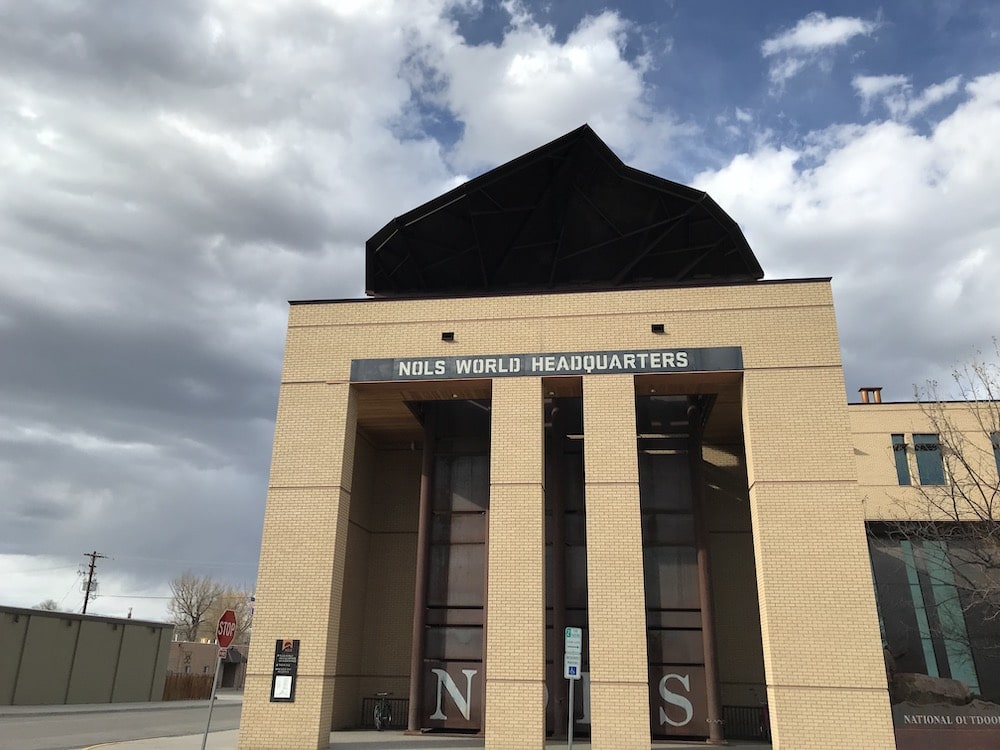
On a Thursday morning shortly after the restructuring announcement, NOLS’ headquarters — a large brick building with an unmistakable metal crest on its roof — was pretty quiet. Its modern, light-splashed rooms were fuller before the pandemic — a hybrid model and more remote workers have changed that.
“This used to be, ‘every desk is taken,’” Associate Director of Operations Jen Sallwick observed from her second-floor office.
Sallwick, who has worked for NOLS for more than 20 years, said Colhoun has been clear that addressing the school’s financial troubles is his highest priority. Still, staff reactions to the news have run the gamut.
“There are some people who saw the writing on the wall” and are relieved NOLS is acting, she said. “And there are other individuals either impacted or at the school who this came as quite a surprise.”
Though most restructuring is outside the state, a couple of headquarters jobs are directly impacted, she said. Though necessary, she added, “all the necessary doesn’t take away from the personal impacts.”
Sallwick, like many of her colleagues, sought employment through NOLS after experiencing a course as a student — a 1999 semester in Kenya. She started instructing in 2002 and went on to work in administration. Somewhere along the line, Sallwick, who hails from the northeast, settled in Lander, where she is raising two sons with her wife.
It’s a common story. Along with those who still work for the school, many Lander residents working in other fields — nurses, landlords, teachers, NGO directors — came to town because of NOLS or are descended from those who did.
Michelle Escudero fits into that category. She took a NOLS semester in Mexico in 1992. That led to years of field instructing across the world, including stints in Wyoming. She and her husband met as NOLS instructors and bought a house in Lander in 1994.
“For me a community is sort of one of the most important things in my life,” she said. “And Lander was a place where I could build a community.”
They raised a daughter and eventually left NOLS to branch into other work. While Escudero helped start the Lander Community Foundation’s Challenge for Charities — which supports a multitude of local nonprofits — her husband, Scott Kane, co-founded a solar energy business with other former NOLS employees.
Kane, who first came to Lander from New Jersey as a wide-eyed 16-year-old in 1980 for a course, said one of the greatest values he sees in the school is the way it diversifies and strengthens Lander.
“NOLS has made lots of ripples in the pond around Lander,” Kane said. “Not only through its own actions, but the people who came to Lander because of NOLS have wound up influencing the community on their own.”
The restructuring news gives Kane some pause, he said. “I am concerned that Lander becomes less energetic and diverse, a less connected place, in the absence of a vibrant NOLS.”
Going forward
The school has weathered trouble before. There was the 2008 recession, 9/11 travel impacts and a tumultuous period when the school parted ways with Petzoldt.
Colhoun pushed back on the categorization of the latest restructuring as “drastic.”
“What we’re actually doing is simplifying our organization to actually generate more revenue with effectively the same number of students,” he said. “To the people who lost their jobs, without a doubt it’s hard. It’s incredibly hard. But for the school, we’re just preparing ourselves for the next chapter of our future.”
That will necessitate a willingness to innovate in a changing market, he said. The campus closures are being conducted in a way that allows for NOLS to reopen them if its situation rebounds, he added.

The school is offering severance packages to those laid off, according to its announcement. Still, at a school-wide meeting to discuss the restructuring, some participants lodged complaints via Zoom suggesting that the school mismanaged funds while executives were handsomely paid, according to reports from participants.
ProPublica shows that NOLS executives have earned six-figure salaries in recent years. Colhoun defended the school’s compensation structures.
“We did not consider as part of [restructuring] reducing compensation for anyone at the school,” he said. “I really felt strongly about that, because I want to compensate our people at the highest level we possibly can afford.”
The school is currently hiring for several positions, including two vice president positions. Colhoun is confident in its durability.
“The most important message for me to share is that the DNA of what we do, the student outcomes, the student experience has never been stronger,” Colhoun said. “So the outcomes are great. And the business model is where we need to focus our attention.”
The need for NOLS’ work, he said, is undeniable.
“The need to have thoughtful leaders in the world has never been greater, and for that reason, there should be a line outside our door,” he said, “and we’re going to get there.”


Wyoming is anti public land (unless you’re a welfare rancher) so perhaps NOLS should consider relocating their headquarters to Colorado.
It is so sad to see what is happening at NOLS. I worked for NOLS for 30 years running the Noble hotel at night when it was full of students and instructors. We had a very collegiate culture with the greatest instructors. They provided excellent courses so much that word of mouth advertising was enough to fill our courses, but before COVID enrollment started to fall off. Nepotism was rampant and it affected the courses. After courses started again after COVID most of the American staff did not return to work for NOLS. I had a great time working for NOLS and I miss the energy of the students and staff. The old NOLS will be missed in Lander.
I worked my first NOLS course in 1972, last one in ’92. (I don’t have the same weeks in the field as many other past instructors as, throughout the year, I had other jobs in and out of the country.) I moved to Lander in 1981. I understand how wonderful and important it is the field staff comes from all over the country, all over the world. I struggle to understand why NOLS administrators work remotely from elsewhere in the country rather than gather together in Lander to form a solid team, a presence, perpetually comparing notes, ideas, concerns, and being available to a variety of traveling field staff and other “worker bees”. Communication, discussion, arguing, around a table or camp stove has been critical, vital to NOLS growth and success. The school has always been rich in diversity, experience, education and opinion. I hope the school can thrive with good Leadership.