


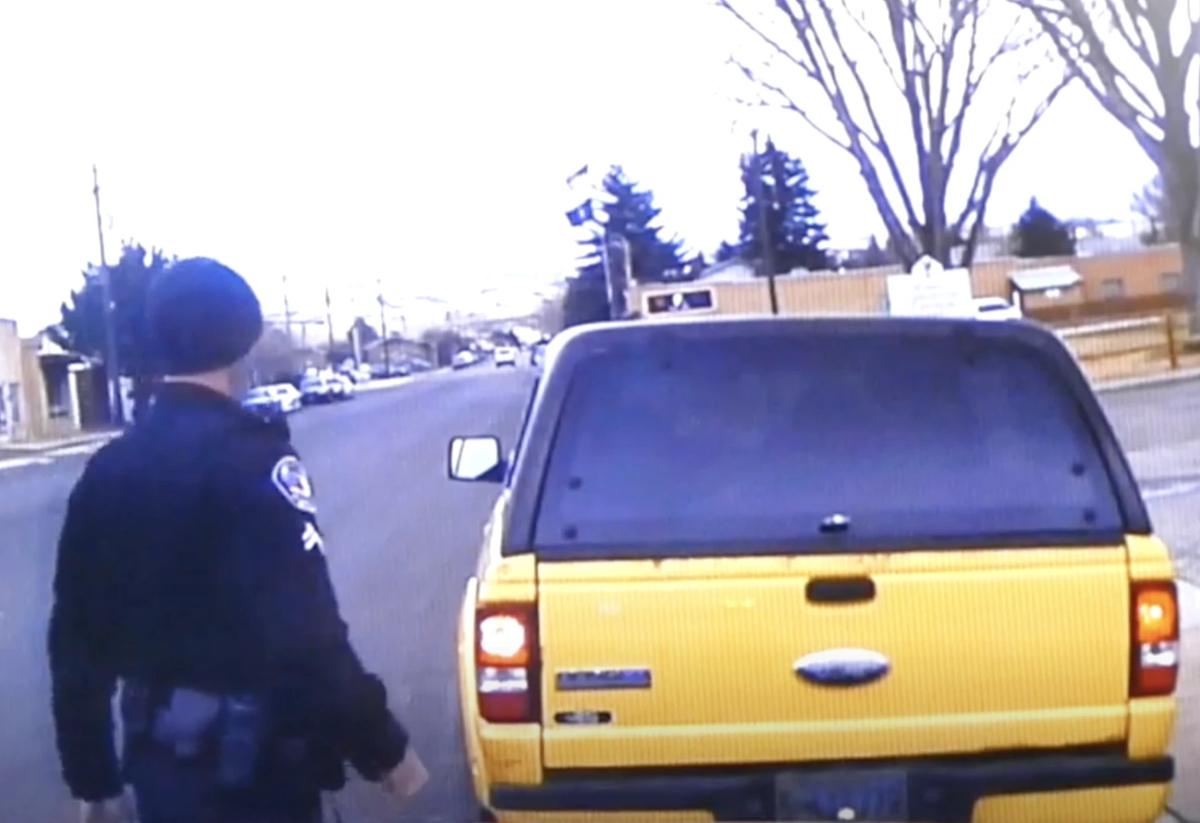
After an Albany County sheriff deputy shot and killed Robbie Ramirez following a November 2018 traffic stop, officials told the public the deputy’s body-worn camera came unplugged as the two men struggled in Ramirez’s driveway.
The pulled cord cut the body camera footage at a crucial moment. Neither the public, nor the state detectives investigating whether Deputy Derek Colling was justified in killing Ramirez, ever saw what Colling did in the crucial seconds before he fired two fatal shots into Ramirez’s back.
Five years later, what happened to Colling’s camera and other video evidence in the case remains in dispute, despite a $1.2 million settlement between Albany County and Ramirez’s family. It is one of many unanswered questions that still linger half a decade after the killing that shook Laramie and sparked protests and policy reform efforts for years afterward.
In a fresh clash this week, lawyers for the family countered a claim by current Albany County Sheriff Aaron Appelhans that all parties to the settlement had agreed there was no “legal basis for evidence tampering” with Colling’s body camera footage or the dashboard camera on his patrol car.
In May 2022, Albany County settled the case roughly two months after attorneys representing Ramirez’s mother, Debra Hinkel, filed a lengthy motion accusing both Colling and other sheriff’s officials of tampering with the body and dash camera footage after the killing.
In violation of the department’s own five-year records-retention policy, a sheriff’s lieutenant deleted the original body and dash camera videos in December 2019, according to that filing. Versions of the video that were presented to the public remain online.
The county maintains the original videos were deleted as part of routine maintenance and updates, and that the lieutenant had not been notified litigation was pending. The family, however, says he admitted to being aware of a possible future lawsuit, which was widely discussed within Albany County at the time.
Though attorneys for the county strenuously denied tampering accusations, the question never got its day in court.
Federal Judge Nancy Freudenthal had scheduled a hearing on the allegations of evidence tampering for May 3, 2022, court records indicate. The parties reached a settlement agreement on May 2, and the hearing was canceled — ending litigation that had gone on for a year and eight months.

Earlier this January, after continued Wyoming Public Records Act requests from WyoFile and its attorney for the document, Appelhans released the previously confidential agreement dictating the terms of the settlement. But in a press release announcing that release, he asserted that all parties to the settlement agreed there was no legal basis for the evidence tampering claim.
Hinkel’s attorneys responded this week with a press release of their own. They rejected that claim, while also calling on Albany County to allow the release of other evidence from the case that could allow “all of Wyoming law enforcement to learn from this tragic story.”
Considerable evidence uncovered during the prosecution of the civil suit remains sealed because of a court order sought by Albany County, Hinkel’s attorneys wrote in their statement. After the shooting, then-Albany County District Attorney Peggy Trent convened a grand jury, proceedings of which are usually held in secret. What she presented to those jurors has never been made public, but led the grand jury to conclude Colling should not face any criminal charges for the shooting — his third fatal use of force in uniform. (He was not charged criminally in the other two instances.)
“The protected evidence would be critical in assessing the evidentiary integrity and fairness of both the grand jury proceedings and the truth behind the shooting death of her son,” Hinkel’s attorneys wrote.
Over 25 documents are labeled non-public or sealed, according to WyoFile’s review of the court records. Several refer to Colling’s psychiatric records.
Both public scrutiny and the legal case have focused on whether former Albany County Sheriff Dave O’Malley erred in choosing to hire Colling after he was fired by a metropolitan police department. The Las Vegas Police Department fired Colling following an inquiry into allegations that he beat and arrested a videographer for filming police from his driveway. Video of the incident went viral. The episode followed another controversial killing in which Colling was the sole shooter.
O’Malley hired Colling into the sheriff’s department a year later.
While Colling left the sheriff’s department in 2021, the Peace Officer Standards and Training Commission has been considering whether to disqualify him from future law enforcement work in Wyoming. However, the thorough review necessary to decertify an officer has been limited by Albany County’s refusal to share Colling’s personnel records, according to Director Chris Walsh. The Legislature will consider a bill during the upcoming session to grant POST access to law enforcement personnel files for investigations.
Altered footage?
According to Hinkel’s attorneys, Colling’s camera may not have come unplugged the day he killed Ramirez in 2018. Instead, they contend he or his supervisors deleted five seconds of the body-worn camera footage before he handed it over to detectives from the Wyoming Division of Criminal Investigation — a state agency that typically investigates police officer killings.
Those five seconds “likely would have shown Ramirez badly wounded and face down on the ground when Colling killed him with two shots to the back,” the attorneys wrote.
They argue Colling’s camera was in “offline mode” during the shooting, a status that allows videos to be altered before they’re uploaded to an evidence storage system. Colling had plenty of time in which he could have deleted the footage himself, because evidence logs indicate he held on to his camera for three hours and 19 minutes after the shooting.
After he handed the camera off, agents with the Division of Criminal Investigation worked with the sheriff’s office to obtain the footage from the camera. That’s not unusual for DCI agents investigating in-custody deaths, agency director Ronnie Jones told WyoFile, because they rely on local law enforcement agencies with access to the camera’s proprietary technology to download the video. It can take multiple hours, and even days, for DCI to obtain footage depending on the circumstances of the case, Jones said.
Before finally handing the footage over to DCI, then-Undersheriff Josh DeBree took the camera into his office alone, according to one of the state agent’s testimony.

Debree has since left the sheriff’s office, along with Colling. Both men are now listed as brokers for the same Laramie real estate firm.
In an April 2022 filing, attorneys for the county rejected all the plaintiff’s evidence-tampering arguments, labeling them “allegations of conjecture, wild speculation and at times, outrageous.”
The alleged tampering was both “physically and technologically impossible,” they wrote. Among their witnesses is an engineer for the body-worn camera maker, Axon.
In an email to WyoFile this week, Appelhans defended his department’s handling of the video evidence in the shooting, citing the county’s court filings. His deputies are certainly unable to edit their body camera footage with today’s technology, he said.
“All video is automatically uploaded to a secure server,” Appelhans wrote.
“The software used makes it impossible to alter the footage recorded.”
But the Axon Body cameras used today — Axon Body 4 — have evolved from the Axon Flex camera Colling wore. In their motions, attorneys for both sides cited Axon’s manual to support their case for the possibility of tampering, or the lack of it.
What the judge said
In June 2022, a month after the settlement agreement, Freudenthal dismissed the plaintiff’s motion. She did so with a one-paragraph order that offered none of a judge’s usual analysis of the arguments.
“Having considered the parties’ arguments, reviewed the record, and being otherwise fully advised on the premises, the Court finds there is no legal basis for evidence tampering,” she wrote.
That decision appears somewhat preordained by the settlement agreement. Outside the usual language dismissing further liabilities, both parties agreed to two specific provisions accompanying the $1.2 million payment to Ramirez’s relatives. One was that the Albany County Sheriff’s Office would commit to “reasonable efforts” to train its officers in crisis intervention techniques — better equipping them to deal with people with mental illness, like Ramirez.
That work is underway, according to the Spence Law Firm attorneys representing Hinkel. “The progress appears real,” they wrote.
The other provision required Freudenthal to publish an order denying the motion on evidence tampering.
Specifically, the settlement agreement required her to state she has “considered the parties’ arguments, reviewed the record, and being otherwise fully advised in the premises, and she finds that there is no legal basis for evidence tampering.”
That is very nearly the exact language that appeared in Freudenthal’s brief order.
“No legal basis for evidence tampering” may sound like Albany County has been cleared of any wrongdoing, but legal experts told WyoFile that’s not necessarily the case. One could read that to mean Freudenthal decided the evidence tampering allegations did not meet the high legal bar for what Hinkel sought, which is for the judge to decide the case in her favor.
Or Freudenthal may have decided that since a settlement was reached, there was no legal basis to proceed with the plaintiff’s motion for summary judgment. In other words, the judge was simply tying up loose ends by deeming the issue moot. Since the settlement agreement required her to find there was no legal basis, she would have bucked all parties in the case by doing otherwise.



Police need to be held to the same laws as everyone else. It’s appalling to hear time and time again of prosecutors not bringing criminal charges against police for their unlawful use of force. It is a violation of our constitutional rights and erodes our freedoms and civil liberties . Prosecutors protect cops and it is wrong . County attorneys like Mrs. Trent fail to uphold their duty to seek justice . Police officers do not face criminal charges and are kept on staff. Families are left to seek retribution only through civil lawsuits. 1. 2 million is peanuts when it comes to someone’s life being wrongly taken. The police are peace officers who work for the public . Their records should be made available. All the more reason to support House Bill HB31 this session . Local governments have proven incapable of firing violent cops , and we must rely on the Peace Office Standards and Training Commission to strip bad cops of their license . I encourage WyoFile to elevate the importance of HB31 for issues as it pertains to issues like this story. We must not let local police forces continue with totalitarianism at the expense of transparency, public freedom and safety.
There may be an opening to take some action against Axon, the camera maker for making a camera that made recordings that could be altered, which would be a flaw in its system that goes directly against the public interest in recording law enforcement activity. Was that a bug or a feature?
Thanks for this update on this important issue for the people of Wyoming to consider. I do find the Judge’s actions on this issue as well as a few others questionable, but hey its still progress as we can now question the Old People’s Network instead of just the Old Boys.
I still cherish the letter that O’Malley sent to the Albany County Democrats imploring us to nominate Josh DeBree for Sheriff as it is a classic expression of narcissistic personality disorder. Seemingly Florida attracts people with this affliction. The cover up was so blatant I would argue that stripping him of his pension would be more than justified.