


This story was updated with a reaction from Citizens for the Responsible Use of State Lands — Ed.
Neighbors worried about development on state land can’t join a legal embroglio between the state of Wyoming and Teton County, the Wyoming Supreme Court ruled Friday.
The group Citizens for the Responsible Use of State Lands didn’t satisfy requirements for participating in the lawsuit, the court found. Furthermore, Teton County is protecting the residents’ interests adequately as it fights the suit — a suit Wyoming brought to stop local building-code inspection of development on state land.
“CRUSL failed to meet its burden,” the five justices wrote in an 11-page opinion. “CRUSL does not have a significant protectable interest in the underlying litigation [and] Teton County adequately represents CRUSL’s interest.”
The justices affirmed an earlier decision by the Laramie County District Court that came to the same conclusion. Neighbors sought to intervene in the suit and argue their own case, not just file amicus briefs supporting the county as a “friend.”
“Teton County fully intends to ensure all its rules and regulations are enforceable on all state trust land in Teton County.”
Wyoming Supreme Court
“We believe the Wyoming judiciary would have benefited from hearing from at least some of those impacted citizens before deciding the weighty issue before it,” Bill Schwartz, CRUSL’S lawyer, said in a statement. “The outcome of this case will impact thousands of Wyoming citizens who may find themselves one day living next to an undesirable business over which their local government may have no power to regulate.”
The issue involves development on state land near Teton Village where the state land officials authorized a canvas-covered glamping hotel, storage sheds and other things. Teton County and neighbors want those projects to be inspected for adherence to local fire and electrical codes.
Wyoming sued to block county enforcement of county codes. Neighbors sought to join the action as a “matter of right,” claiming they were being affected but weren’t being represented well enough by the county’s attorney.
County’s own variance
The high court ruled the neighbors couldn’t intervene because interest in enforcing local codes depends on whether the county itself can enforce those regulations in the face of the state’s superior authority.
“Any interest of those [CRUSL] members is contingent upon whether or not the Teton County land development regulations are even enforceable on the [state] Parcel because of the State’s sovereign immunity,” the ruling states.
The extent of the state’s authority is the crux of the underlying lawsuit the State Board of Land Commissioners brought against Teton County. That question hasn’t been resolved.
“CRUSL’s avenue to protect those [neighbors’] interests only becomes vested if the State is subject to county land use/development regulations on state trust land…” the justices wrote.
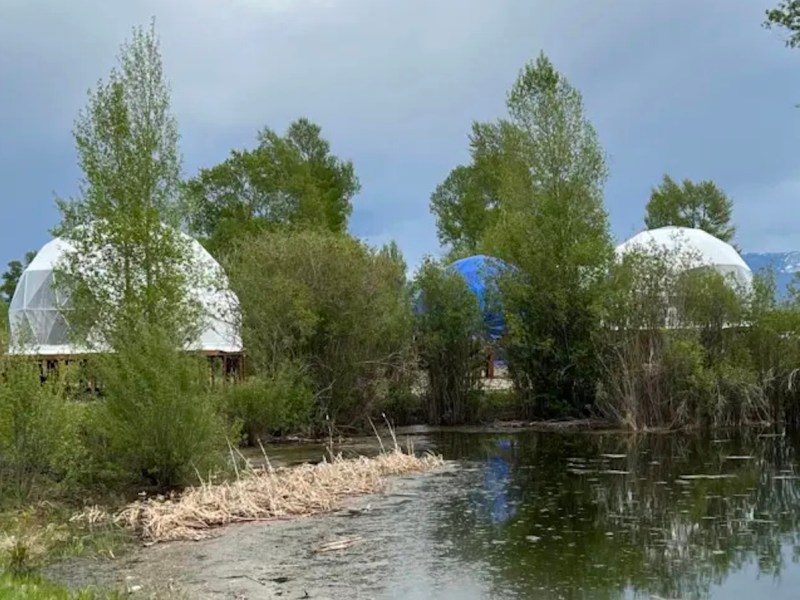

The neighbors also argued that Teton County wasn’t putting up a good enough fight, pointing to the county’s own use of the school trust parcel.
The county wanted to use the property to stockpile rocks to bolster flood-protection dikes, according to the ruling. But that stockpiling is a “non-conforming” use under the county’s own land use rules, justices wrote.
“CRUSL argues Teton County is incentivized to advocate in a manner that does not ensure enforcement of all its rules and regulations,” the justices wrote in summarizing the neighbors’ complaint.
But Teton County sought a variance to its own rules to allow emergency stockpiling. That variance satisfied the Supreme Court.
“The record indicates Teton County followed its own rules and regulations when seeking a variance on state trust lands,” the justices wrote. “It further indicates Teton County fully intends to ensure all its rules and regulations are enforceable on all state trust land in Teton County.”
Whether that intention is fulfilled depends on the county’s success in the underlying suit that the land commissioners brought against Teton County.
“We are very disappointed CRUSL was denied this opportunity and that the only voice heard in opposition to the Land Board will be that of the Teton County Commission,” Schwartz wrote. “That said, we are grateful the Supreme Court has accepted the Amicus briefs filed by CRUSL and other organizations, including the Wyoming County Commission Association and are hopeful for a favorable decision on the merits.”

That parcel is surrounded by some critical tax-dodge habitat.
So people are complaining about the white domes ,claiming they live next door , well sorry to inform you but nobody lives next door as a neighbor . Jus hay fields and more hay fields. What I’m concerned about are all the 10000 sq foot homes that only house vacationing owners , that’s the real problem in Jackson hole
Yup…reminds me of the time when a yurt village was forming in Kelly, abutting the Kelly School 45 years ago. Some didn’t like it. The Idaho Post Register sent myself(photographer) and a reporter out there to check it out. It showed just regular working people finding affordable living. Some yurts were big, some were small. Not sure if it’s still there, 25 years later.
still there
Totally agree
I cannot speak for the neighbors, but many of us in Jackson are concerned about clean water issues related to the glamping site; read the attached article above. Their septic systems threaten an already degraded Fish Creek.