

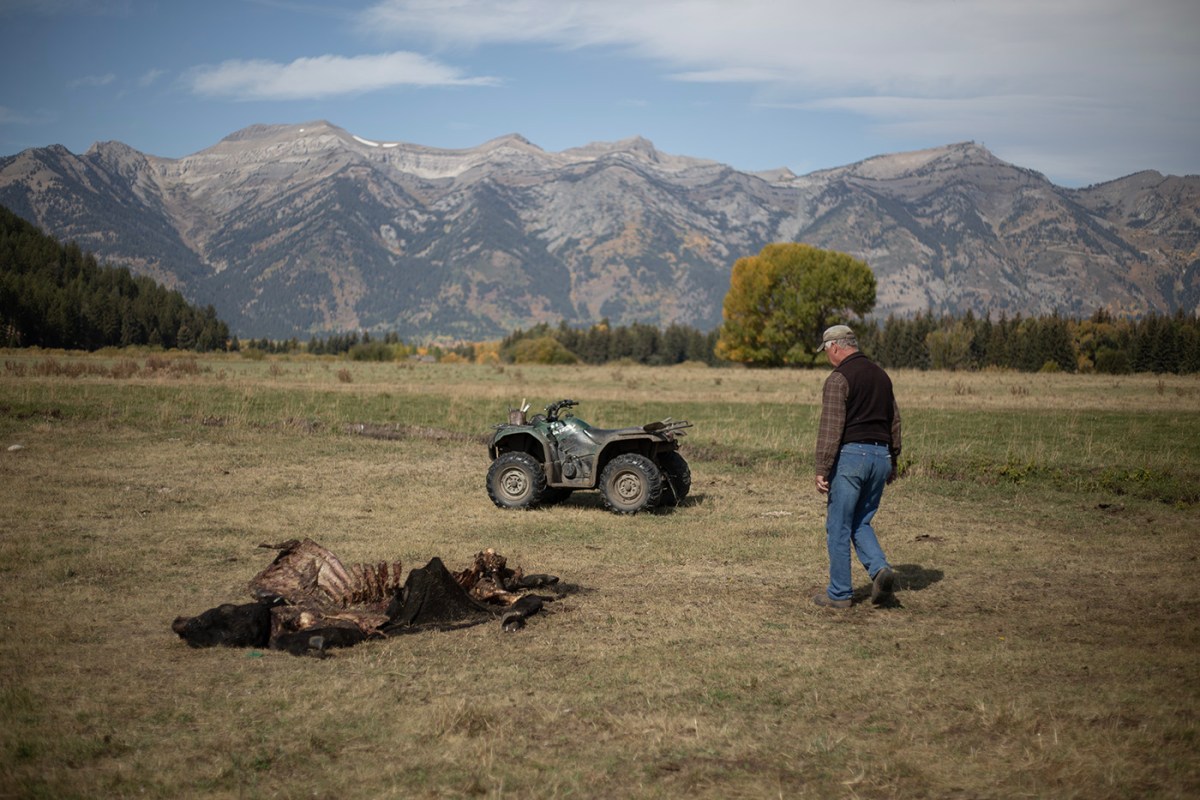
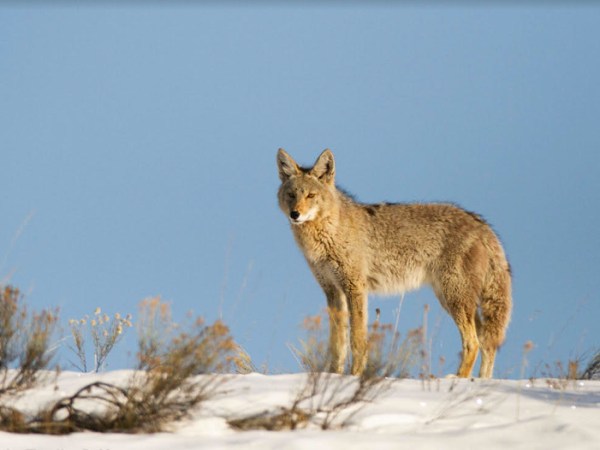
CASPER—Sparse snow cover made killing predators more challenging and “dynamic” this past winter in Fremont County, Rob Crofts recalled.
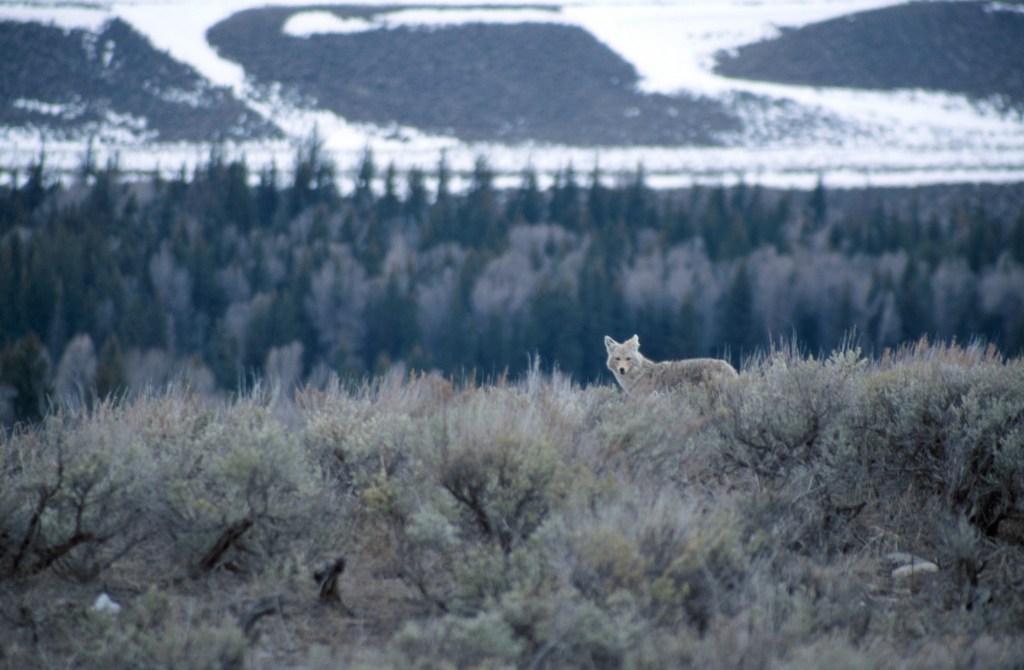
Even if tracking and spotting wildlife was trickier, contracted trappers and hunters incentivized by a bounty program still managed to kill roughly 1,000 coyotes, the Fremont County Predator Board chairman reported before pausing to ask the Wyoming Animal Damage Management Board a question.
“What would that be like if we did not do predator control?” Crofts asked rhetorically.
He also pointed to the agriculture and livestock producers who benefit from that “control” — a sanitized way to describe what typically involves killing. Fremont County houses 987 farmers and ranchers who exceed $10,000 in sales, he said. He recapped the coyote and predator-control activity in his 4.9-million-acre county while pitching the Wyoming Animal Damage Management Board last week for more funding to do it all again.
Plainclothed federal government employees who carry out the lethal actions — running traplines to catch wolves and shooting coyotes from the air — sat nearby listening to the pitch in the Agricultural Resource and Learning Center building at the Natrona County fairgrounds.
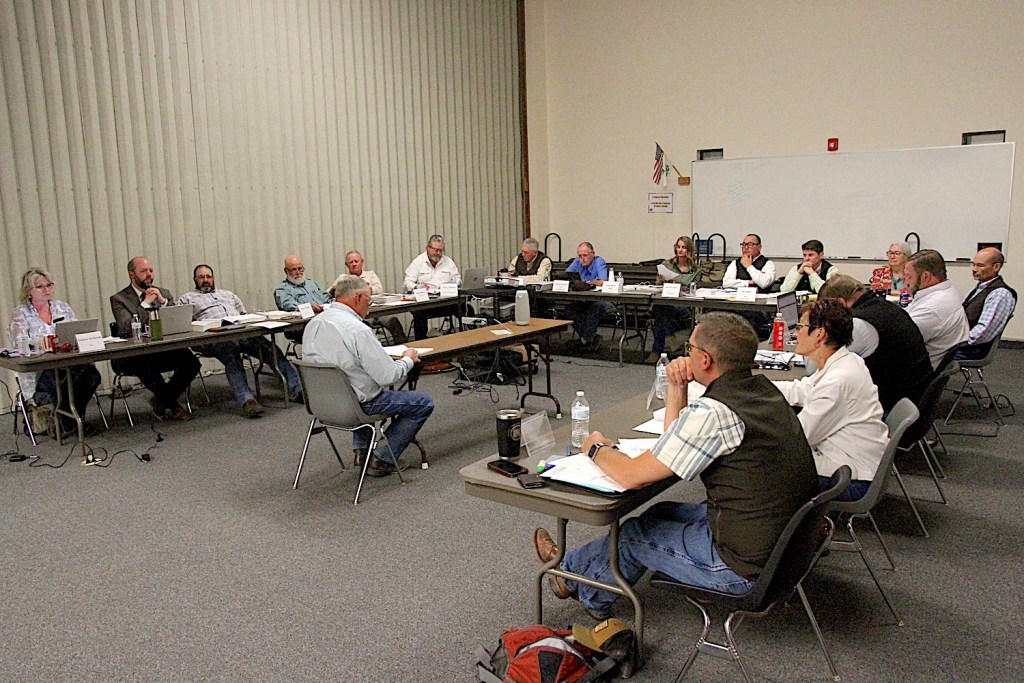
Fremont County’s predator board applied for $387,000 for the coming fiscal year. Government trappers will have to make do with significantly less. Statewide, there is more demand for predator-focused dollars than money available, and by the time the statewide board signed off on its budget for 2026-27, the panel had knocked down Fremont County’s allocation to $290,000 — a nearly $97,000 haircut.
Almost all other county predator boards in Wyoming are in a similar position, and will have to get by with less funding than requested. There was a roughly $466,000 gap between county predator board requests and available funds. As a result, only three county boards are receiving their applied-for allocations. (Crook, $179,100, Sheridan, $188,700 and Weston, $100,000)
Sizable cuts to requested funds also hit the Johnson County Predator Board, which was granted $380,000, some 16% less than the $450,000 requested. Natrona County, meanwhile, was allocated $322,000 in funding — 11% less than the amount it applied for.
Growing investment
The shortfalls come at a time when Wyoming taxpayers are putting more and more money into efforts to kill animals the agriculture and livestock industries and county predator boards have deemed a nuisance. This coming fiscal year, it’s a nearly $4.8 million expense
The Wyoming Legislature allocates funds for the Animal Damage Management Board, created in 1999, on a two-year basis during the budget session.
In 2022, when state lawmakers set a COVID-shrunken two-year budget, the board was allocated some $5.8 million from Wyoming’s general fund. The expense grew to $8.4 million by 2024, and early this year, the Legislature signed off on a budget that gave Predator Management Coordinator Jerry Johnson nearly $9.8 million to distribute to the county boards over the next two years.
“They did take into account fuel costs and inflationary costs,” Johnson told WyoFile.

In Wyoming’s 2026-27 budget, lawmakers stipulated that $1.6 million of the funding be appropriated for “special projects prioritized for preventing listing” of a species under the Endangered Species Act.
In practice, that resulted in a sage grouse-specific line item for each county predator board. That species, which depends on the declining sagebrush biome, is facing sustained population decline.
Johnson and the Animal Damage Management Board broke up $800,000 in sage grouse-dedicated funds for the coming fiscal year, prioritizing counties that had the largest chunks of “core” habitat. Most county boards were granted $38,000, while Carbon, Natrona, Sweetwater and Fremont counties each received $65,750. Goshen County, on the eastern plains and holding few to no sage grouse, was awarded $5,000.
Not all counties receive money from the statewide board.
Teton County stands alone in not having a predator board, even though statutorily it’s technically supposed to possess one, Johnson said.
“They just choose to coexist, I guess,” he said. “They just don’t hire trappers.”
For counties to be eligible for state board funds, livestock producers in county districts must pay a $1 per-head predator fee when they sell. There’s about $1.2 million in proceeds across Wyoming, revenue that’s retained by county predator boards.
The Platte, Laramie and Sublette county boards don’t charge the full fee nor receive state board funding. Sublette County may start, however. Kristy Wardell, the county board treasurer, briefed the state board on efforts to convince local producers to pay the $1 per-head predator fee — she’s distributing a questionnaire to gauge interest.
A federal trapper told the state board that Sublette County could keep his staff busy if there were funds for a “full-time” program.
“That’s a very adverse landscape,” said Brady Smith, a district supervisor with the U.S. Department of Agriculture’s Wildlife Services. “Full suite of predators. You’re dealing with both the [wolf] trophy and predator zone.”
Bang for the buck?
County predator boards report their activities in an annual report submitted to the governor and three legislative committees.
Reporting requirements aren’t standardized, however, and some county boards provide much more information than others.
Big Horn County’s predator board is among those that delves into the specifics. In 2025, the board employed two Wildlife Service trappers, and they responded to $5,062 in reported livestock damage and another $6,900 in verified livestock damage.
Federal trappers working in the westslope Bighorn Range county targeted six species over the course of the fiscal year.
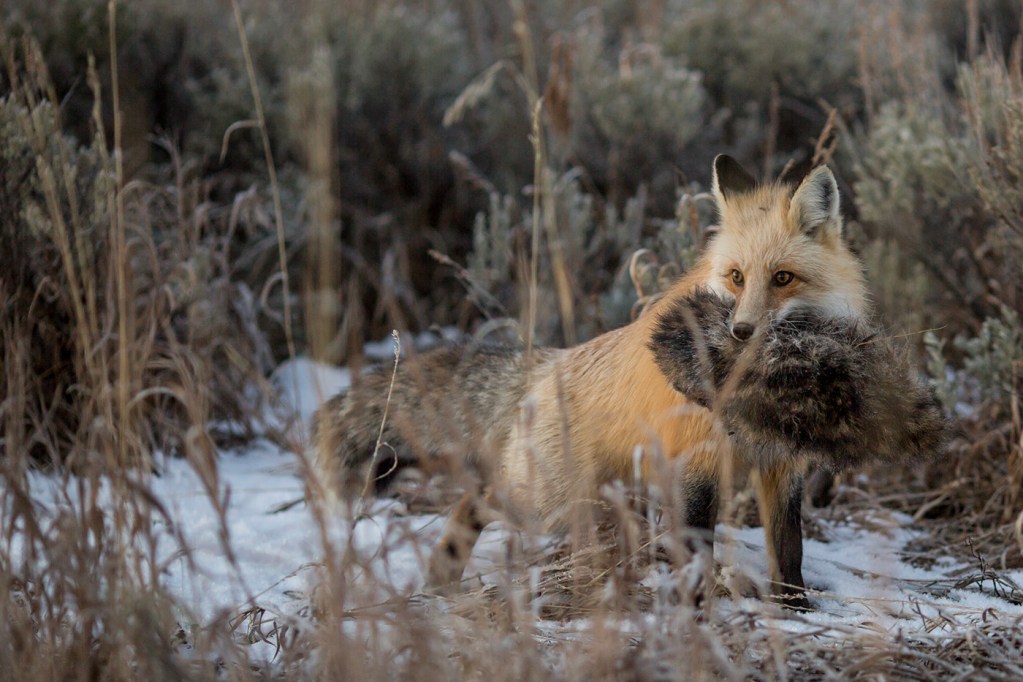
They reported killing 483 coyotes, including six dens of pups. Another 30 red foxes and six fox kit dens were eliminated. So were five ravens, including a nest, 206 raccoons and an untold number of nonnative European starlings on four different feedlots.
Other counties were sparse on details in the annual report.
The Lincoln County Predator Board, which has been investigated for Airborne Hunting Act violations, provided no overall accounting of the wildlife its civilian trappers killed using the state funding.
Woolgrower Jon Child, the county board’s chairman, used the report to detail a request for an additional $20,000. (Although Child wrote that he was asking for $20,000 more, state records show that he only asked for $10,000 more.)
“One other thing we would like to mention is that our equipment is wearing out and is not dependable,” Child wrote.
At last week’s meeting, the Animal Damage Management Board awarded Child and the Lincoln County Predator Board almost all of the requested funding. The county board received $295,000, just $3,500 less than what Child asked for.
Johnson, Wyoming’s predator management coordinator, proposes county funding levels to the statewide board. He explained his recommendation.
“Lincoln County’s always been fairly lean,” Johnson told the board. “I dropped him just a little bit.”
The Lincoln County Predator Board was in line to get the additional funding to help Child pay for a new snowmachine, he explained.
The Animal Damage Management Board made no changes to the county allocations that Johnson recommended. Last week, the board also set its budget for special projects. The nearly $268,000 in funds for those, which are often research-related, come out of a separate pot. The Wyoming Game and Fish Commission contributes $200,000, and the remainder comes from the Wyoming Department of Agriculture.
Although project dollars are routed through the Animal Damage Management Board, the Wyoming Game and Fish Department prioritizes the projects and recommends funding levels. Cuts, out of necessity, were steeper: There were 16 projects totalling nearly $440,000 in requested funding, but only about 60% of that sum was available.
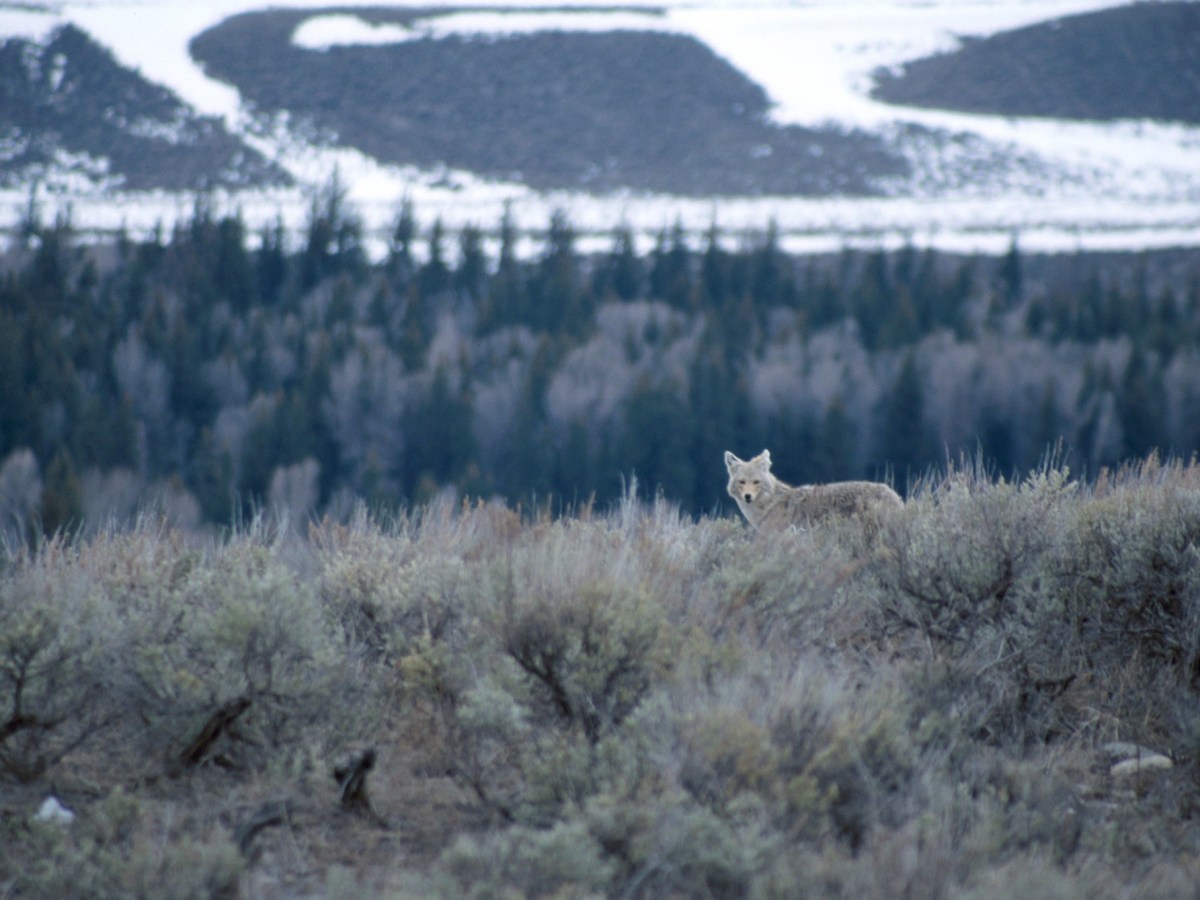
Some board members took issue with some of the projects. Sharon O’Toole, representing the cattle industry, took issue with a joint Game and Fish-University of Wyoming research project that seeks to develop coyote abundance estimates to improve understanding of why the canines key in on subadult deer in some mule deer herds more than others.
“I would like to eliminate it altogether,” O’Toole said. “I don’t know, in the end, if anybody would learn anything that the trappers don’t already know.”
Game and Fish Director Angi Bruce, who co-chairs the state board, stood behind the project, her agency’s second-highest priority. She spoke to the research’s “indirect” benefits.
“[We’re] gaining that understanding of the factors out on the landscape that may lead to more coyote predation in one area versus the other,” Bruce said. “If we can get to the heart of that, then we can start to manipulate things in a way that makes an impact long-lasting.”
The Animal Damage Management Board agreed to give the coyote abundance project $40,000, about half of the $77,000 that proponents requested.

When comparing the cost of loses of livestock to predation vs. the cost of killing predators (aside from starlings and ravens), it sounds like the program is ripping off the public to make ranchers, trappers and people who want a full time job happy, nothing more.
Killing pups in their dens is evil and cruel. How do you justify killing foxes? Are taxpayers doling out millions to kill wildlife so cows, sheep and chickens can roam free on the land?
If ranchers have their way, Wyoming will be nothing more than a giant feedlot. Yuck.
Every year an immense amount of public money (a tax really) is spent on predator control. The amount of money spent yearly shows that this method of controlling predators is primarily benefiting the hunters and aircraft pilots who engage in the “predator control.” Wouldn’t it be much more effective and less expensive to instead fund preventive measures like livestock guardian dogs, donkeys, flashing lights, etc. Many studies show these methods are effective and much less expensive for the already overburdened tax payer. Reports also show that more and more livestock growers are adopting such methods because they work. I would like to see a story with personal accounts about how livestock guardian dogs are helping Wyoming livestock growers.
Now I know a very good reason NOT to move to Wyoming.
I strongly believe that farmers and ranchers should bear the full cost of predator control. US Wildlife Services predator control programs should be totally eliminated.
These wolves were INTRODUCED BY THE GOVERNMENT. The Govt. created the problem, the govt must pay for the problems they caused.
If you are running stock on US government land, why do you believe you can order the government to kill its own animals? There are risks to farming stock that are assumed if you know you are ranching on land with predators.
In addition, predator control is a waste of time and money. It has little, if any effect, and can introduce unintended consequences.
Predator control is 100% effective if you get rid of EVERY wolf.
Unintended (or maybe completely intended) consequences were introduced along with the invasive canis lupus occidentalis. It was a crime against nature to release them in the lower 48 where they never existed before.
The government speeded up wolves coming into MT, WY, ID etc but given time the wolves would had repopulated these areas naturally by coming down from Canada, Minnesota and Wisconsin. Nature works in mysterious ways that we don’t fully understand.
Unnatural relocation, not a natural migration, Tom.
Maybe they should start protecting the Lake Trout in Yellowstone lake as well by your reasoning, because they could have eventually made it there naturally.
The wolves were here long before the government existed.
As a shepherd and cowhand for Wyoming ranches and a Forest Service grazing cop, I saw predation close-up. I also caught ranchers using illegal methods, chiely strychnine and 1080 drop baits, against predators, killing a wide spectrum of non-target species: eagles, hawks , foxes, badgers, ravens, and quite a few pet dogs. Researchers, notably Frederick Knowlton of Utah State, found that most predator control programs are ineffective, because they mostly eliminate younger animals, which pack dynamics prevent from breeding or leading hunts. When breeding (alpha) animals are killed, it disrupts the packs and the younger animals split up into multiple breeding pairs and start freelancing for prey, increasing the loss of domestic sheep and cattle. By remaining steadfastly ignorant of predator biology, these programs aggravate the very problem they are intended to solve.
So you’re saying we need to get rid of all of them, since hunting/killing only some of them only causes more problems.
I’m for it!
Thanks
I know you would be for it. Maybe you could get an elk.
you guys killed a species of concern, Kit Foxes in the Big Horn Basin? Huh?
I wondered what those dastardly Kit Foxes were preying on. And the starlings.