

Many Wyoming businesses already struggle to hire and retain workers. Recent data from the U.S. Bureau of Labor Statistics and Wyoming Department of Workforce Services project more challenges ahead as Wyoming jobs increase and the unemployment rate rises.
It’s not a case of no jobs. Instead, it’s too many jobs without enough people to work them.
Labor statistics
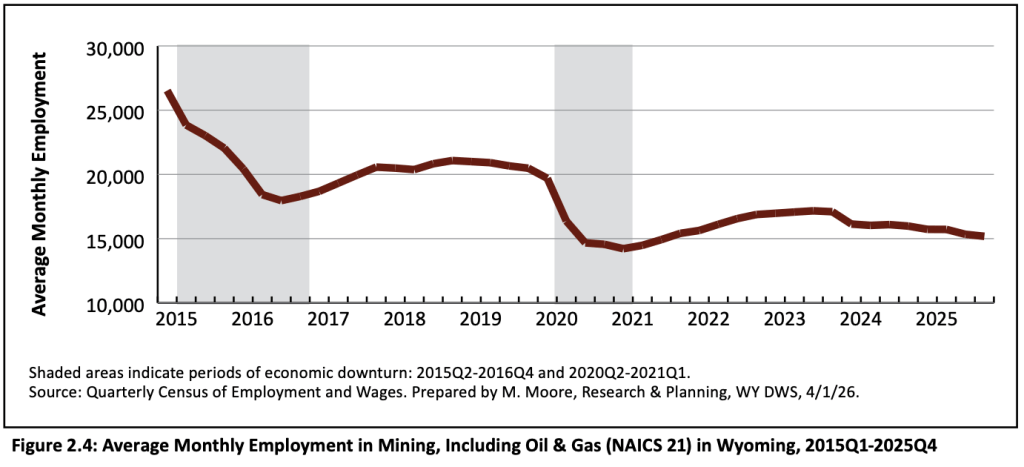
Wyoming has continually lost mining jobs, which includes the oil and gas industry, over the last several years. This isn’t new, as employment in the mining sector peaked in the fourth quarter of 2008 and has declined since.
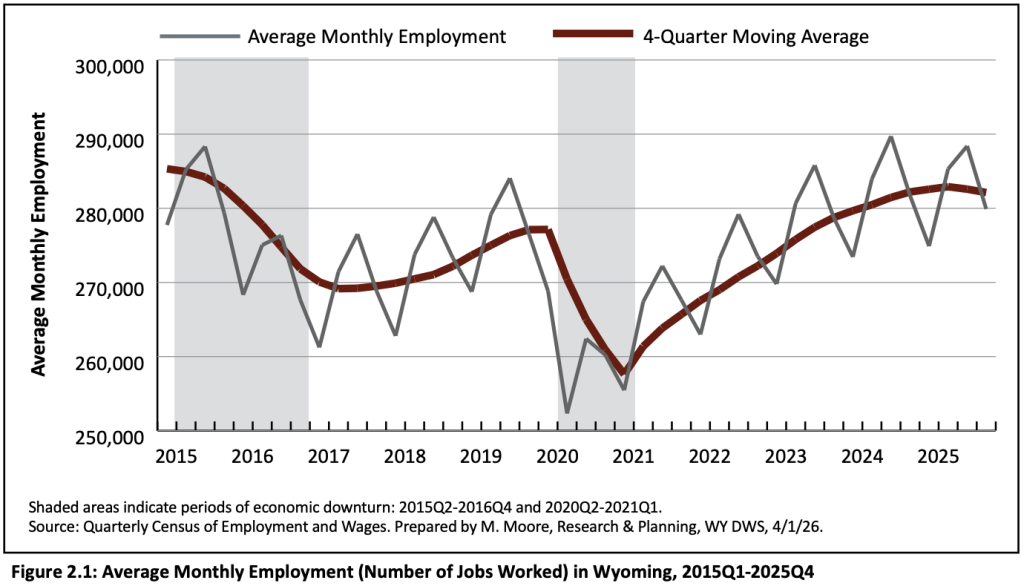
However, according to the 2026 Wyoming Workforce Annual Report the number of jobs in Wyoming has remained unchanged due to growth in other fields. What has changed? The unemployment rate — or the percent of people unemployed out of the total labor force.
Wyoming’s unemployment rate increased from 3.1% to 3.4% between 2024 and 2025, and has stayed at that rate since, according to Workforce Services.
“People aren’t working for whatever reason: They’re in school or they’re taking care of a loved one or they’re for whatever reason they’re just not participating in the labor market here in Wyoming,” said Michael Moore, a research supervisor for the Workforce Services Research and Planning Division. “And so that way, we have a smaller pool to draw from with workers.”
Business impact
This smaller pool of workers is a challenge for businesses. Currently there are more jobs than workers, which hinders hiring and employee retention, Wyoming Business Alliance President Renny MacKay explained.
“There are challenges getting the talent that businesses need.
And so then that affects the ability for business to put in a new bid on a new project, to bring in more revenue or something,” MacKay said.
Part of these challenges can be attributed to Wyoming’s decreasing labor force, MacKay said. Wyoming’s aging population, combined with an exodus of young people from the state, makes it more difficult for businesses to fill job openings. While some people from other states have moved to Wyoming, it isn’t enough to fix the labor shortage.
The Wyoming Business Alliance identified several factors that make it harder for businesses to hire employees. A lack of affordable housing, a need for more educational opportunities and difficulties securing childcare impact workforce numbers.
Problems and solutions
Housing is one of the hurdles to working in Wyoming. Some employers will make a job offer and have it accepted only for a person to not be able to find housing, specifically affordable and available housing.
To solve this, the Wyoming Business Alliance advocates for less regulations around zoning and permitting to make it faster and easier for developers to build housing. This past session, the Legislature passed House Bill 2, “Fast Track Permits Act,” which sets specific deadlines for local governments to respond to residential building permit applications.
Another problem is a mismatch between the jobs employers are trying to fill and the skills people have. Sometimes the right training programs aren’t offered in Wyoming or there are too few spots available.
Gov. Mark Gordon created the Wyoming Innovation Partnership to help solve this problem. The partnership works to establish training programs in nine different categories including healthcare, energy and agriculture. Some of the programs develop degree programs at community colleges and the University of Wyoming.
Affordable childcare is also a problem. Some families can’t afford childcare, leading people to care for their children instead of entering the labor force. According to MacKay, it’s more affordable to open a childcare business out of a home, but zoning regulations can prohibit it. Currently the Wyoming Business Council, Wyoming Community Foundation, the Department of Family Services and Department of Workforce Services are exploring solutions.
Wyoming outlook
Wyoming is projected to gain over 6,000 new jobs from 2025 to 2027 and over 28,000 new jobs from 2024 to 2034. The largest increase in jobs is predicted for the construction industry and specifically the speciality trades. The arts, entertainment and recreation industry is predicted to have the largest percent increase in jobs with agriculture following close behind.
Since the COVID-19 pandemic, much of Wyoming’s job growth has been in the construction industry, Moore said. Many of these jobs are temporary and vanish once the construction projects are completed.

Workforce Services’ Research and Planning Division puts out long and short-term Wyoming job market projections. The projections are based on historical trends going back decades. More emphasis is given to recent years, so if the projections are prepared during an economic downturn, the projections show slow growth or job loss. If they’re prepared during rapid economic growth, more job growth will be projected. Projections do not account for unforeseen events, such as economic collapse, a pandemic or natural disaster. Taking those limitations into account, these projections help businesses and workers make informed decisions.
“That really gives people a way to dig in and get an idea of what jobs are in demand and what the requirements are to enter jobs,” Moore said.
“The occupational projections in particular have a lot of value to them because those also include what it typically takes to enter an occupation, what education you need, what training you need, what type of experience you may need.”


Lots of people don’t work because of consistent low wages and meager or no benefits. Wyoming is known for lack of health insurance and no retirement plans in private sector. Also exploding rise in rental costs if jobs are found
I have a One Word Partial Remedy for Wyoming’s perennial worker deficit : Immigrants. Which I’m positive will go absolutely nowhere , no matter how effective the fit.
The past is prologue. Who did the Union Pacific employ to provide blunt stoop labor building the transcontinental rail route across Wyoming? Chinese immigrants. Couldn’t have done it without them , after the first two labor pools were rejected: Mexicans and Afro-American slaves. It got the job done , but was both ugly and bloody.
Fast forward to WWII . When Wyoming’s men went off to war, who tended the crops , cattle, and sheep and once again the railroads? Braceros. Those were Mexican immigrants brought here in 1942 to brace up agriculture and keep the trains running on time . 4.6 million nationwide , and Wyoming had plenty. A great many stayed after VE-VJ days, and the Bracero Program persisted into the 1960’s.
Not exactly ‘ immigrants ‘ , a great many of the 15,000 Japanese-Americans interred at the Heart Mountain camp 15 miles from Cody stayed here after the war, because they had nothing to go back to. US Government zeal had demolished their houses , seized their property, and largely disowned them. Besides, the Nisei and their offspring Sansei had taken a liking to the place. Local white Euro farmers quickly learned the Japanese farmers were a wealth of agriculture knowledge and pretty fine people , all told. IF those caucasians were open minded about it. Too many were not.
Further down the timeline, after the Vietnam War, my town of Cody were gifted about 35 families of Southeast Asian refugees and expats from the former French IndoChina region , because Denver was a so-called ‘ redistribution center ‘. Again , those newly arrived foreigners were incredible people and community assets if one were open eyed -open minded to absorb it. I remember one shy young Vietnamese girl who arrived in Cody at age 7 not speaking a single word of English. Ten years later she was the valedictorian of the Cody High School graduating class.
Take a snapsot of all this today. Wyoming’s Chinese immigrants of the 1860’s were discriminated , shunned , treated like animals, then largely ejected and purposely wiped from memory. The Mexican Braceros suffered somewhat less a dark fate, but in the end were heavily discriminated against , on the receiving end of much racial bigotry that continues to this day ( Admit it. ) . All of the relocated Vietnam War refugees that were brought to my town of Cody eventually left under dark clouds. They were never really welcomed much. None remain. Cumulatively , all this disparages my home town and I’m not proud of that.
On the sunnier side more recently , Cody has become a sanctuary of sorts for a good number of Ukrainian expatriates in the past four years, a couple hundred. We have a prominent local business person who had invested in Ukraine many years ago and took it upon himself to provide opportunities for his adopted countryfolk. Today there is a newly remodeled Ukrainian-Byzantine Eastern Orthodox church on Cody’s main street on the site of the former Christian Science church whose congregation had long ago sublimated away. The Cody Ukrainians stay pretty low key , but I can tell you personally they are fabulous folks of great skills and firm productive beliefs. Shortly after Russia invaded their country, I installed two Ukrainian flags on the exterior of my corner residence , in solidarity. ( I was raised hardwood Methodist, but that didn’t last into adulthood ). Every so often a Ukrainian stops by for a chat. Trust me, they are exactly the kind of people you want moving to your town and integrating into your community.
That’s the point, Wyoming. It’s time we correct our past transgressions and update our belief systems and political framework to be inclusive of Immigrants. All of them. All 2025 sovereign nations and the many hundreds of ethnicities and language groups this world has to offer. The deficit Wyoming workforce so very desperately needs them. So many unfilled jobs in a place surrounded by so many human beings willing to work and have so much to offer. We’re all just one Genus and specie, after all …
Many people are “not participating in the labor market” because the jobs aren’t where they live, or they are disabled, or older, or are otherwise not trained or able to work in the jobs that have openings, especially Labor and Healthcare. Wyohire seems uninterested in promoting Remote and disabled friendly jobs, and the jobs that are being created are simply not available to those “not participating in the labor market”.
Where to begin, not disagreeing with this article of any of the other comments at all, but it feels like this is nothing new. I’ve lived in Wyoming for 8 years now and I work in heavy equipment on the construction/mining side. I did courses in outdoor recreation and tourism management at UW and loved it, loved Laradise, UW, skiing at snowy range, wetzel wings, lanny’s homemade ice cream and so much more. Lived also in Cheyenne too and that city has a lot to offer as well as other places in Wyoming. For Wyoming to keep people who want to live and work in Wyoming the jobs that are here need to bring wages up for one thing, from experience I have searched numerous companies in Wyoming and they all seem good, except the salary they offer. People can’t survive on just wages from late 90’s and be expected to take care of bills, gas, groceries, families, etc. If companies want their workforce to stay in Wyoming they also need to invest in them as well, give them the training tools to become better, offer continuing education if some workers want to get a degree and learn coursework. Don’t be so selective to who they hire just because they want a B.S with 5 years experience for a wage that makes Buc-ees look better! The data center builds that are being constructed do help some I feel, help by giving people working opportunities, but once they are all done, then what happens? What happens to the local workforce that can’t find jobs due to the project coming to an end? Before I moved to Wyoming, the wind turbines west of Cheyenne didn’t even exist and neither did the data centers or the solar farm south towards Greeley. It feels like Wyoming is catering to the wrong crowd and not the ones who call Wyoming home and make it their home. Housing is the other issue as everyone else has mentioned and they are 100% correct. Yes, Jackson being the biggest example of course. It is strange though that this should come up because when I was doing coursework for ORTM at UW, one of my final exam projects was to come up with a way to solve the housing issue in Jackson/Teton County. So, doing all the research our team did, it was a complete puzzle at times due to zoning laws and regulations, cost, affordability, etc. From people who work for sanitation, wydot, plumbing, nurses, ems, fire, police, hospitality, groceries. It is nearly impossible for them to own any house or even get affordable housing in that area, which then leads them to live across state line in Idaho and commute to and from work each and every day. Then winter comes and boom roads need to be cleared, but Wydot workers can’t get to work because they have to commute an hour and half just to do their job! Not to bring disdain to other workers who have to endure this, but this is just a prime example. Yes I do believe careers are achievable in Wyoming, but housing is another issue that Wyoming needs to cater to along with childcare cost, but that is a topic I don’t know much about. Overall, Wyoming needs to invest in it’s people who call Wyoming home and listen to their needs and act on it. Don’t cater to the outside investors or those with deep pockets. It’s the everyday people who live and work in Wyoming that need to be heard, if they don’t then they will most likely pack up and move and leave. And to be honest, I can’t blame them.
I have to wonder how many jobs were filled by immigrants who are now threatened with detention or deportation. Some of these people had decades of experience as small business owners, paid taxes and employed people who earned enough money to support themselves and raise families. Federal government went on a rampage of cutting jobs, in the guise of doing away with fraud and waste, putting hundreds of highly trained and experienced government workers out of jobs. Fewer jobs provide healthcare benefits, more people can no longer afford health insurance, and healthcare facilities have to close, so more medical professionals are losing their jobs. The cost of living is spiraling, including housing, gas, and food.
All these issues are challenging people right here in Wyoming. I don’t think we can do much to entice people to stay or come here if we don’t focus on solving at least some of them first.
This Wyoming job market is truly a unique issue and after 20+ years of watching it as a part-time resident it really has not changed much except that wages have finally been increasing but it is still to little to late. Living in Lincoln county an hour from Jackson Hole area the #1 problem is affordable housing, #2 problem is year-round jobs with full time hours, #3 is commuting time to a job of 2 hours day five days a week it isn’t affordable with vehicle wear tear and fuel. Then the hub cities have lots of jobs in tourism industry that are usually given to 40-50 year old college students not in college just have that mentality of get enough cash for next hike or ski trip. But if you drive 1.5 hours to Idaho Falls you have opportunities within minutes of affordable housing. Comparing the two areas it’s easy to see why younger people are leaving the struggle and putting roots down in other areas.
I thought it was interesting that immigration was not mentioned in an article about our work force.
No kidding!!! Came here to say this.
Wyoming doesn’t have enough workers for the following reason
1. Wages are not economically sustainable for families.
Wyoming has done a great job of educating its youth.
They leave for higher wages and housing stability elsewhere.
Data Centers are temporary opportunities, once they’re built the jobs go away.
Folks won’t move to Wyoming unless WYOMING creates an economy that is energy and natural resource based that has high paying jobs to live here.
Its about money, its about a glaring lack and failed leadership and focused initiative in the Governors Office on down.
It appears to me that once legislators reach Cheyenne and the Capital, they lose touch with the reality of the everyday Wyoming citizen.
“A Patriot is not loyal to the President,
A Patriot is loyal to the country.”
Theodore Roosevelt
Start acting like it.
2. Exorbatant housing costs.
Realestate values are an imaginary set of values propped up by greed and market speculation and not based on actual physical structure values.
Maybe 1, 2 million works in California, however, reality is different in Wyoming.
Not everyone thinks apartments are housing.
( Except the out of state carpetbagger developers and property owners).
No one wants to live 2 ft. from neighbors, pay outrageous costs for renting or leasing without any equity gain.
It’s not Communist California or Stalinist Colorado.
Its WYOMING, People want space, land, and quiet.
3. Wyoming has not pushed oil and gas, mining development with the amount of regulatory cut backs to foster activity.
Wyoming treats its natural resources as though the prosperty from oil and gas as well as mining are sunsetting or ended.
That is a failure mode of thinking and governing by individuals with no innovative or visionary attributes.
Without better controls on Wyoming real estate transactions, enforcememt against non disclosures in house leasing, lease to purchase, and outright sales prices, and the present
” hands off” by prospective buyers will continue.
Too many folks have been burned by nefarious types that no one in Wyoming investigates or holds such parties to account.
That gets around to buyers as well as prospective businesses as well as future residents that may have at one point considered basing operations or living in Wyoming.
Just because Wyoming has done the same thing for 60 years does not mean the same thing will work now and in the future.
I moved to Wyoming as a proven talent in natural resource exploration and resource development, however, as there are few opportunities in my area of work I’m considering leaving.
Wake up.
Same old story 50 years later.
This a symptom of a problem too many business leaders brush under the rug and just keep complaining about. In WYO we have high housing costs (verified), high childcare costs (verified), and in many places high cost to live there (example Jackson); but too many business leaders in this state still pay poor wages with little or no benefits. And in the next breath the business leaders will bemoan that they can’t find workers. The workers are there; they just won’t work for what the business leaders are offering.
Too many business leaders ignore the fact that most employees change/leave jobs because of poor managers. At minimum wage and no benefits they leave to make more money/benefits, but quickly the reason for leaving is bad management. Offer a crappy wage, no benefits, schedules with little/no flexibility, managers/owners who treat employees badly, and it’s no surprise when business leaders are struggling to fill positions. Why would anyone take a job if they are going to be treated poorly, and treading water or even going backward financially?
And yes, in most cases younger generations have to be managed differently than us boomers. Complaining about younger workers and their job expectations doesn’t make the problem go away.
Rugged individiualusm right up until business owners need to actually offer paid training instead of hoping qualified professionals fall in their lap, then i, the tax payer, have to cover their costs for the training program. Maybe the business owners need to solve their own issues and accept they they dont need an rv or a boat and invest in their business accordingly.
To attract people from out of state, and to keep young people here, wages will have to go up. The free market sets the minimum wage in WY. That is a decision we made. We need representatives who advocate for workers instead of oil companies.
https://usafacts.org/answers/what-is-the-average-wage-in-the-us/state/wyoming/
‘Wyoming is open for business!’ Is what every governor we ever have seems to say on day one. But we never really are, are we? Buffalo has grown (slowly) and yet we manage to shed businesses every year because….there’s nobody here to work. Just retirees and lazy kids.
Thank you for publicizing this jobs report. It appears to be a valuable public resource for those who are interested in improving their employment opportunities.